Osaka

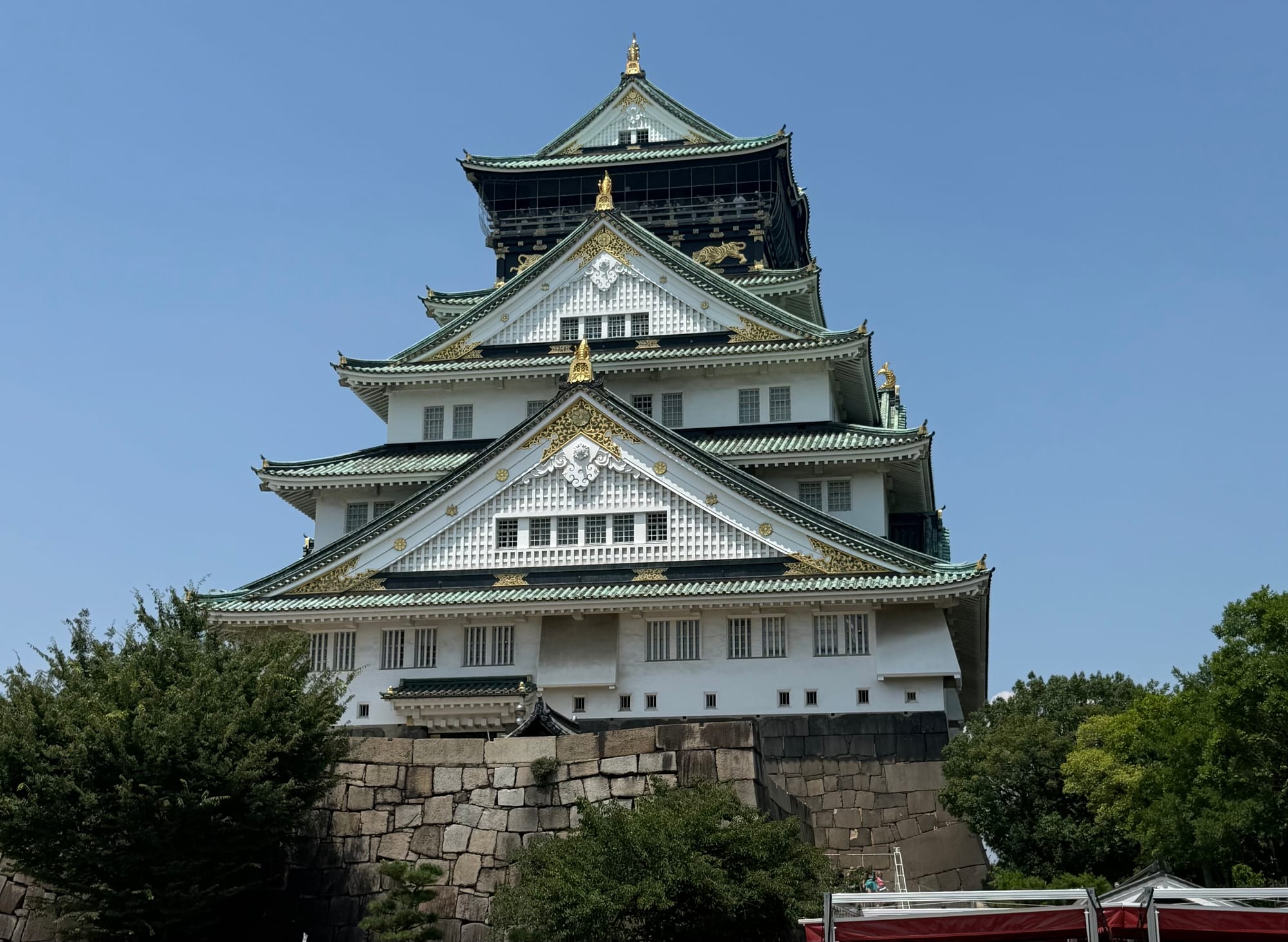
Osaka Castle in central Osaka, featuring its distinctive white walls, green roofs and gold ornamentation rising above stone ramparts beneath a clear blue sky.
Osaka Castle stands as one of Japan's most iconic landmarks, combining historic architecture with impressive stone defences in the heart of the city.

So now that I have been in Osaka for a few days, it is time to update my blog!

Rest day/Get Train Tickets

20thJuly

After the long journey from Manchester to Osaka Via Abu Dhabi, I was still absolutely knackered, even after a good night sleep

First, I got my breakfast at one of the restaurants that I booked when booking the Hotel in the first place. It was a restaurant called Café Montparnasse. I went for the Scrambled egg and sausage breakfast, which was very nice, they also have different drinks on hand, bread and jam, onion soup and rice if you want it.
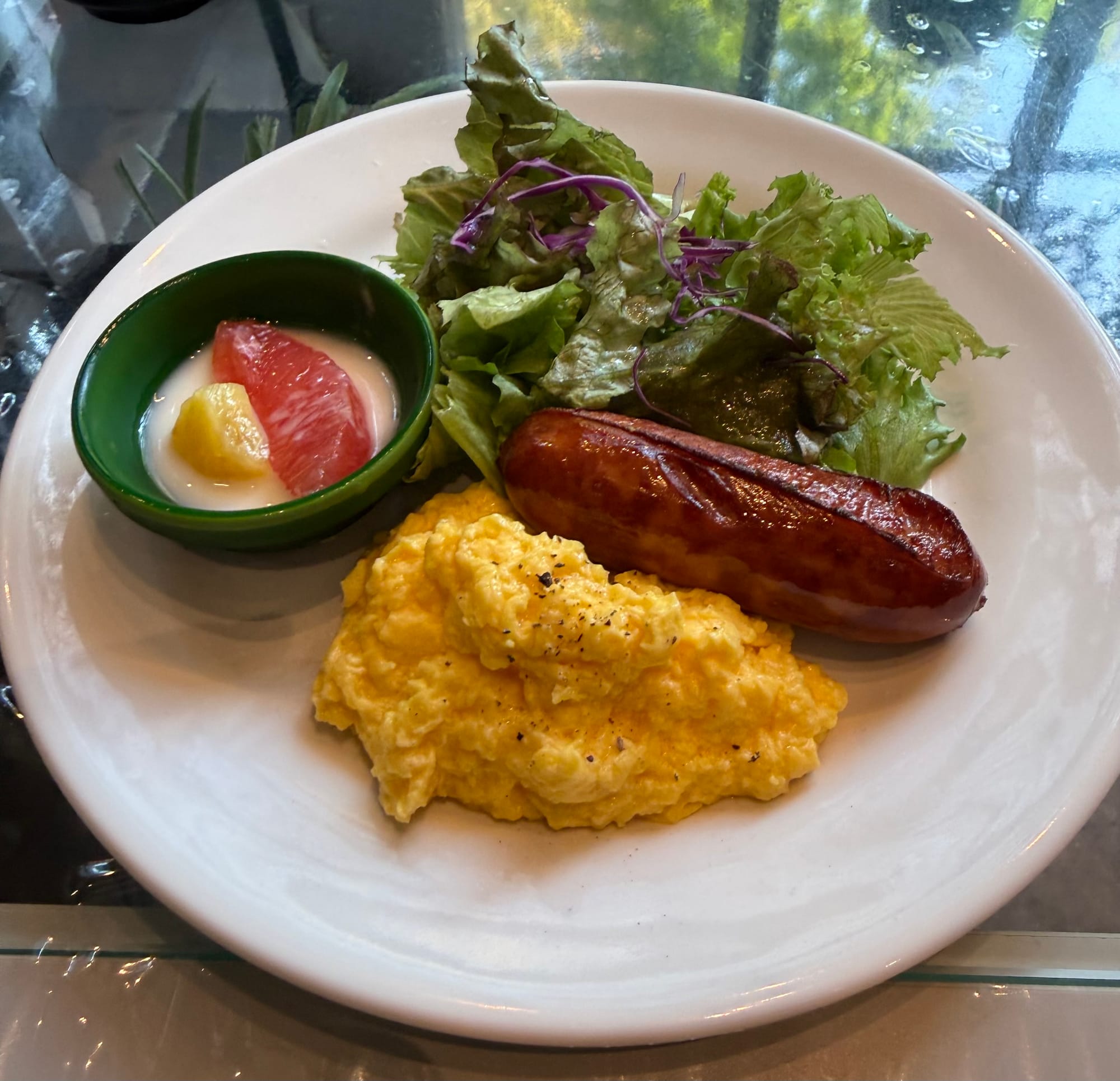
Breakfast plate with scrambled eggs, a grilled sausage, mixed salad and a small fruit yoghurt, served on a white plate in a hotel restaurant.
A simple hotel breakfast of scrambled eggs, sausage, salad and fruit yoghurt, providing a filling start to a day of exploring Osaka.

They even have deserts that you can have after your breakfast, which are: Tiramisu or Crème Brule.

When I come back to the same hotel near the end of the trip, I have booked to have breakfast is a different restaurant there called Orchid Time, which is on the top floor (34th floor) and is next to the rooftop pool.

Before the sun came up in full force, I decided to go to Osaka Station to sort my three remaining train tickets out.

Pedestrians wait outside JR Osaka Station at night as bright red and blue light trails from passing traffic streak across the foreground in a long-exposure photograph.
Photo by Ling Tang / Unsplash

Interesting Fact: Train tickets in Japan work a bit differently to how they do in the UK as they build on each other. First there is always the basic fare, which is based on the distance you are travelling. This basic fare is usually the only thing added on local trains and subways. Then there is the limited express fare, which if you get a limited express train that doesn’t stop at all stations or get a Shinkansen (bullet train), then this is added on top of this. Of course, the Shinkansen’s limited express fare is more. Then of course if you go for green or gran class (green = business class flying equivalent and gran class = first class flying equivalent), then this is also added extra on top of it.
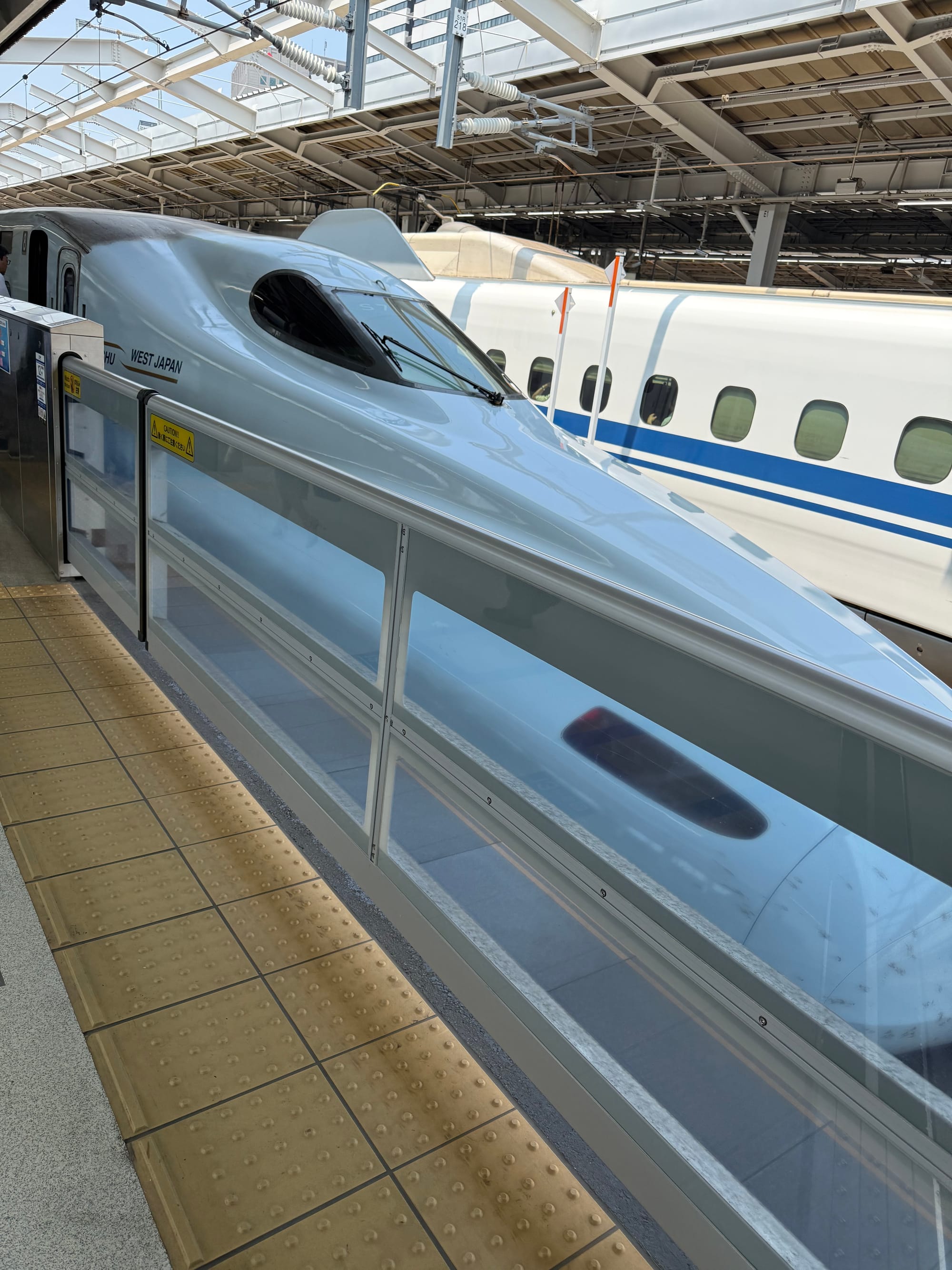
JR West N700 Series Shinkansen at a platform in Osaka, with its streamlined blue-and-white nose parked beside another high-speed train under the station canopy.
A JR West Shinkansen waits at the platform in Osaka, showcasing the sleek aerodynamic design that has made Japan's high-speed rail network famous around the world.

The cost of buying my tickets, ¥23,620 (£108.64) for 4 hours of reserved Sakura Shinkansen seating, ¥7,660 (£35,23) for 2 hours Korishima Limited Express green class seating and ¥11,300 (£51.98) for 3 hours 15 mins Nichirin Limited Express green class seating, but I got to choose where I could sit, unlike if I booked them online, I could only specify window or isle seat.

Hint: If you ever come to Japan, get an IC card, especially if you plan to return as well, it will make your life so much easier as it is a contactless card that you top up, like the oyster card on the London underground. There are a few different ones like ICOCA and SUICA to name two popular ones. If you have an iPhone you can add a SUICA card to your apple wallet like I have done and all I need to do when I get to a ticket gate for local trains and subway trains is tap my phone. You can also use there at vending machines, at restaurants, on buses and more.
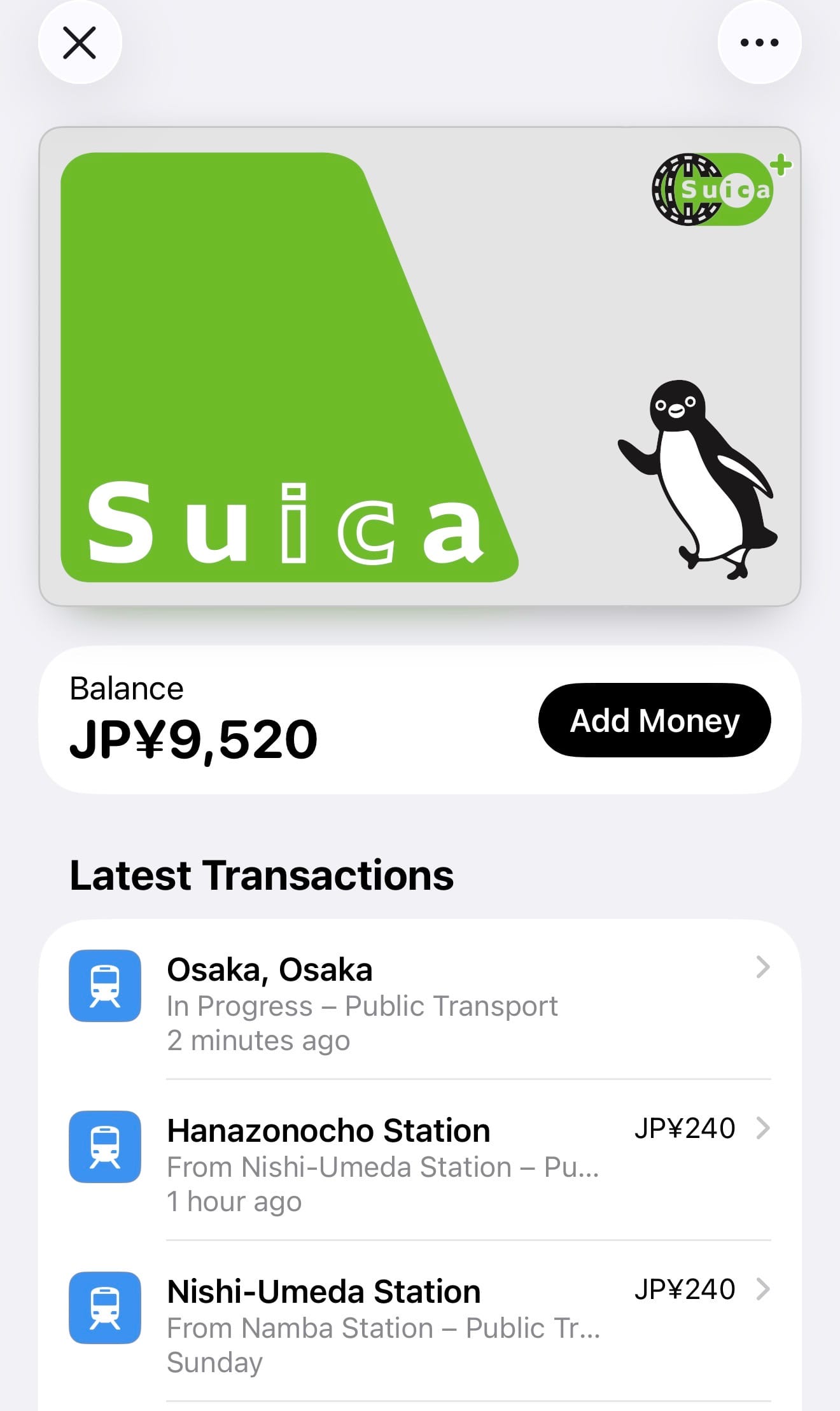
Digital Suica travel card displayed on a smartphone, showing a balance of ¥9,520 and recent public transport transactions in Osaka, including Nishi-Umeda and Hanazonochō.
My Suica travel card in Apple Wallet, used for trains and public transport across Japan, with recent journeys and remaining balance displayed while travelling in Osaka.

I went back to the hotel and had a bit of a kip as I was still knackered and then went out for some ramen to a place called ‘Ramen Zundoya Umeda’, where I got a bowl of char sui ramen, small portion of fried rice and 500ml of coke zero for only ¥2,050 yen (£9.41), try getting something for the cheap back in the UK.
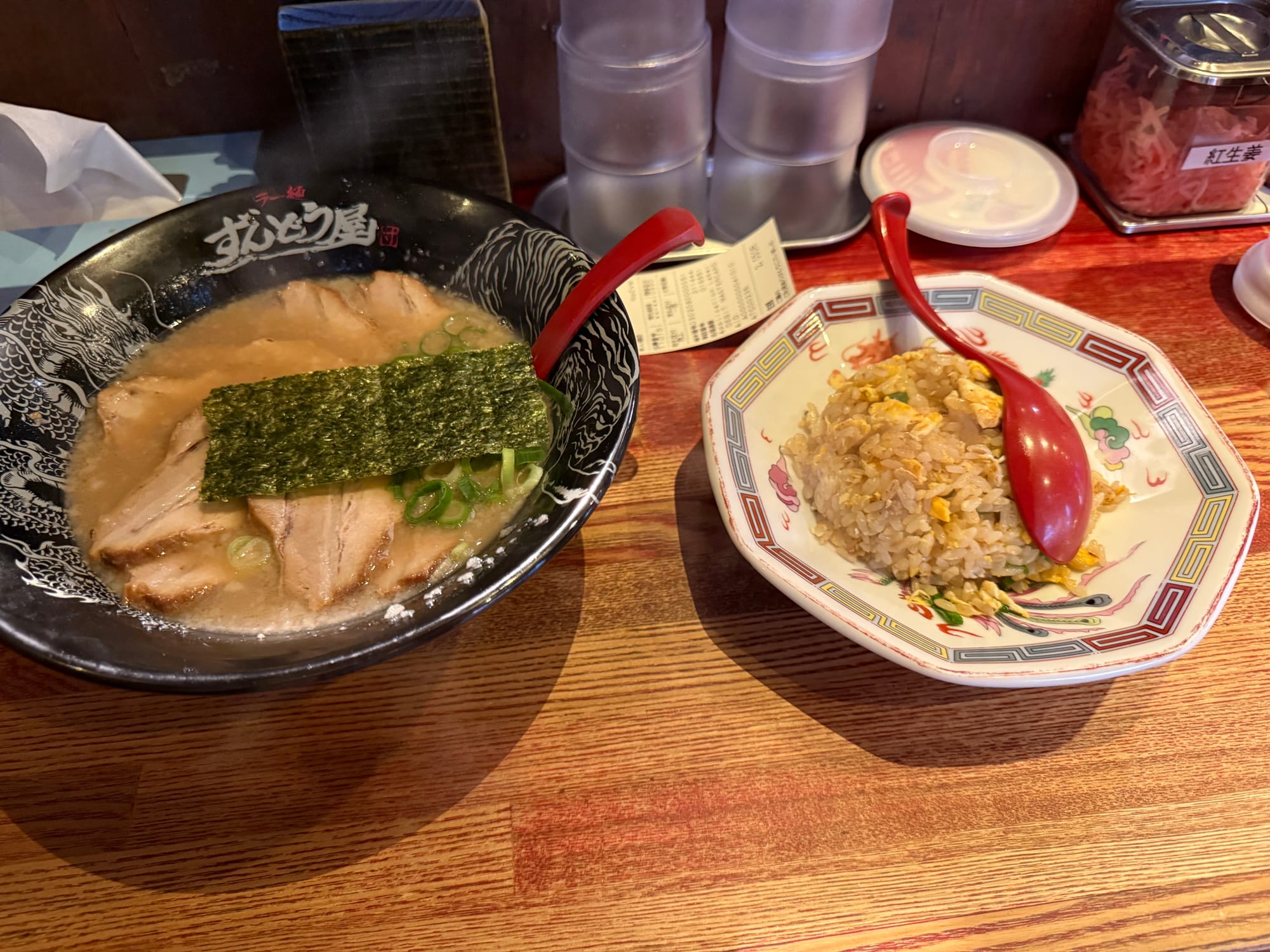
Bowl of tonkotsu ramen topped with sliced pork, spring onions and nori, served with a side of fried rice at a ramen restaurant in Osaka.
A satisfying meal of rich tonkotsu ramen and fried rice, enjoyed at a local ramen restaurant in Osaka during the first days of exploring Japan.

Then I went back to the hotel had a soak in the onsen and then called it a Monday night.

Traditional Japanese onsen bath illuminated at night, with water flowing from a wooden spout into a steaming pool surrounded by dark timber walls.
Photo by Wren Chai / Unsplash

Sumo Experience, Osaka Castle and Go-Karting

21stJuly

This day was my first full day in Japan where I had things planned, so let’s have a look at what they were:

Sumo Experience

First was the Sumo experience, which you can find here: Sumo Experience with Live Show and Audience Challenge
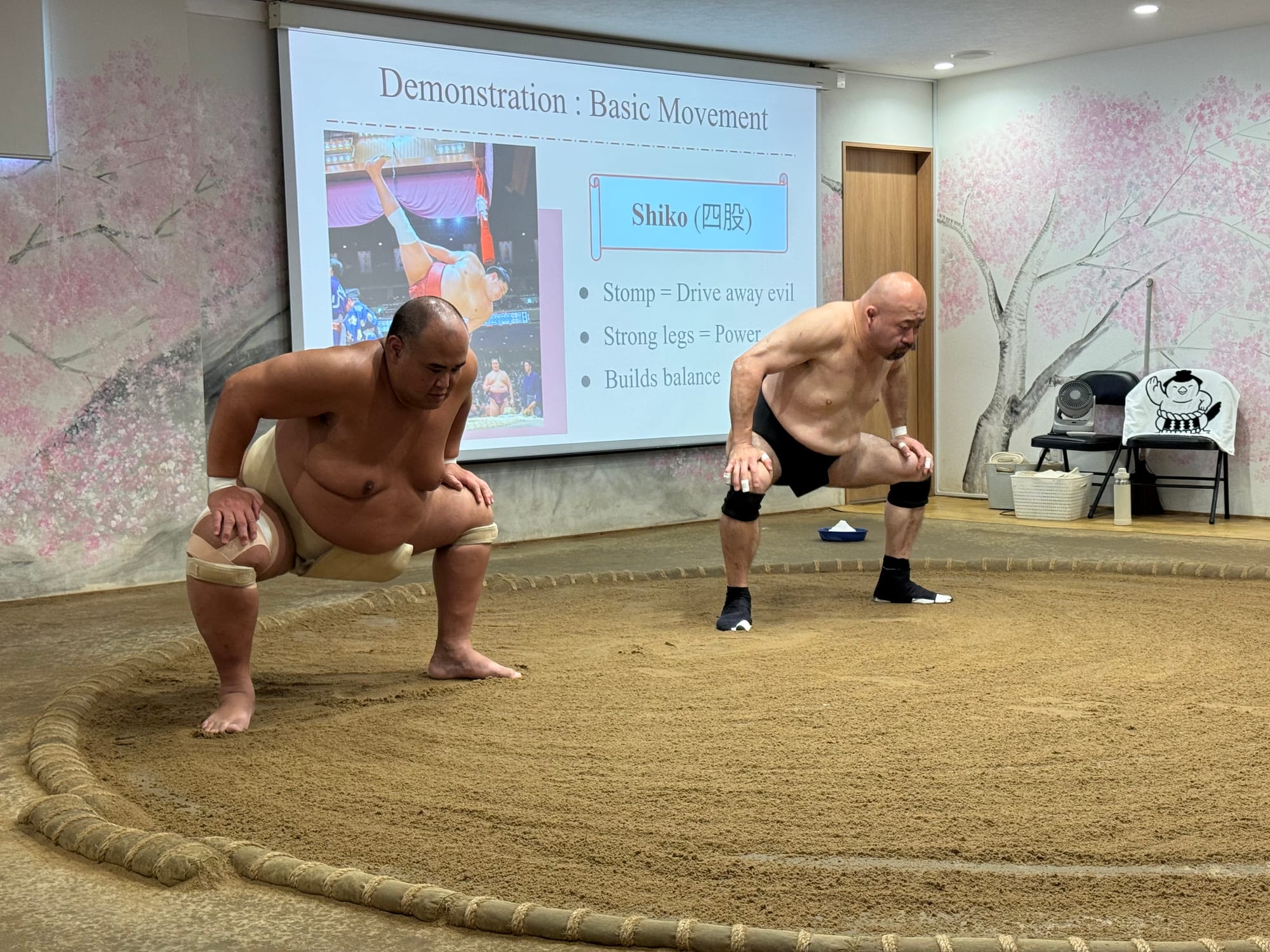
Two sumo wrestlers demonstrate the traditional shiko exercise inside a dojo in Osaka, standing in the ring before a presentation explaining its purpose and technique.
Sumo wrestlers demonstrate shiko, a fundamental training exercise that develops balance, strength and stability, during a sumo experience in Osaka.

It was amazing and went over the history of sumo, how they train, eat, different moves that are both legal and illegal, all before a proper bout and then 10 of us from the audience got to do a bit or practice before doing a friendly challenge.
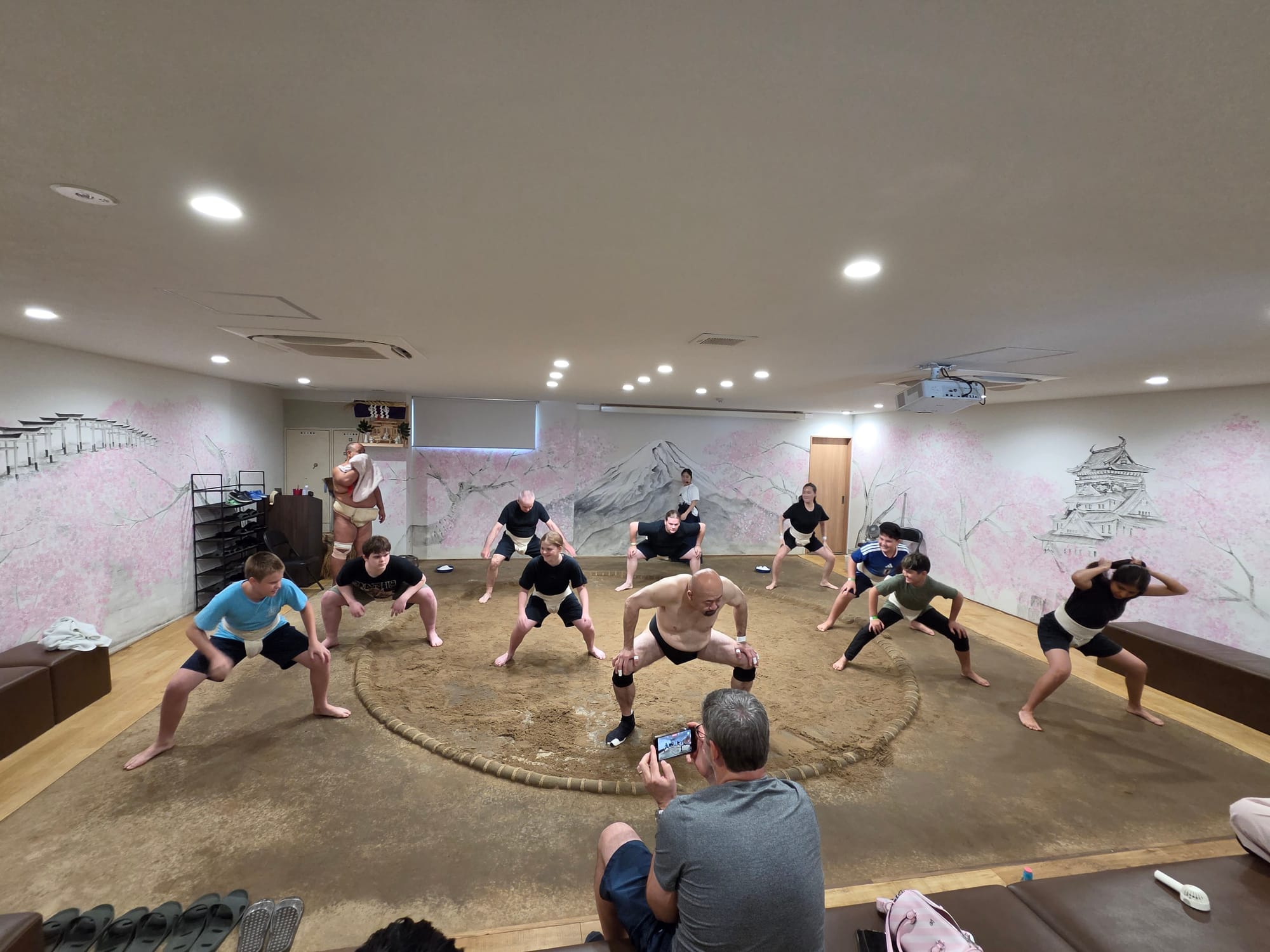
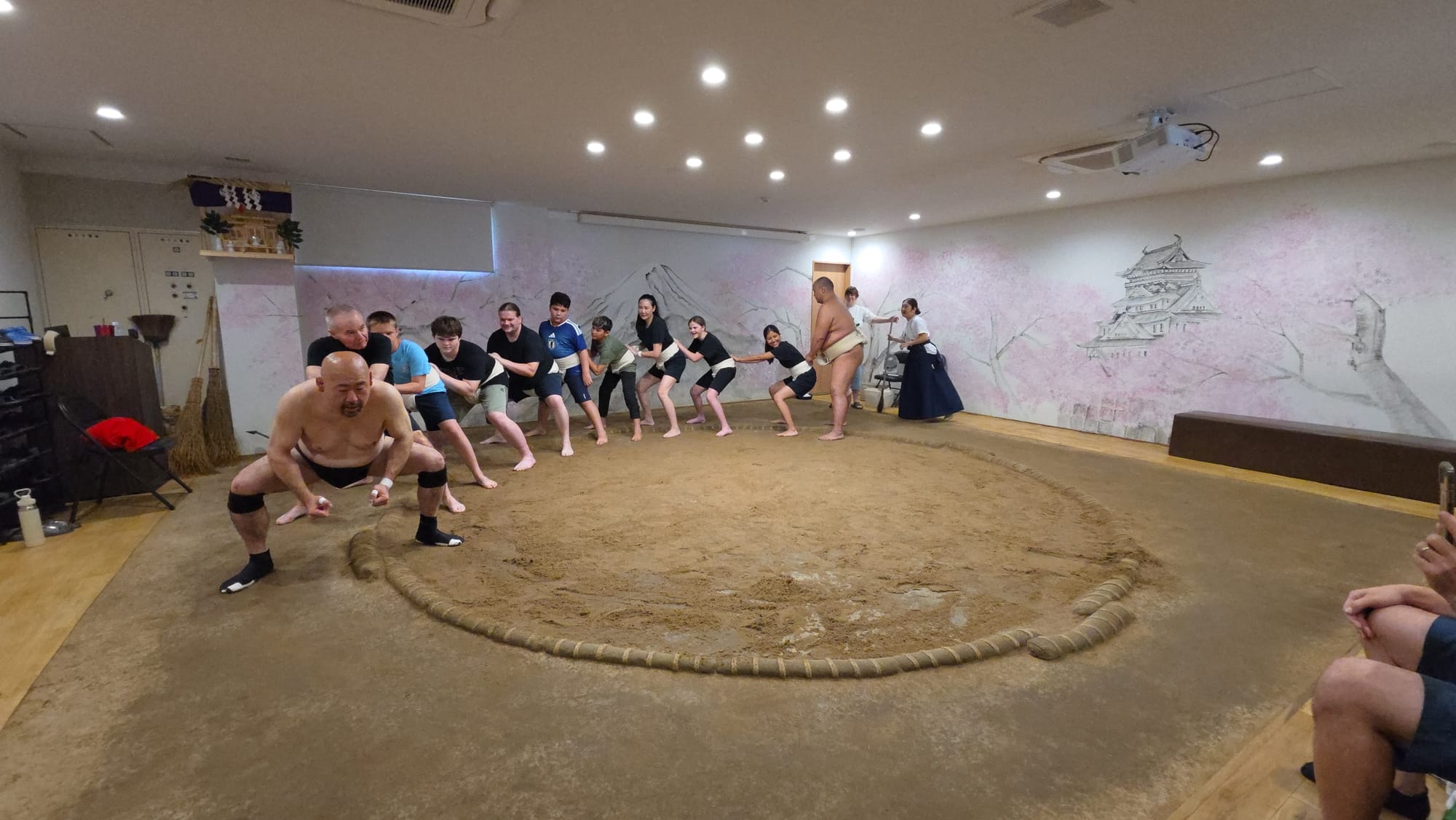
Participants practise sumo wrestling techniques in a training ring, following an instructor's movements inside a dojo decorated with murals of Mount Fuji and Osaka Castle.
Taking part in a sumo experience in Osaka, learning traditional warm-up exercises and training techniques inside a practice ring under the guidance of an instructor.
Participants practise a sumo pushing exercise inside a dojo in Osaka, following instructions from a former wrestler around the clay ring during a hands-on training session.
Learning the fundamentals of sumo in Osaka, participants take part in a practical training exercise inside the ring under the guidance of former sumo wrestlers.
0:00
/0:43

Video of the practical training on learning how to move like a sumo, going around the clay ring

It was fun and was worth going to, especially after I couldn’t get tickets to the grand sumo tournament in Nagoya, which I was originally planning to go and see this day. Both wrestlers were quite friendly, although when I did the pushing practice with Ryuu (the heavier one, who is a former upper rank Sumo), it was like trying to push a brick wall. Then doing the friendly bout vs Taki (I think that was his name) (the lighter one who trains the next generation of sumo), was fun. I think he was surprised when I was able to pick him up, but then he was able to pick me up and swing me around easily.
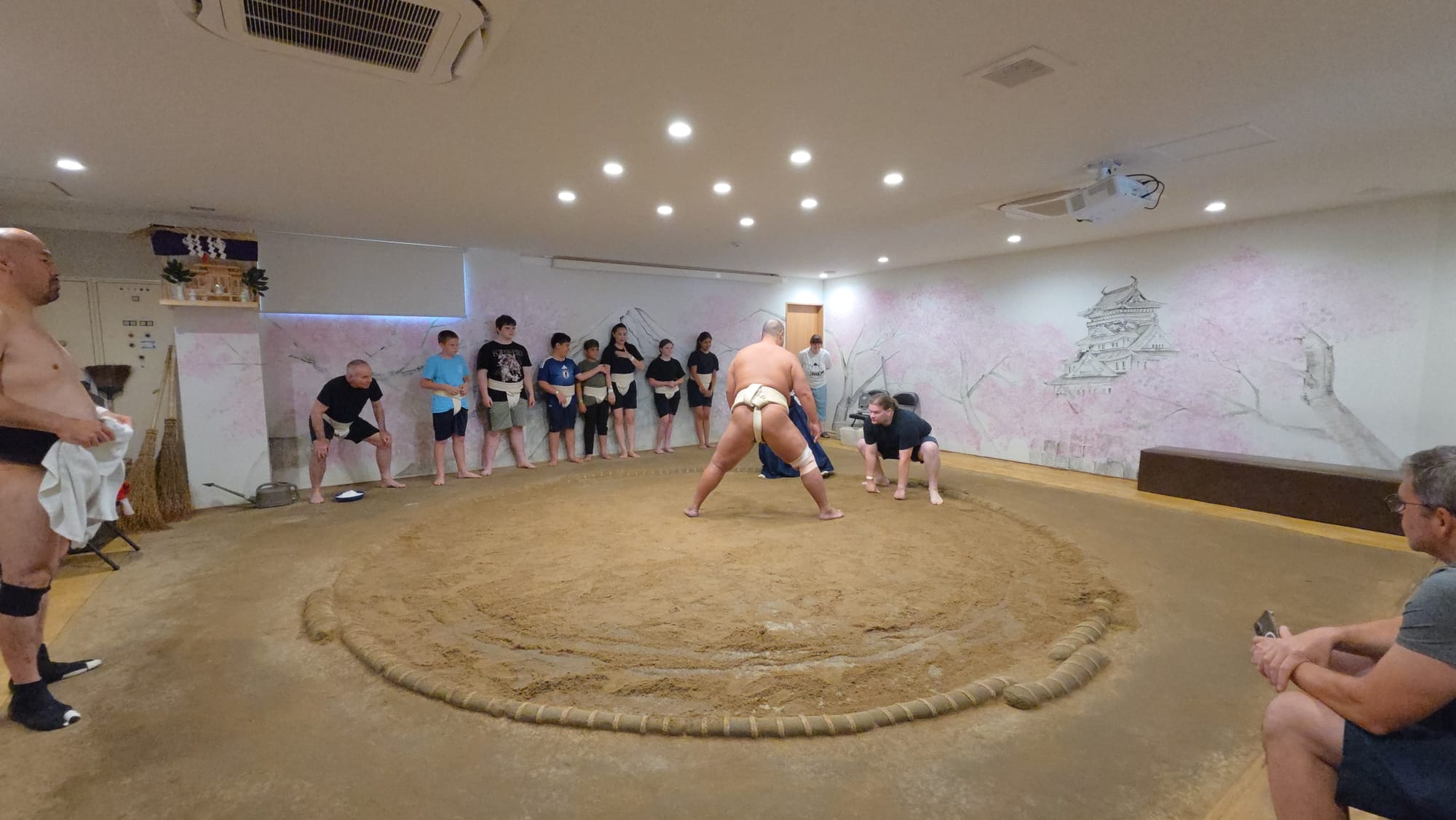
Participant prepares for a sumo pushing exercise inside a dojo in Osaka, facing a former wrestler in the ring while other visitors watch and await their turn.
Getting ready for sumo pushing practice in Osaka, with a former wrestler demonstrating the correct stance and technique before the exercise begins.
0:00
/0:33

Video showing the sumo pushing practice, with the former wrestler.
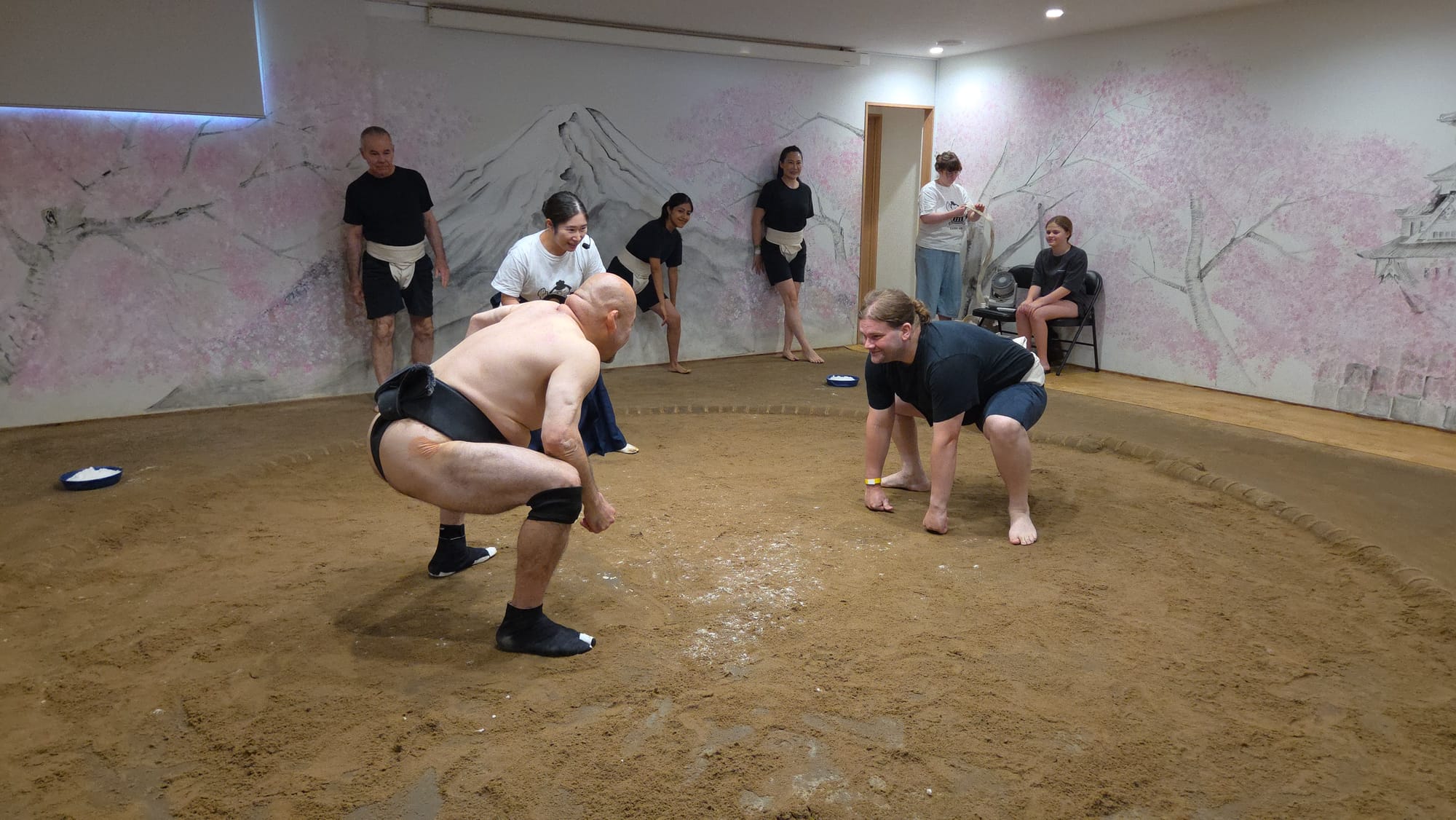
Participant and former sumo wrestler crouch facing each other in a sumo ring in Osaka, preparing for a practice bout while other visitors watch from around the dojo.
Getting ready for a sumo bout in Osaka, facing a former wrestler in the ring after learning the basics of stance, balance and traditional sumo techniques.
0:00
/1:28

Video of sumo bout, facing a former wrestler in the ring.
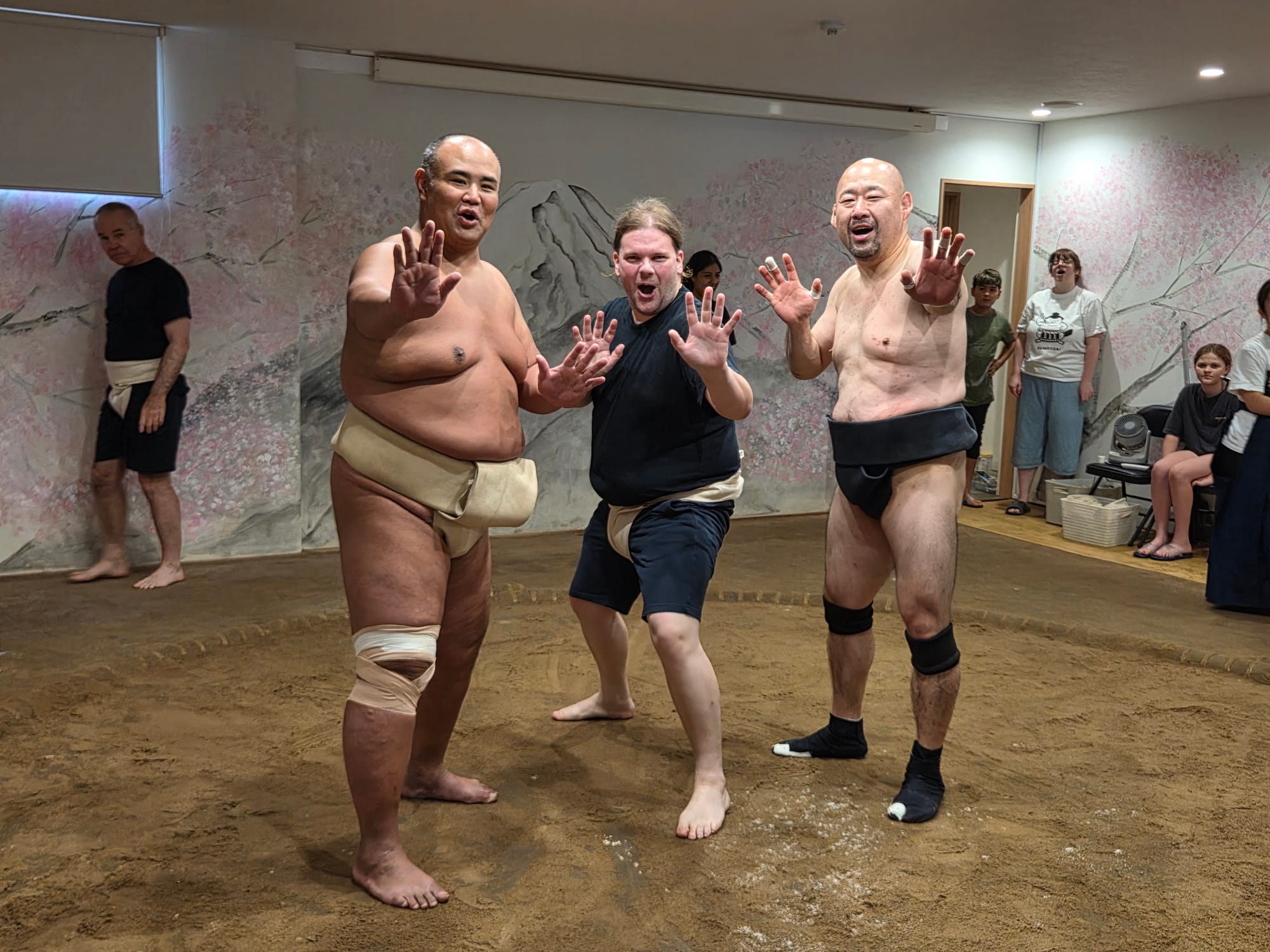
Participant poses with two former sumo wrestlers inside a dojo in Osaka after a training session, standing together in the ring with hands raised towards the camera.
A memorable photo with two former sumo wrestlers after taking part in a hands-on sumo experience in Osaka, learning the traditions and techniques of Japan's national sport.

Because of the ticket I got, I was also able to get each of their signatures on a board with a handprint on it, which was a nice touch, although I wasn't expecting this.
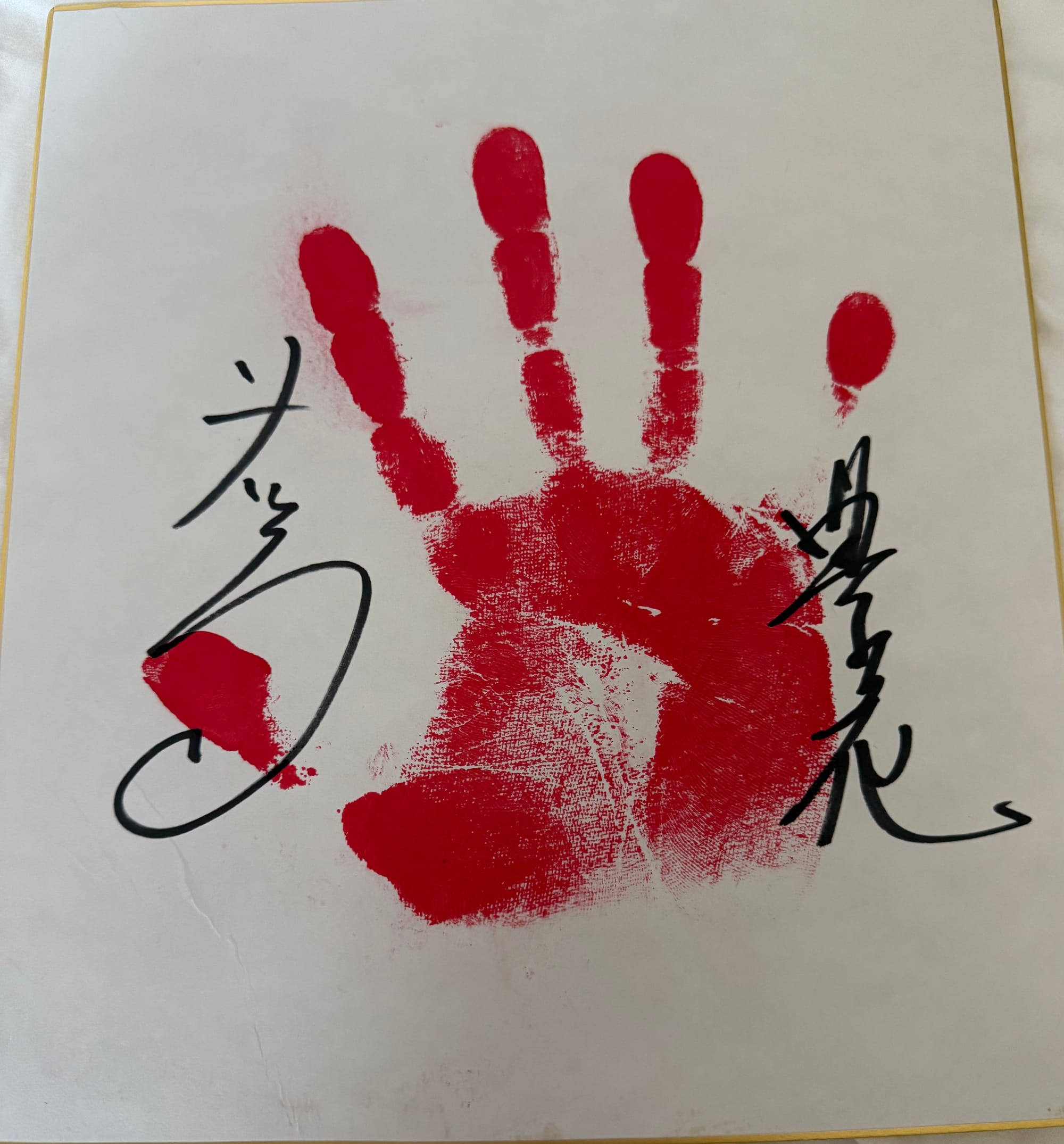
Red handprint on a shikishi autograph board, signed by two former sumo wrestlers, presented as a souvenir following a sumo experience in Osaka.
A unique souvenir from the sumo experience in Osaka, featuring handprints and signatures from the former wrestlers who led the training session and demonstrations.

A bit about accessibility: Have you ever seen the yellow tiles all around cities and towns in Japan. We these are there for a reason, they are for people who are visually to find their way around. The yellow lines represent ways to follow whereas the raised dots represent caution, which in the case of the picture below is caution, because the train gate is right there. Raised dots are also usually found at pedestrian crossings and there are two different types of sounds that pedestrian crossings make to indicate west/east or north/south. It’s something I find fascinating and they do have them in the UK as well, but I have yet to really notice it in the UK or at least it might be the place I am from just not having them.
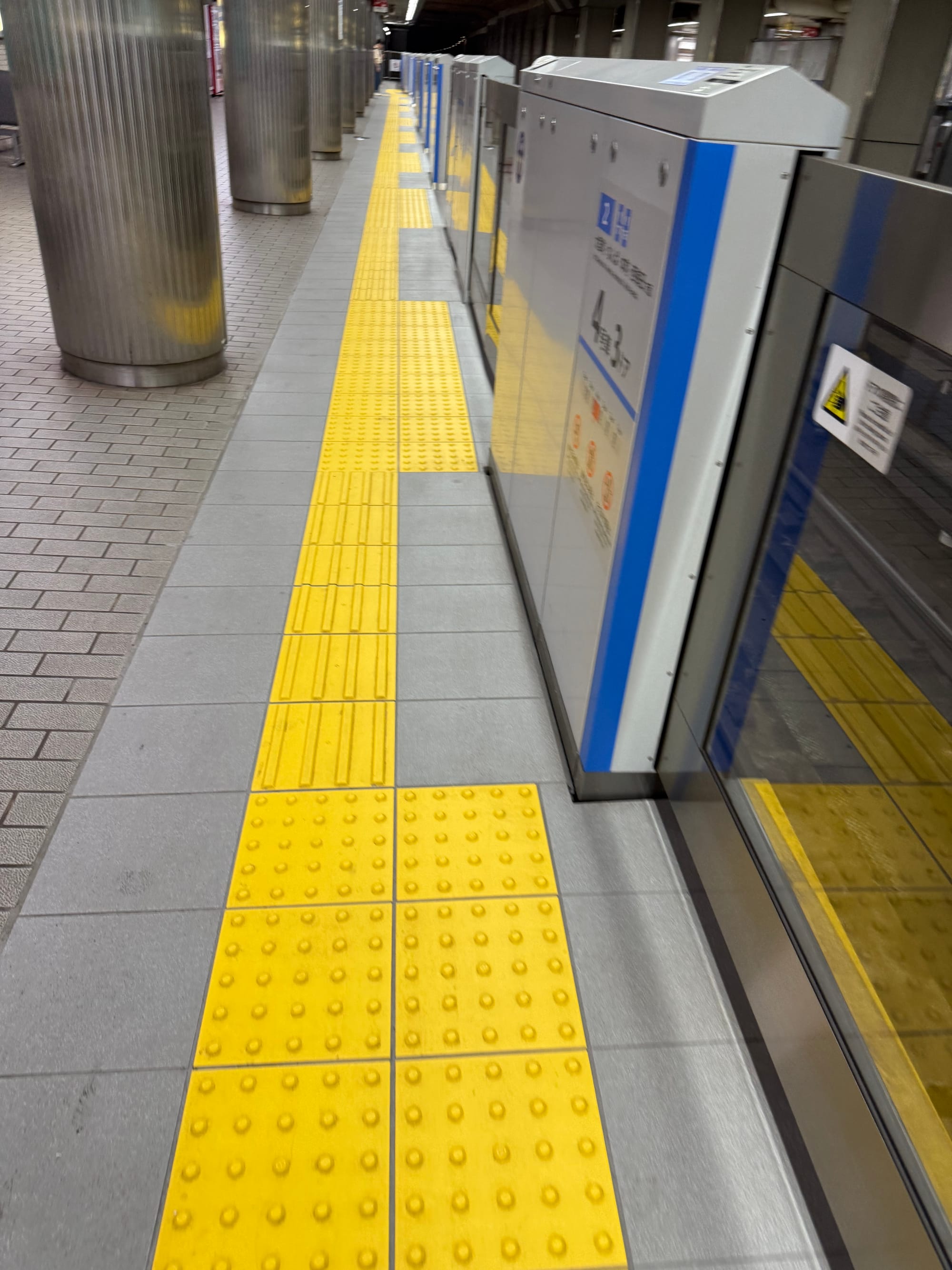
Platform screen doors and yellow tactile paving at an underground station in Osaka, showing accessibility features designed to guide and protect passengers.
Accessibility features at an Osaka underground station, where tactile paving and platform screen doors help improve safety and navigation for passengers.

Osaka Castle

As I still felt up to it, it was time to go to Osaka castle, which I wanted to go to last time I was in Japan, but didn’t have the time to spend there, so decided to go there straight from the Sumo Experience. First, I had a look around the grounds of Osaka castle, including an on-site shrine.
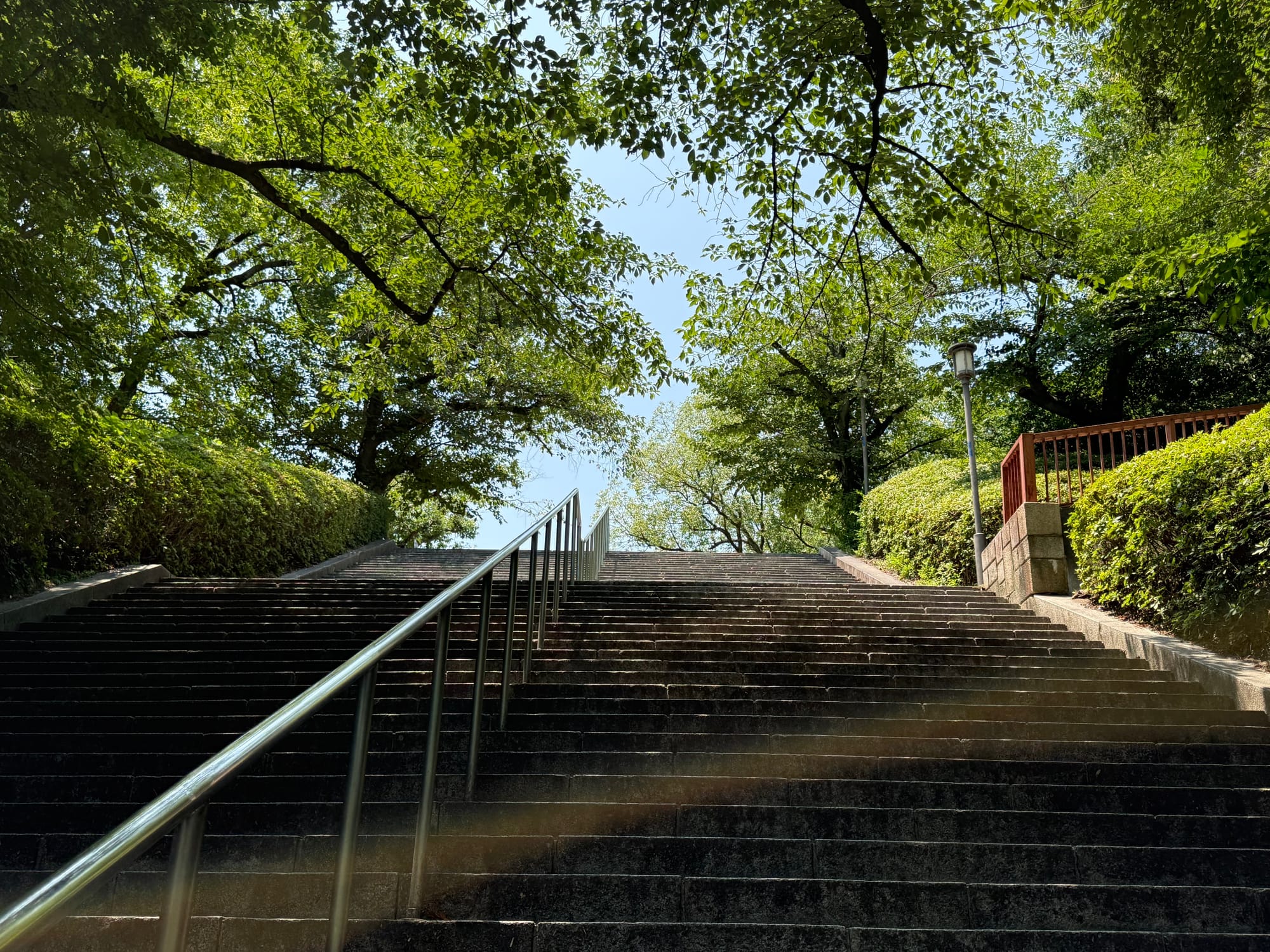
Stone steps leading uphill through Osaka Castle Park from Morinomiya Station, shaded by mature trees with sunlight filtering through the green canopy overhead.
Climbing the steps from Morinomiya Station towards Osaka Castle, passing through the park's leafy surroundings on a warm summer morning.
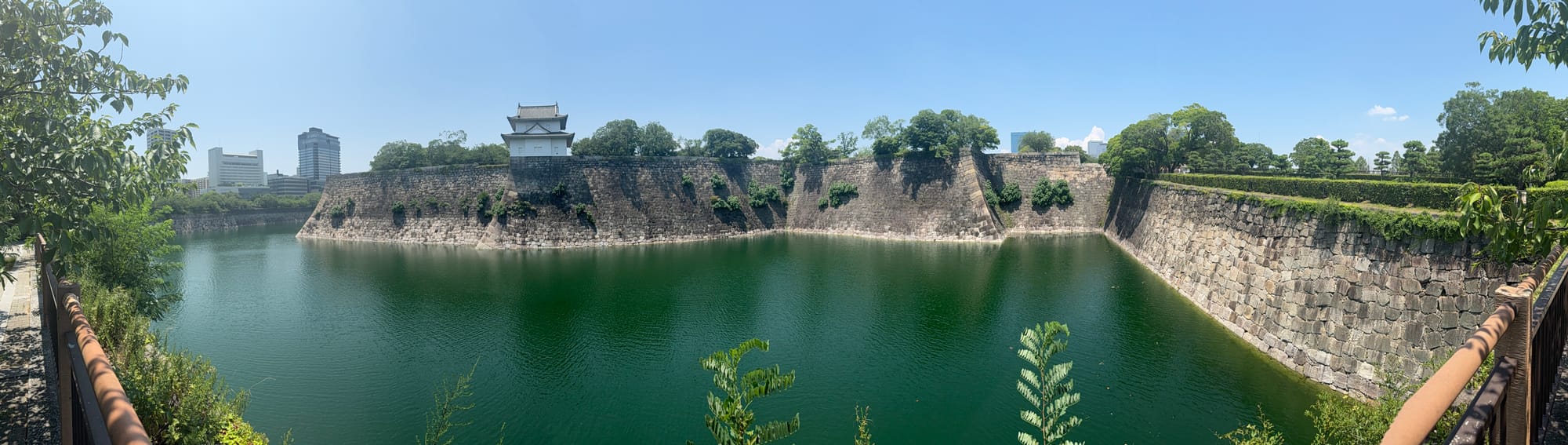
Panoramic view of Osaka Castle's moat, with emerald-green water surrounded by towering stone walls, a watchtower and trees beneath a clear blue summer sky.
One of the impressive moats protecting Osaka Castle, where vast stone ramparts and calm green waters highlight the scale of Japan's most famous historic fortifications.
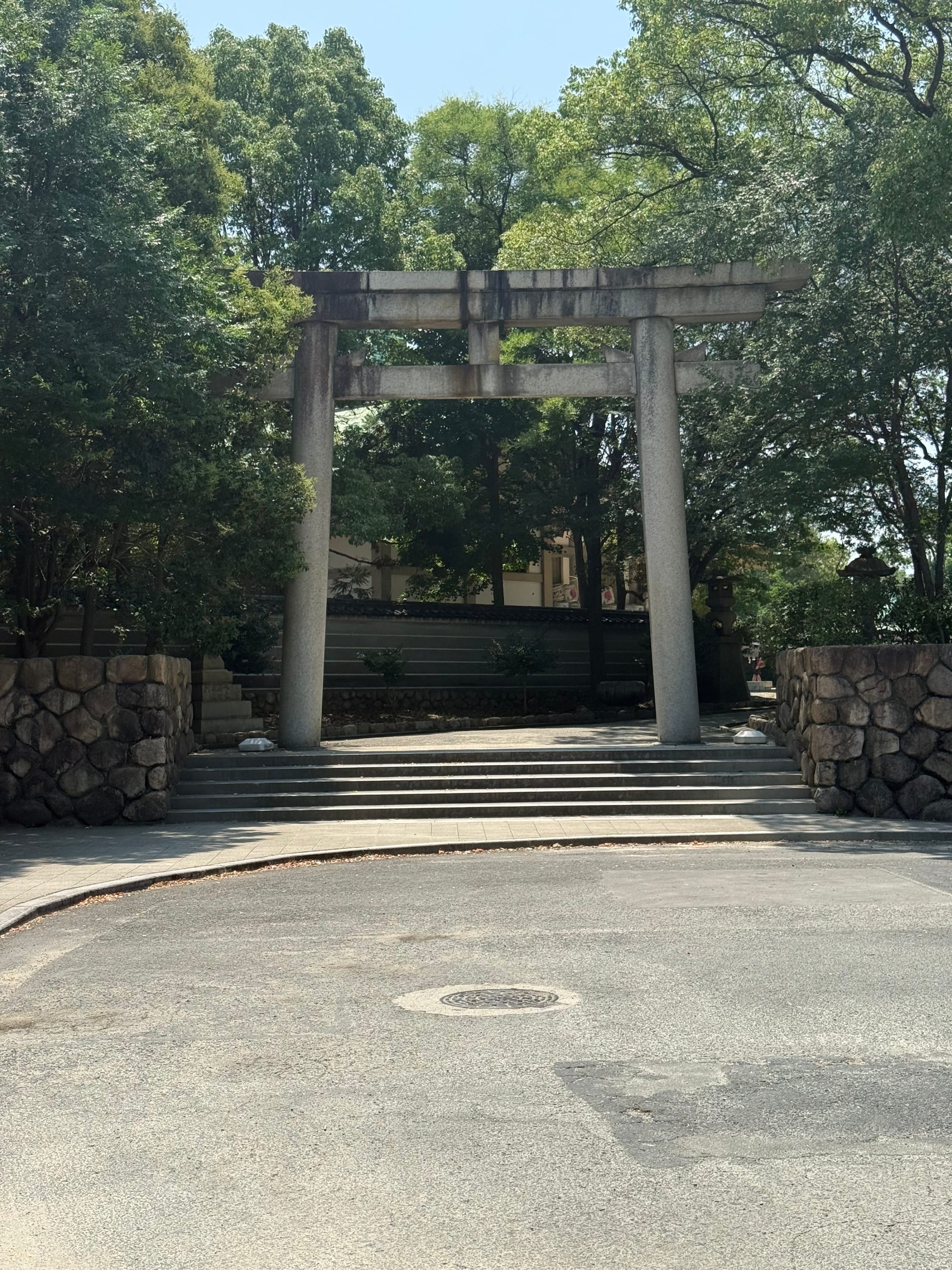
Stone torii gate within Osaka Castle Park, framed by mature trees and stone walls, marking the entrance to a Shinto shrine beneath a bright summer sky.
A torii gate in Osaka Castle Park marks the entrance to a peaceful Shinto shrine, offering a quiet retreat among the historic grounds surrounding the castle.
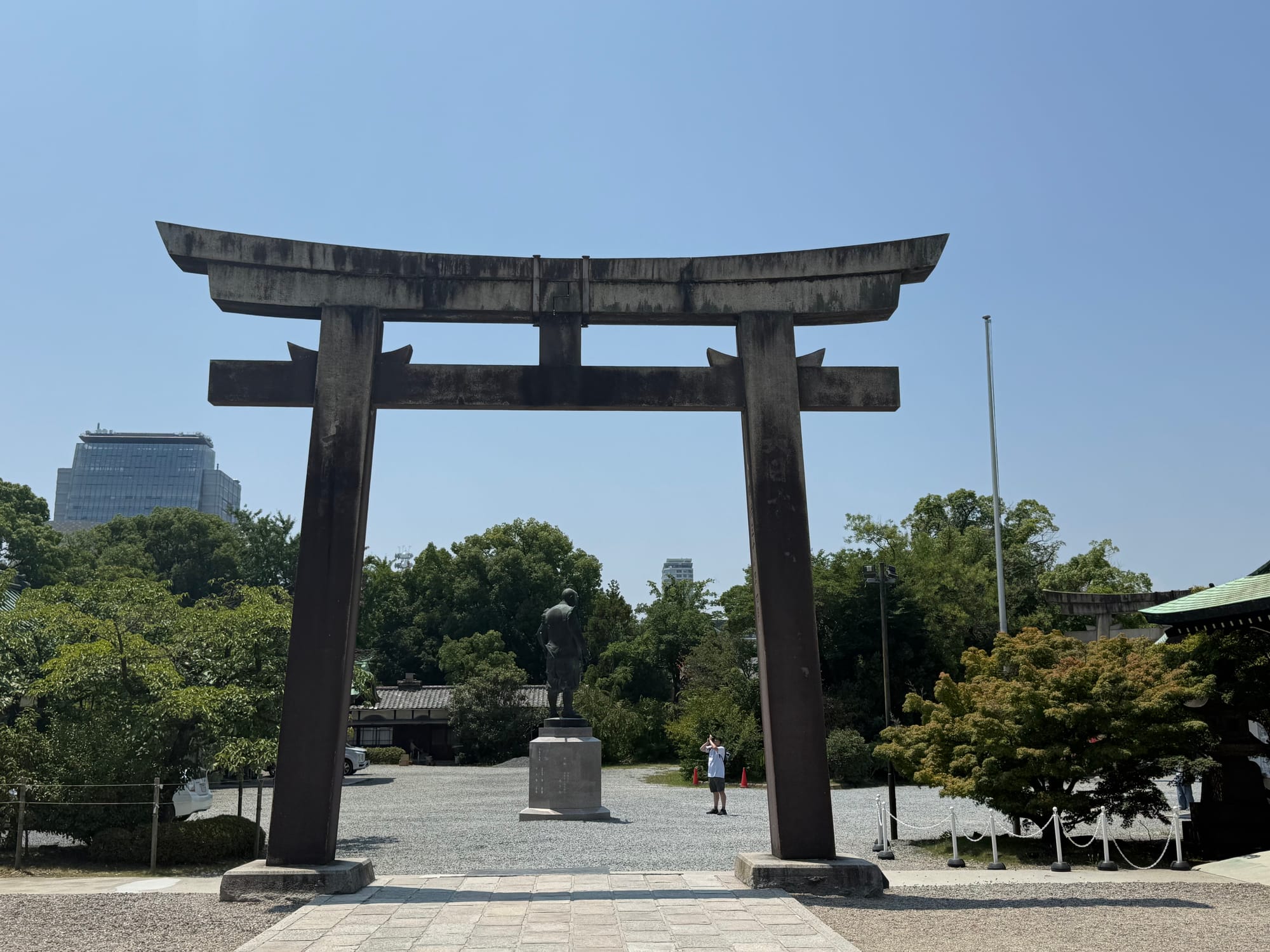
Large stone torii gate in Osaka Castle Park, standing before a statue and shrine grounds, framed by trees and viewed beneath a clear blue summer sky.
A monumental torii gate marks the entrance to Hokoku Shrine within Osaka Castle Park, blending Shinto tradition with the historic surroundings of the former castle stronghold.
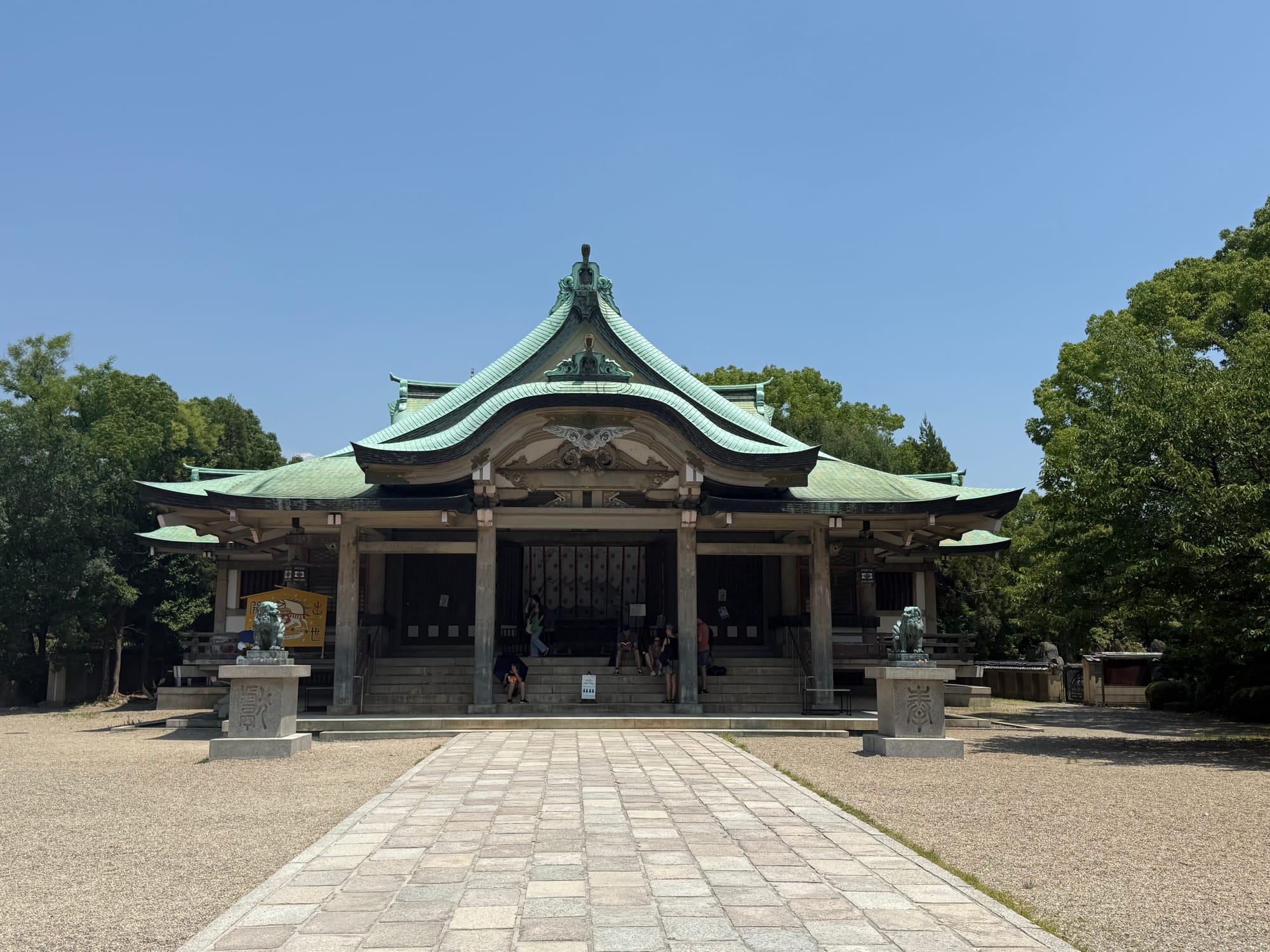
Hokoku Shrine in Osaka Castle Park, featuring a traditional Shinto shrine building with a curved copper-green roof, stone pathway and guardian statues beneath a clear blue sky.
Hokoku Shrine in Osaka Castle Park is dedicated to Toyotomi Hideyoshi, the warlord who built Osaka Castle, and provides a peaceful contrast to the nearby fortifications.
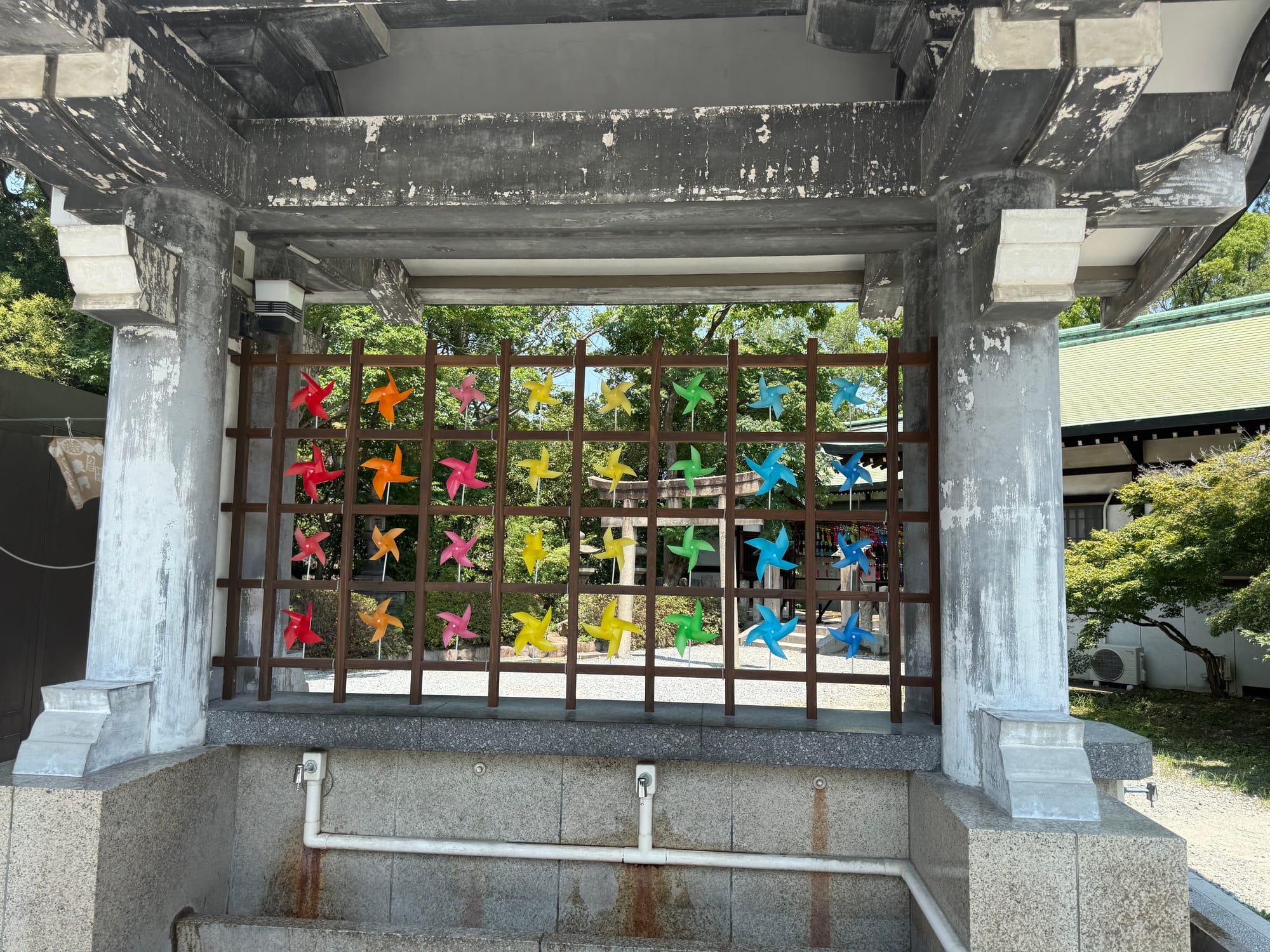
Colourful pinwheels displayed on a wooden frame at Hokoku Shrine in Osaka Castle Park, with the shrine grounds and a torii gate visible in the background.
Brightly coloured pinwheels add a splash of colour to the grounds of Hokoku Shrine, creating a cheerful contrast with the traditional architecture and historic setting of Osaka Castle Park.

Then proceeded up to the Sakuramon (south) gate.
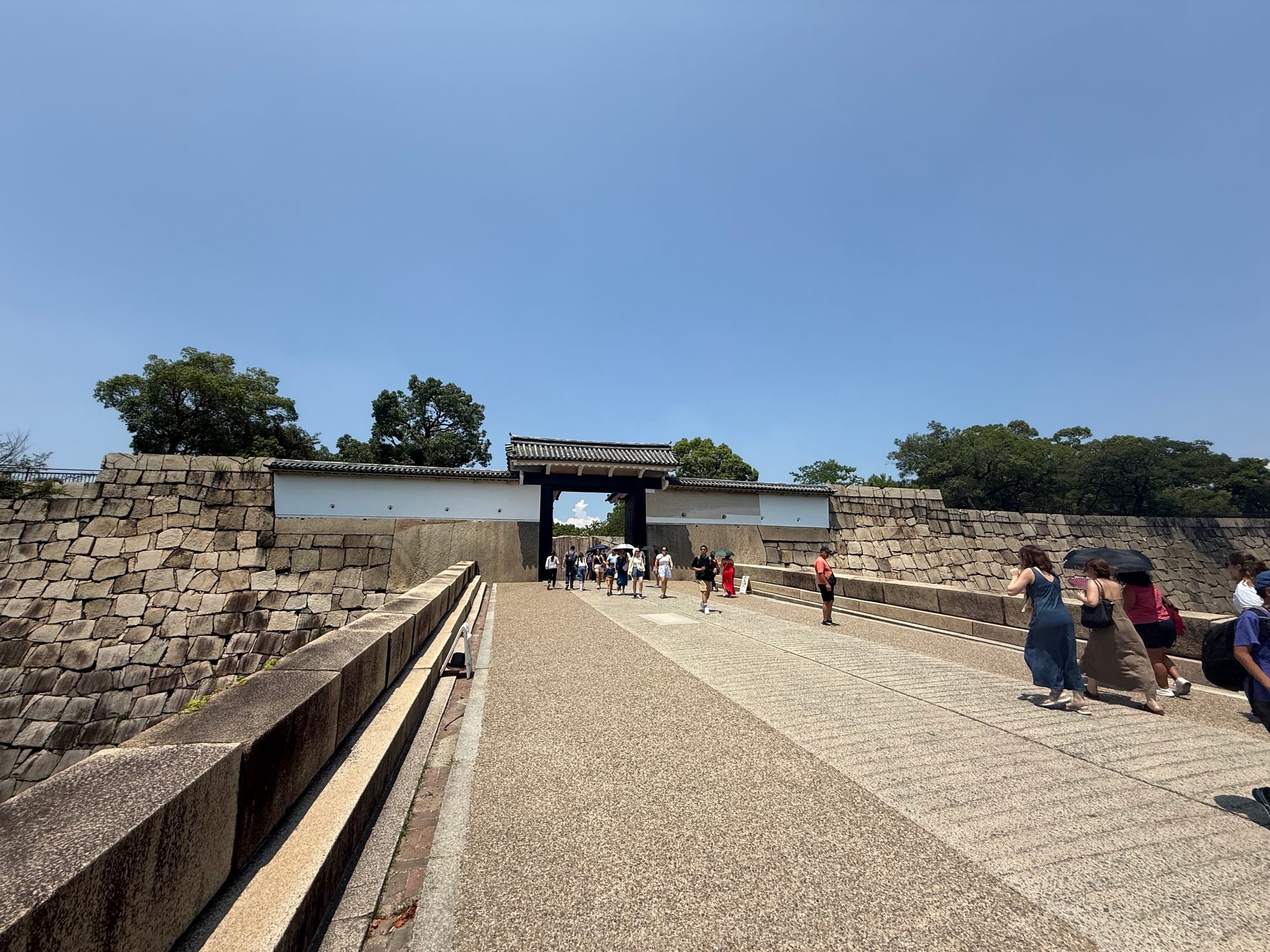
Sakuramon Gate at Osaka Castle, viewed across a broad stone bridge and surrounded by towering defensive walls, with visitors entering beneath a clear summer sky.
Crossing the bridge towards Sakuramon Gate, one of the principal entrances to Osaka Castle, where massive stone walls and fortifications demonstrate the scale of the historic stronghold.

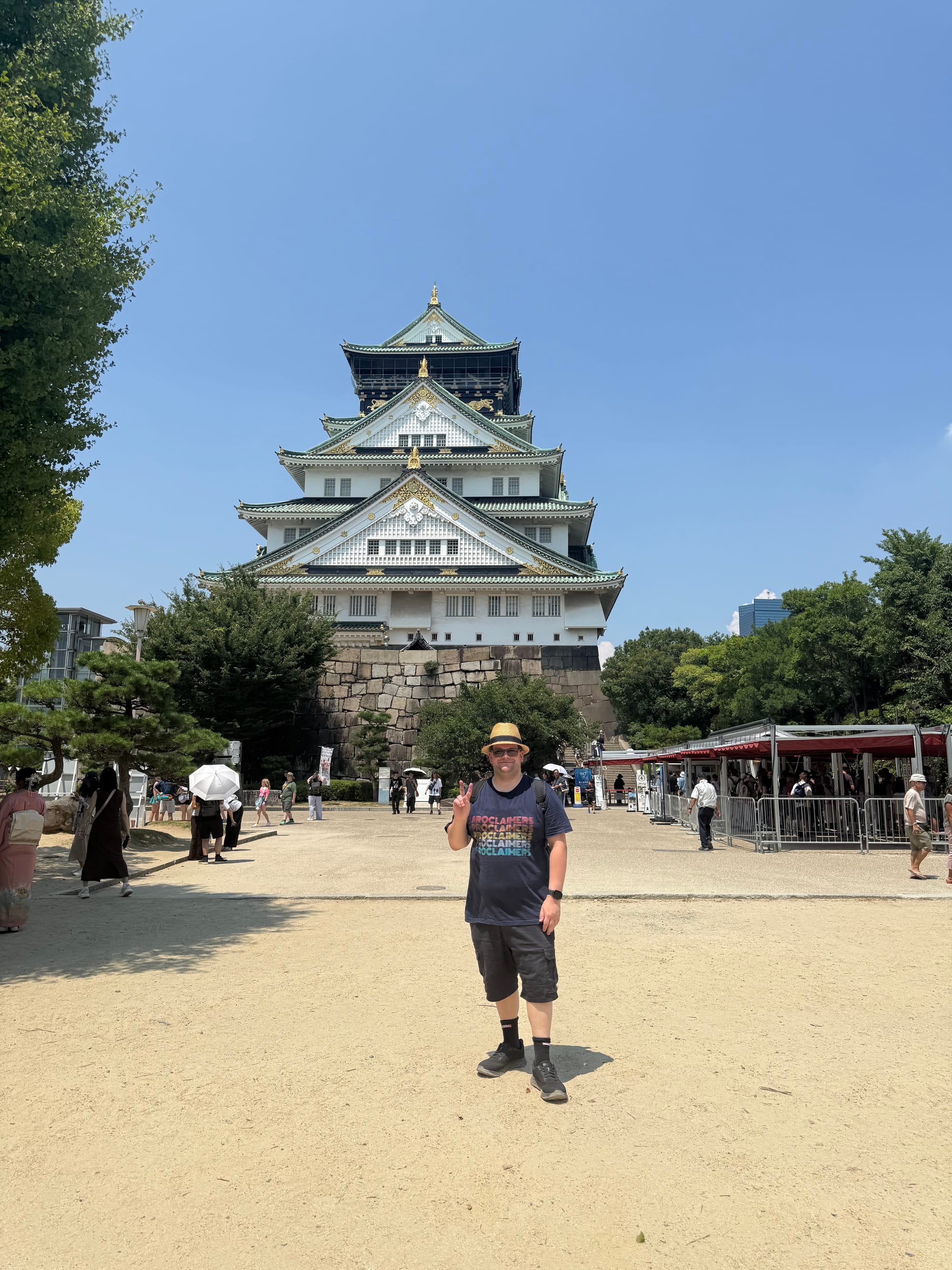
And I finally found the main keep.

Visitor standing in front of Osaka Castle, making a peace sign, with the historic castle keep rising above stone walls and trees beneath a clear summer sky.
Posing in front of Osaka Castle on a bright summer day, with the iconic castle keep providing a spectacular backdrop to one of Japan's most famous historic landmarks.

I then went inside the main keep museum, which is the keep itself and was reconstructed in 1931 and then later fully restored in 1997 to look like its original Edo period design. This is the third reconstruction since it was originally built in 1583 by Toyotomi Hideyoshi who was known as the second great unifier of Japan after, Nobunaga Oda, who he was a retainer for in his early days.
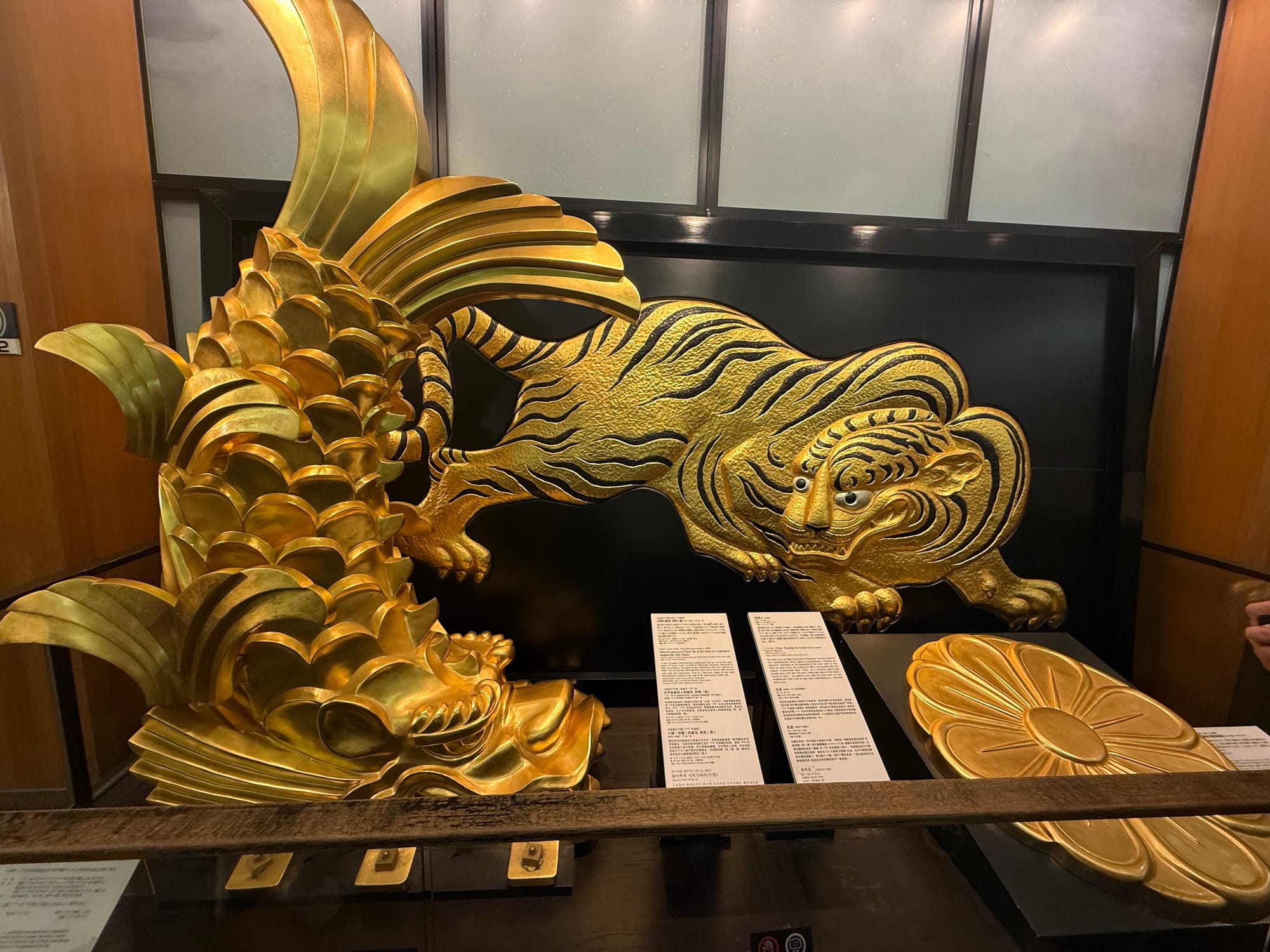
Golden shachihoko and tiger ornaments from Osaka Castle on display inside the castle museum, showcasing decorative symbols associated with the historic fortress.
Exhibits inside Osaka Castle include the castle's famous golden shachihoko roof ornaments and tiger motifs, symbols of power, protection and prestige in Japanese castle architecture.
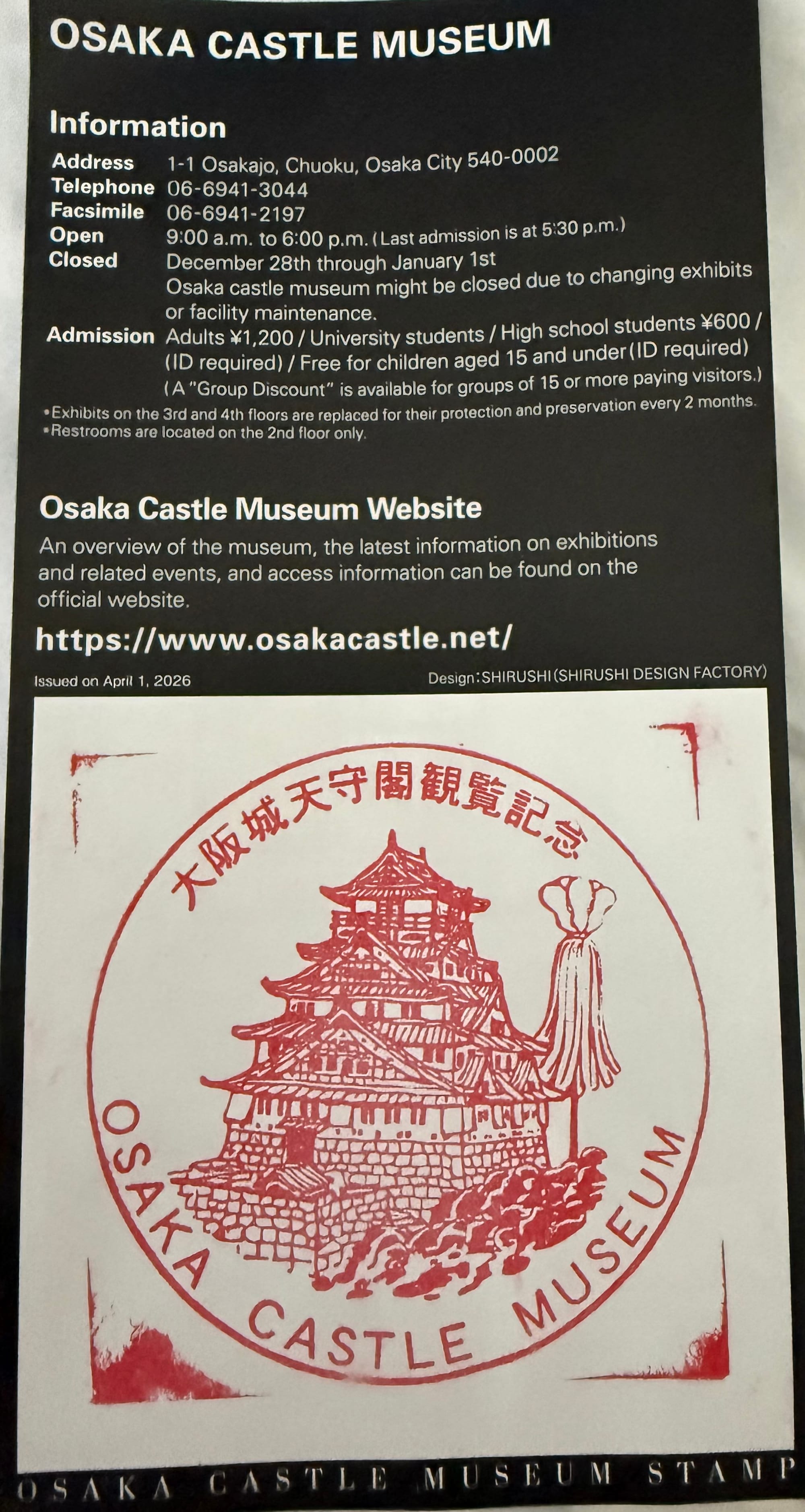
Osaka Castle Museum information leaflet featuring opening details, admission prices, website information and a commemorative red Osaka Castle stamp.
A commemorative Osaka Castle Museum stamp collected during a visit to the castle keep, alongside museum information detailing opening hours, admission and visitor facilities.
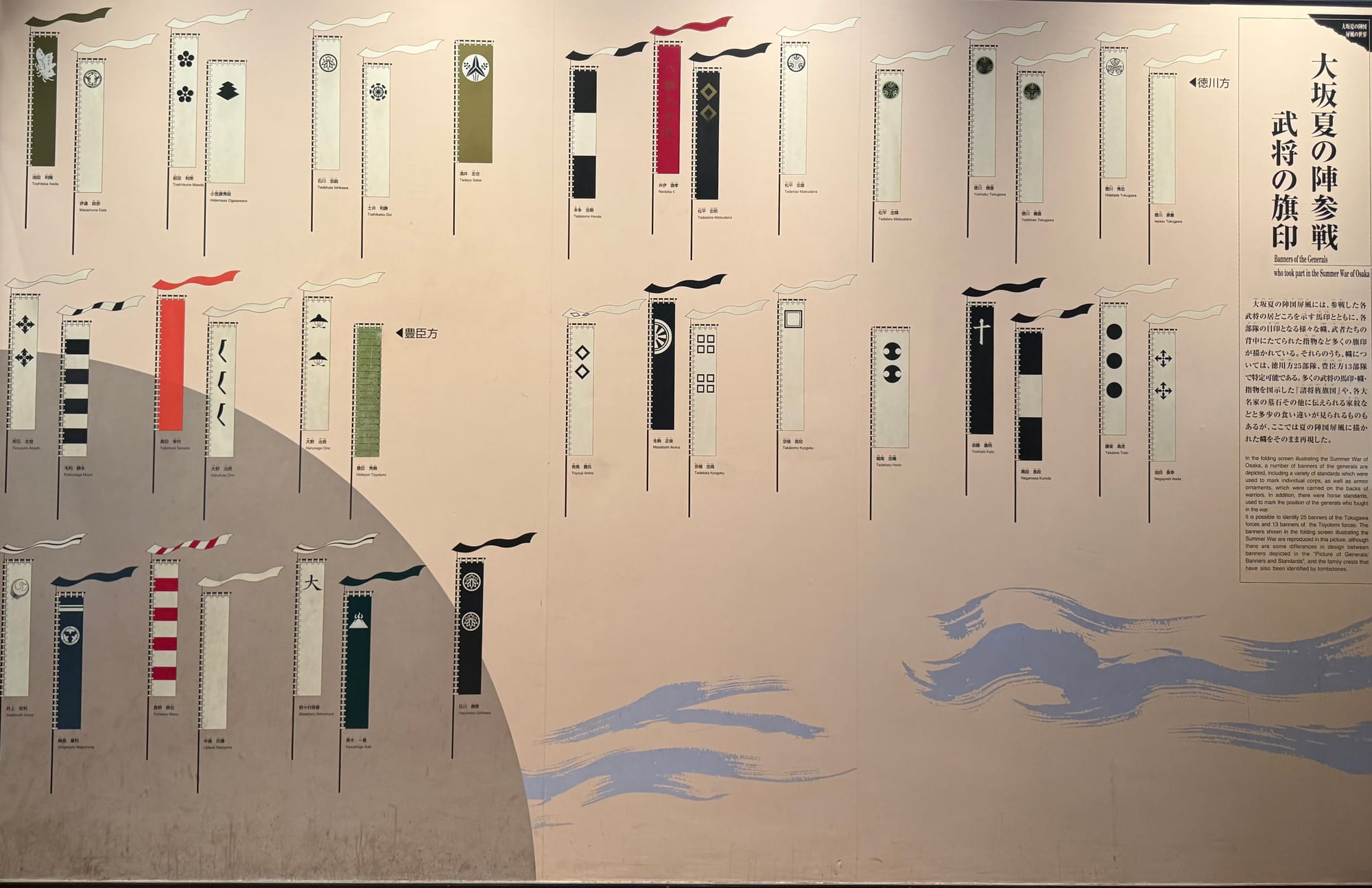
Display in Osaka Castle Museum showing the battle standards and banners of samurai commanders who fought in the Summer Siege of Osaka, with distinctive clan symbols and colours.  Caption:
An exhibit in Osaka Castle Museum illustrates the battle banners used by commanders during the Summer Siege of Osaka in 1615, helping identify allied forces on the battlefield and demonstrating the importance of heraldry in samurai warfare.
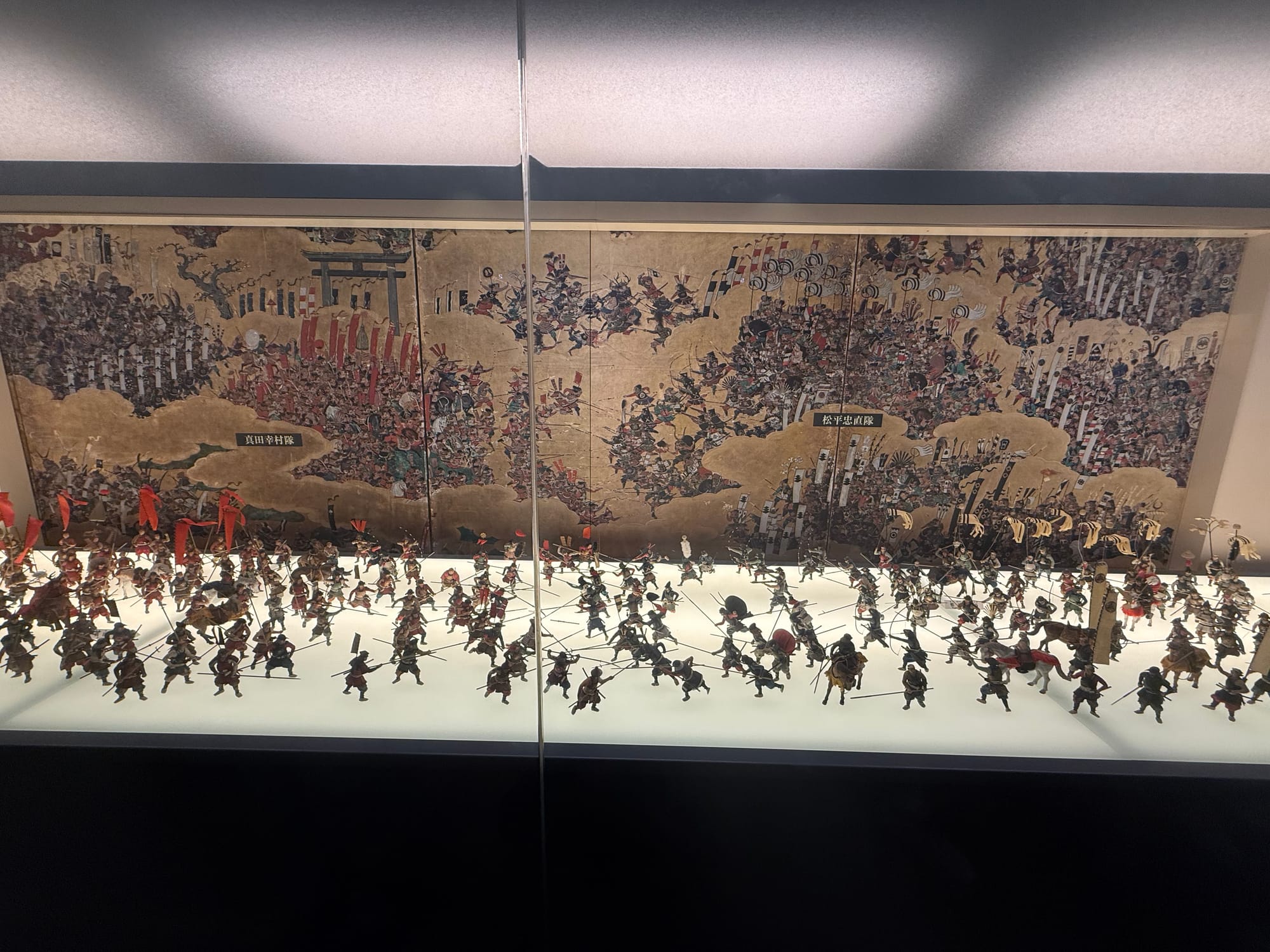
Diorama of samurai warriors and cavalry displayed in Osaka Castle Museum, set before a detailed battlefield screen depicting fighting during the Siege of Osaka.
A detailed battlefield diorama in Osaka Castle Museum recreates the fighting of the Siege of Osaka, combining miniature samurai figures with historical artwork depicting one of Japan's most significant conflicts.
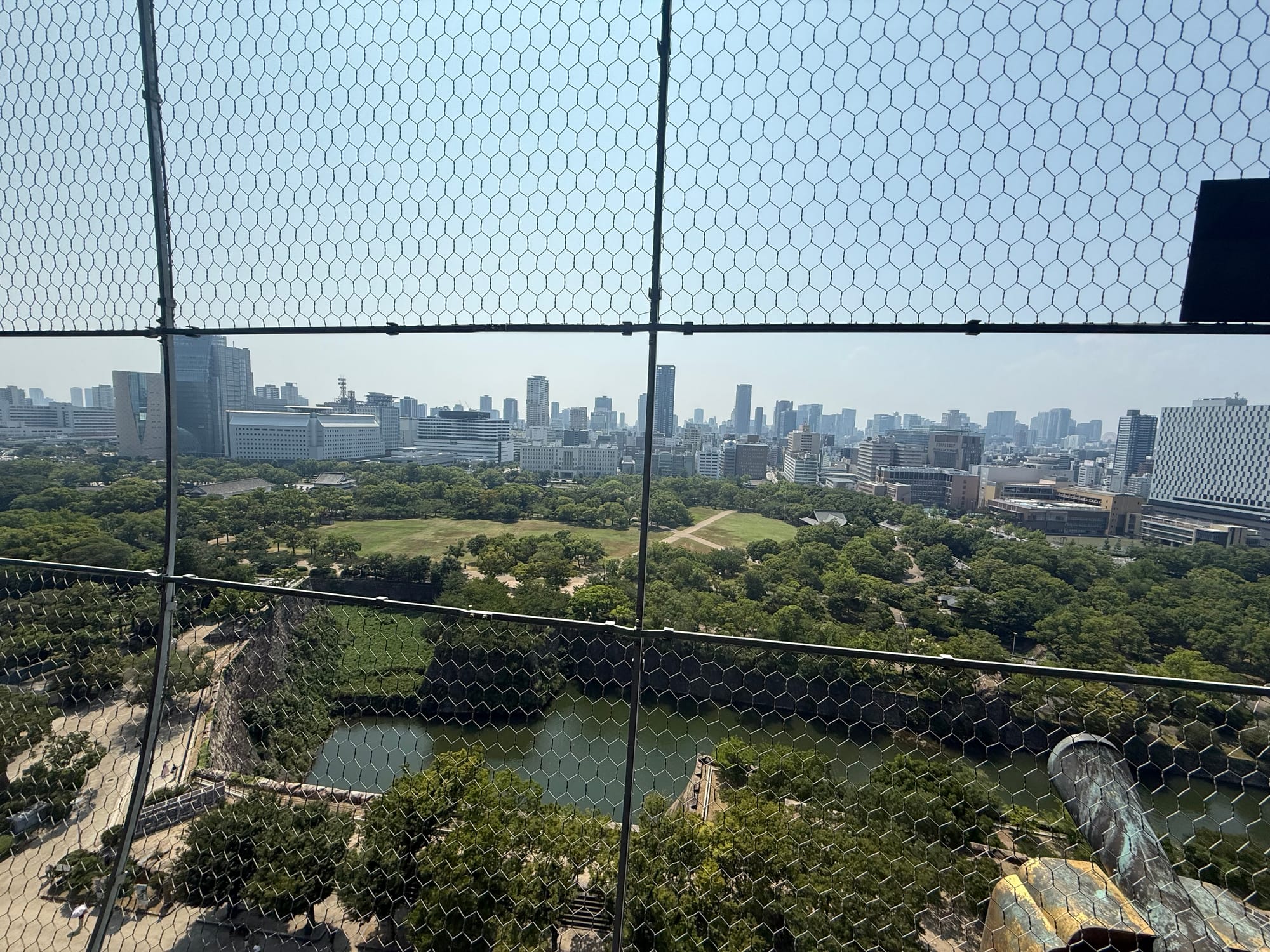
View west from Osaka Castle's observation deck across the castle moat and parkland towards central Osaka, with modern skyscrapers stretching across the skyline.
Looking west from the top of Osaka Castle, across the inner moat and castle grounds towards Osaka's modern city centre, where skyscrapers rise beyond the historic fortifications.
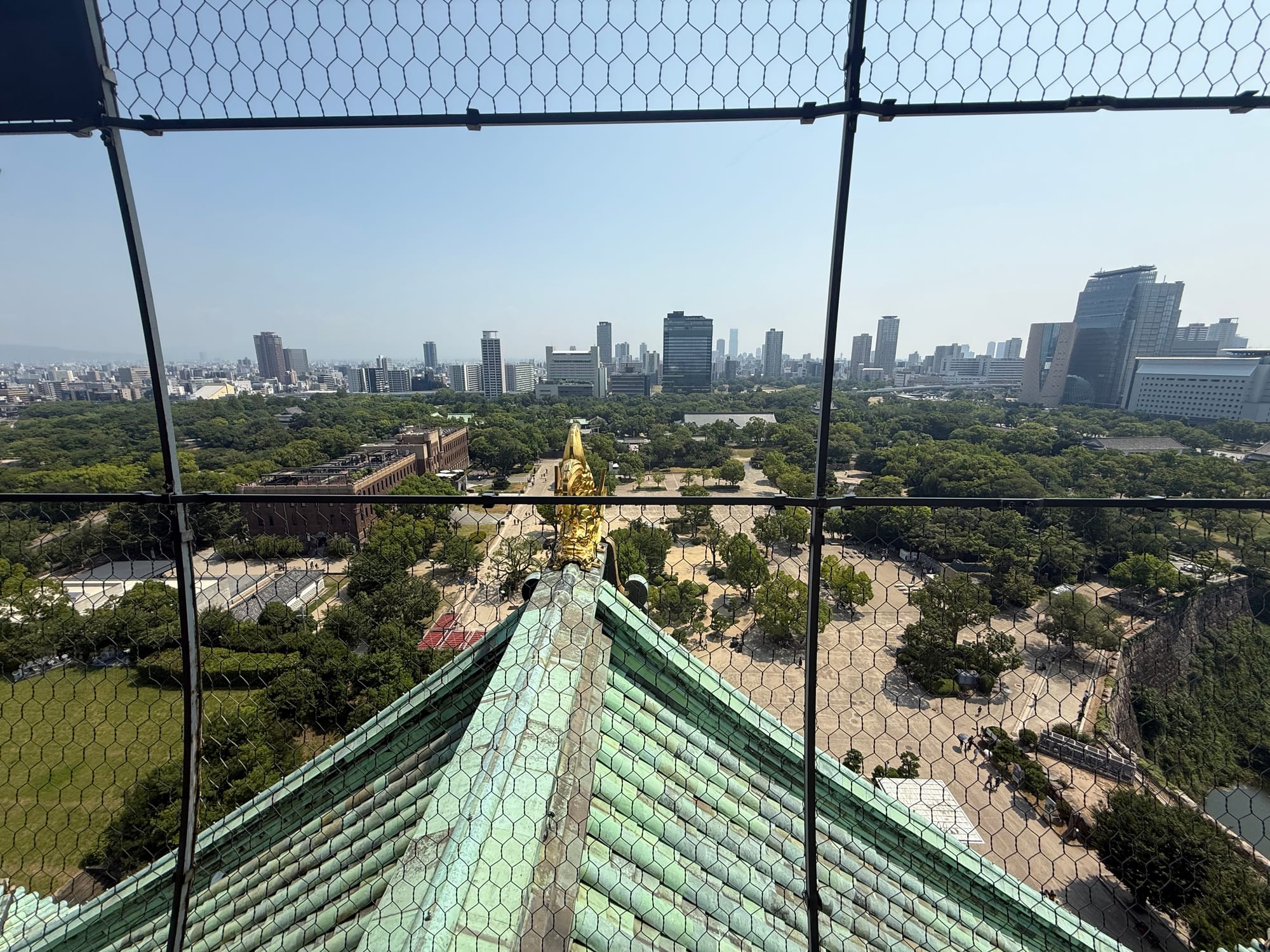
View south from Osaka Castle's observation deck, looking over the castle roof with a golden shachihoko ornament towards Osaka Castle Park and the modern city skyline.
Looking south from the top of Osaka Castle, the castle's copper-green roof and golden shachihoko lead the eye towards the parkland below and Osaka's modern skyline beyond.
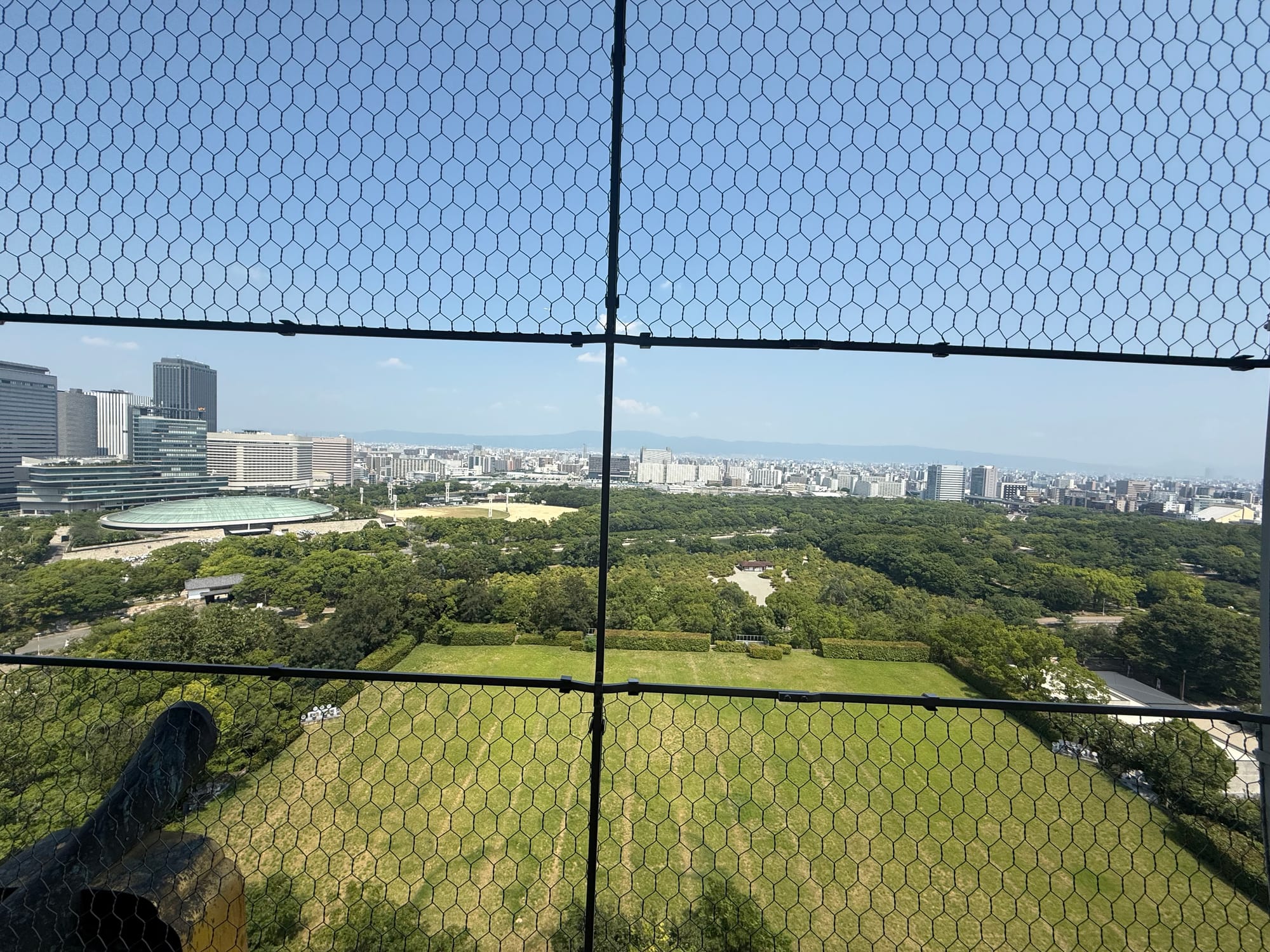
View east from Osaka Castle's observation deck across castle parkland and moats towards central Osaka, with office towers, city streets and distant mountains on the horizon.
Looking east from the top of Osaka Castle, expansive parkland and historic defences give way to Osaka's modern skyline, with mountains visible in the distance beyond the city.
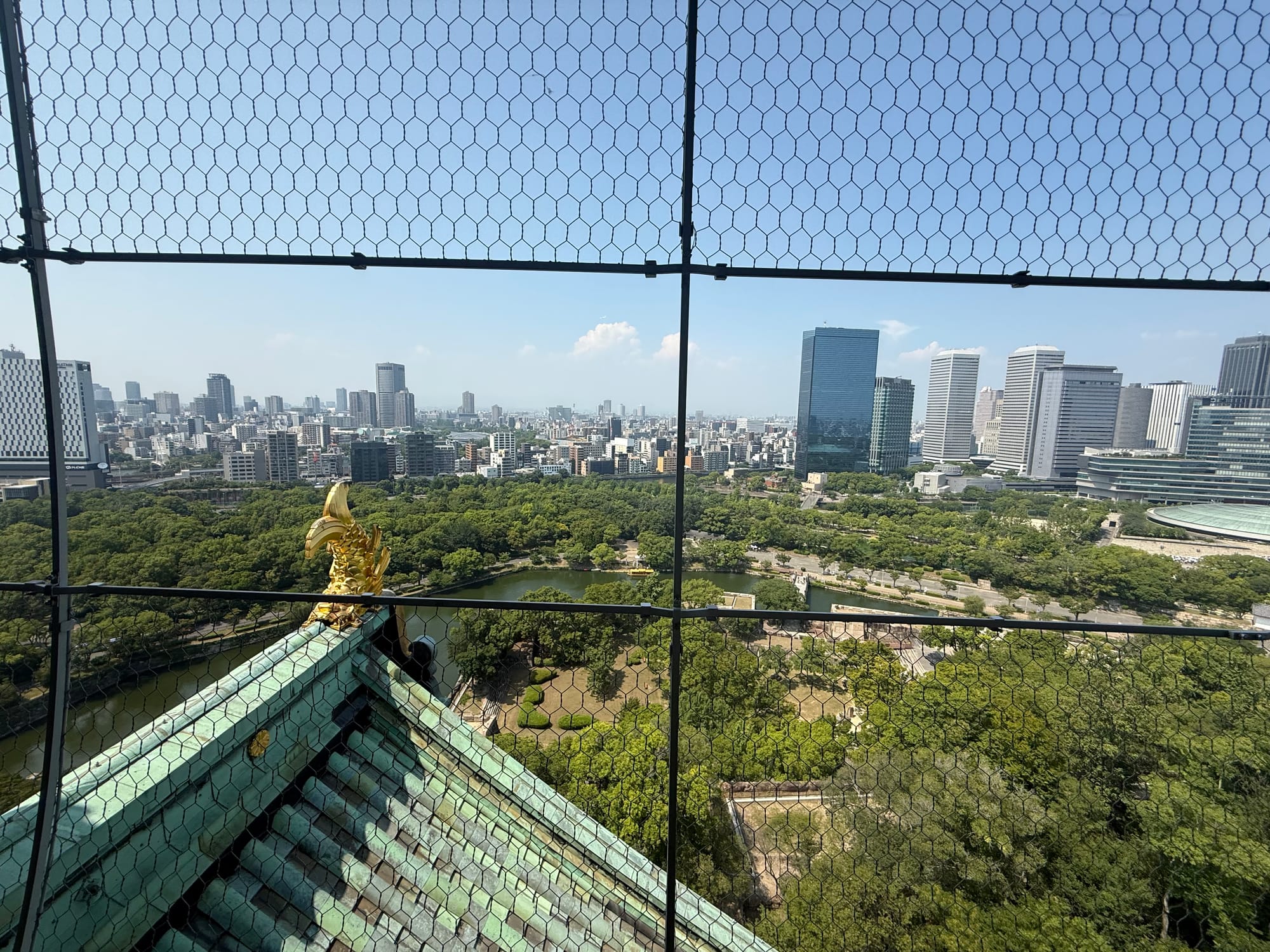
View north from Osaka Castle's observation deck across the castle moat and parkland, with a golden shachihoko roof ornament and Osaka's modern skyline beyond.
Looking north from the top of Osaka Castle, the castle's golden shachihoko and historic grounds contrast with the modern office towers and cityscape stretching across northern Osaka.
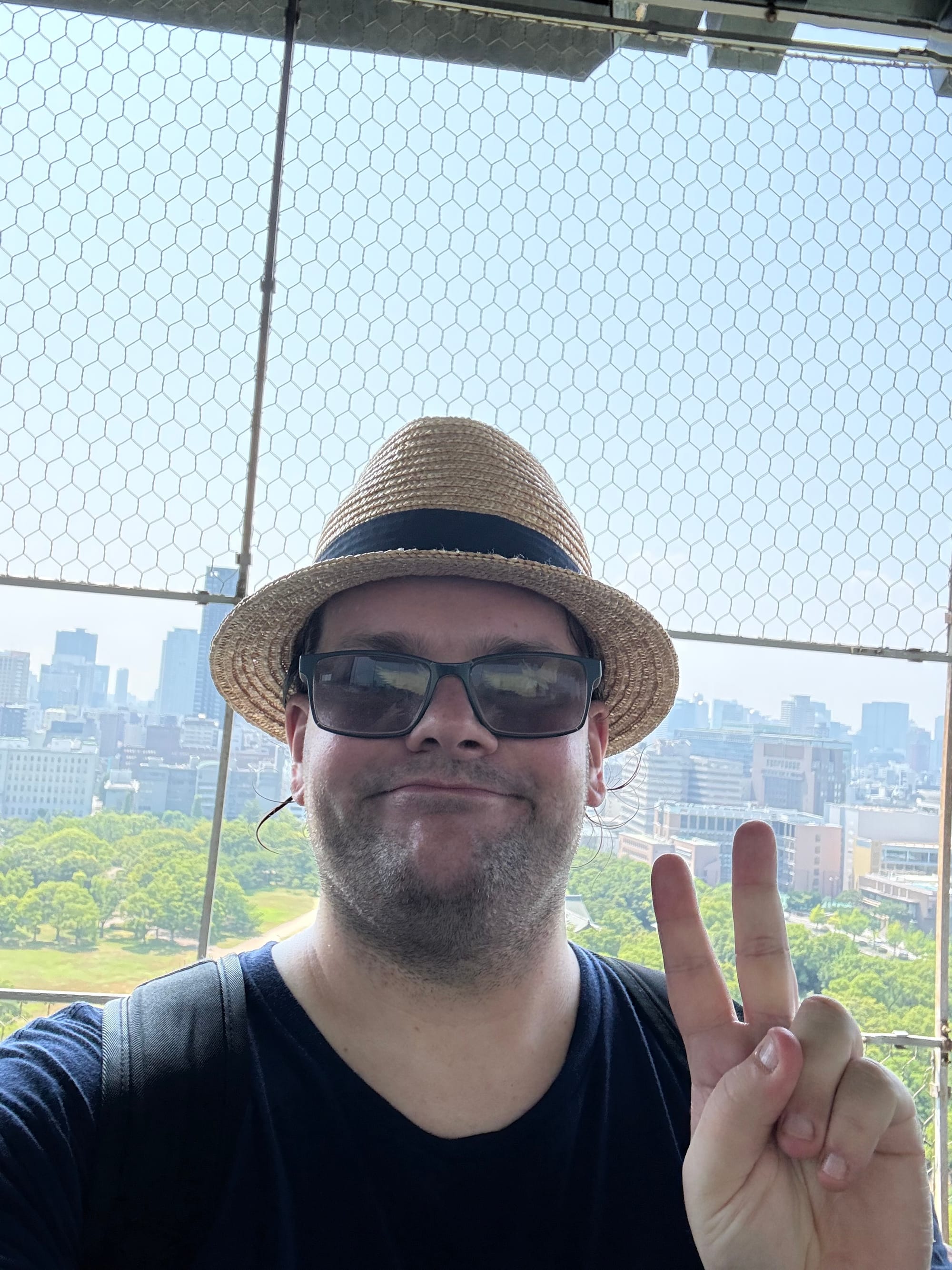
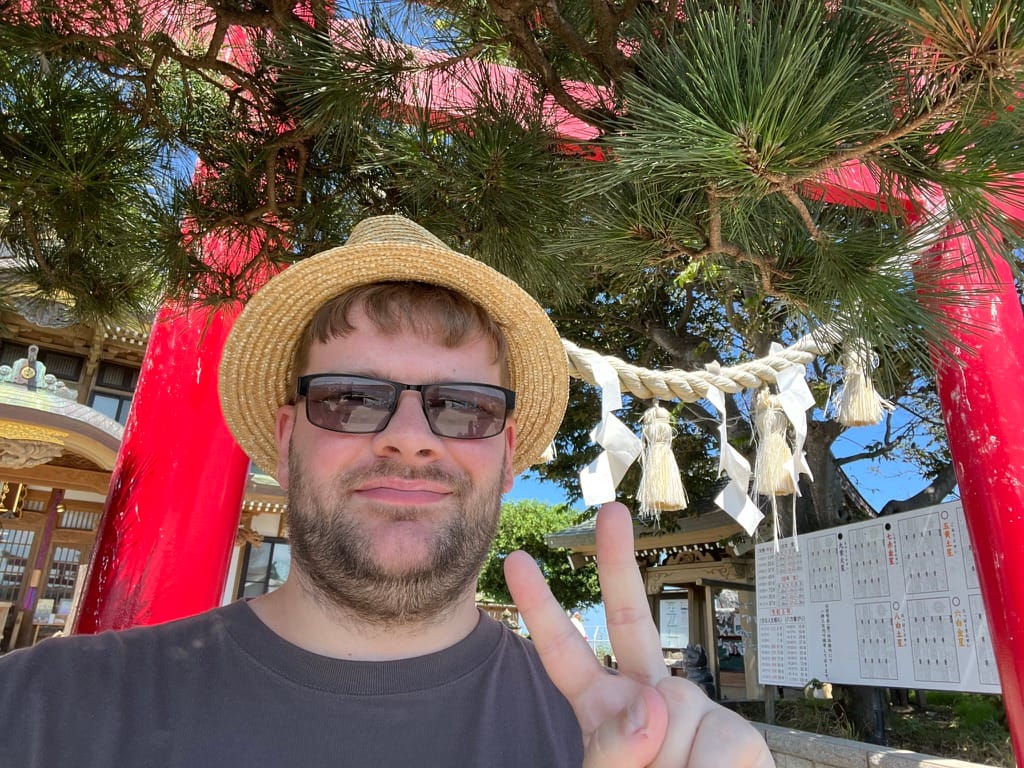
Visitor wearing a straw hat and sunglasses poses for a selfie on the observation deck of Osaka Castle, making a peace sign with the city skyline visible in the background.
A selfie from the top of Osaka Castle, enjoying panoramic views across the city while exploring one of Japan's most famous historic landmarks.

I could even see my hotel from here! If you look closely, you can see the big white ‘APA’ letters in the distance on a black background orange corner clads.
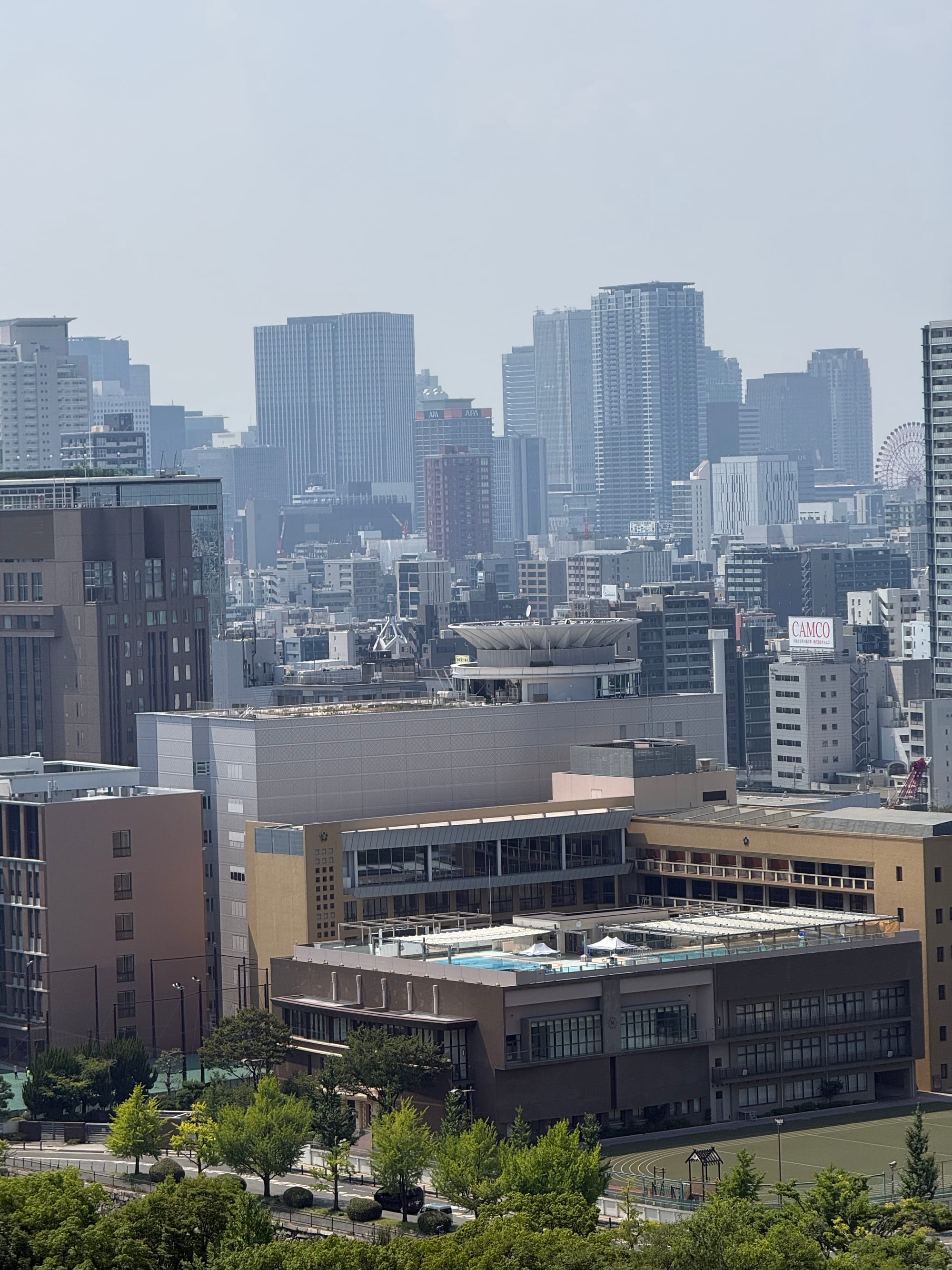
View across central Osaka from Osaka Castle, showing modern office towers, apartment blocks and city streets stretching towards the horizon on a hazy summer day.
Looking across Osaka from the top of Osaka Castle, I spotted my hotel among the dense skyline, highlighting the sheer scale of Japan's third-largest city.

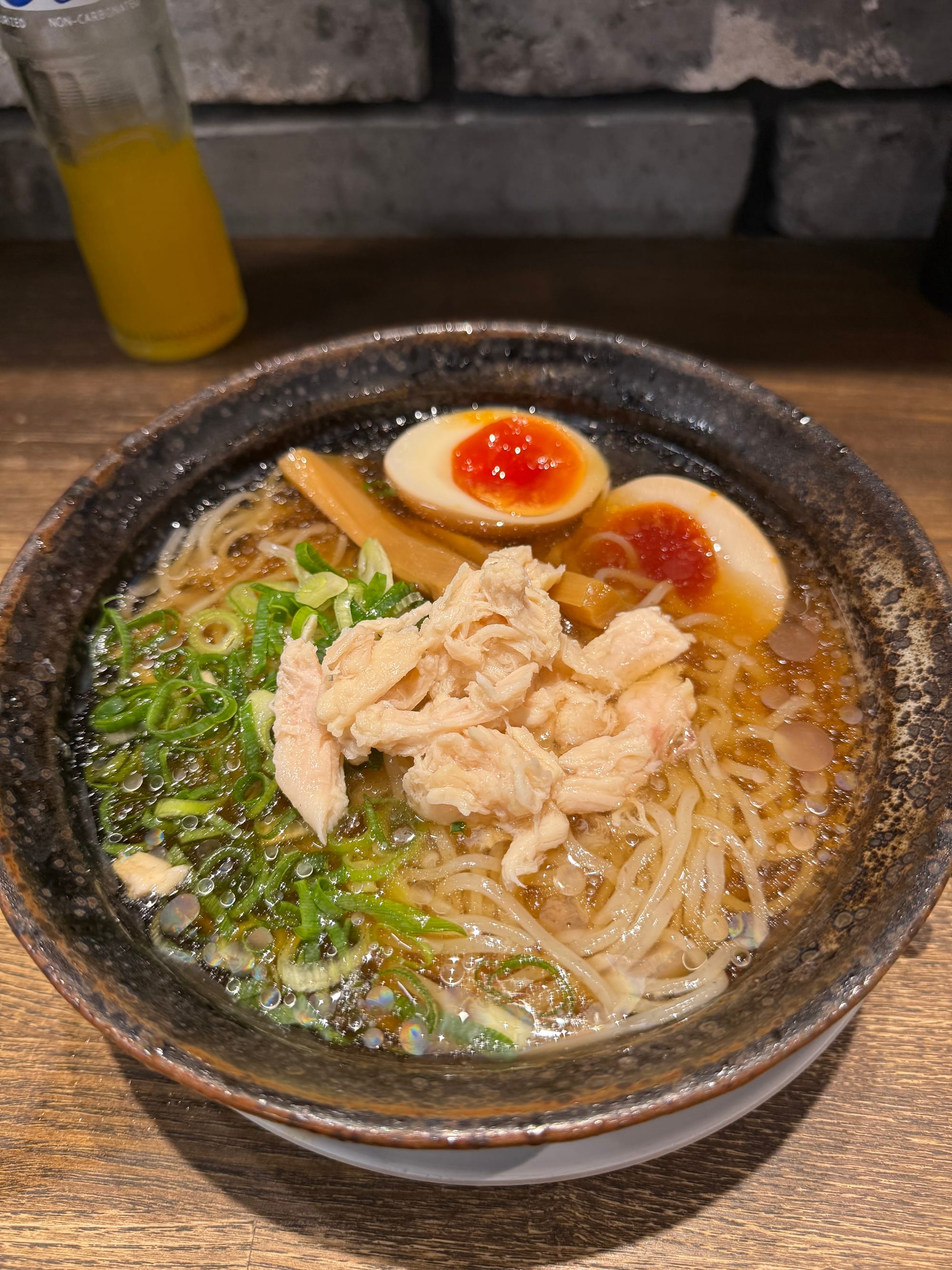
After this I headed to the Jo-Terrace Osaka, where there are a few restaurants and I rested their last time, I was in Osaka. I went to a restaurant called 中華そば 喜城苑, which I got a chilled shoyu ramen from, along with some apple juice and extra noodles. It was delicious and as it is chilled, it was really nice and refreshing, because it was 36c outside!
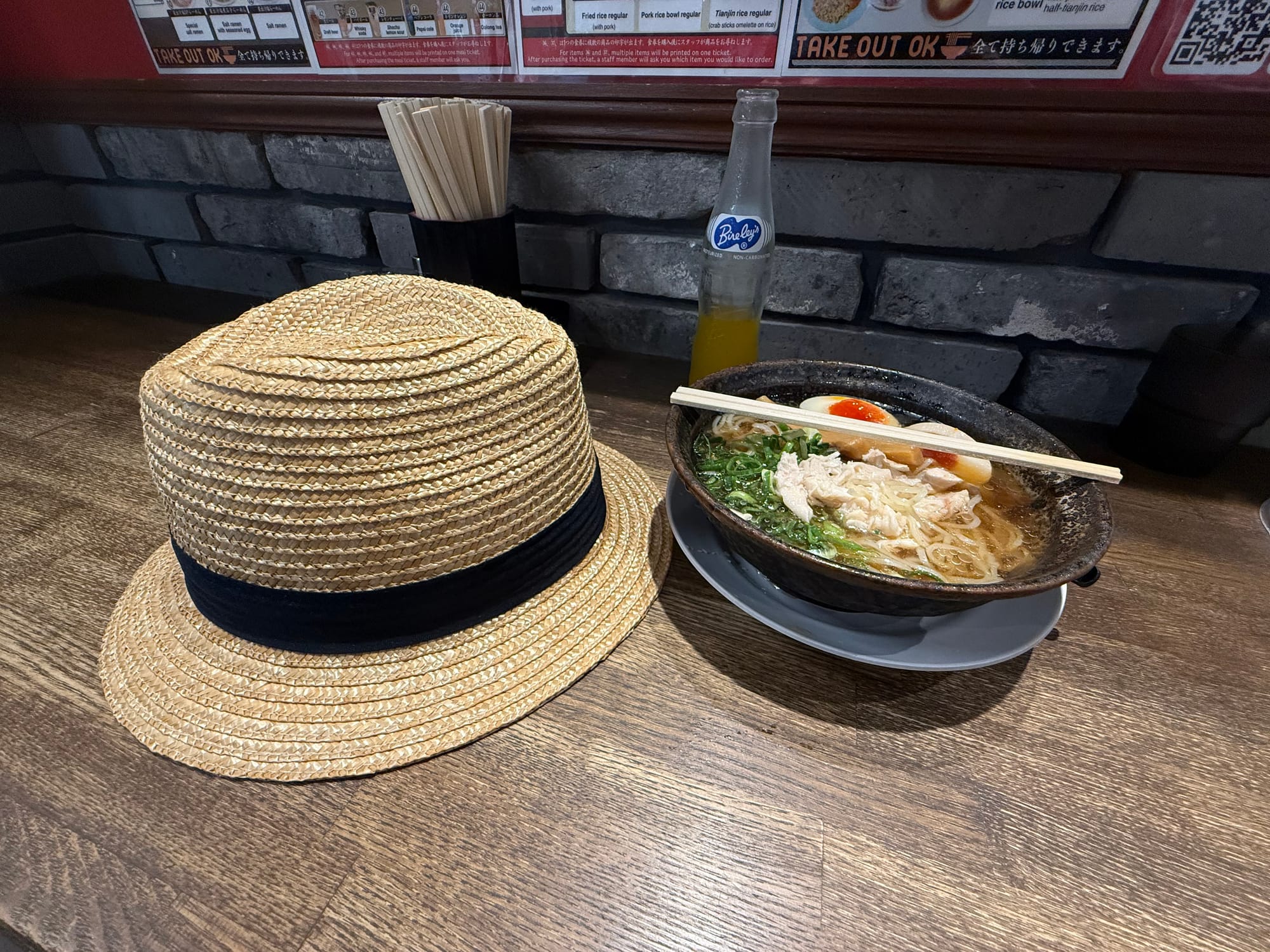
Straw hat resting beside a bowl of ramen topped with sliced pork, spring onions and egg, served at a counter in a Japanese restaurant.
Mr Hat takes a well-earned break for lunch, joining a bowl of ramen at a local restaurant during a day of exploring Osaka.
Bowl of chilled shoyu ramen topped with shredded chicken, spring onions, bamboo shoots and marinated soft-boiled eggs, served at a counter in a Japanese restaurant.
A refreshing bowl of chilled shoyu ramen, topped with chicken, spring onions and marinated eggs, providing welcome relief from Osaka's summer heat.

Now it was time to go back to the hotel, have a refreshing dip in the onsen and have a kip before going out for the Go Karting Tour, which is something I did in Tokyo last time and to can find my thoughts the last one I did here: Click Here to See Tokyo Go Kart Experience

Go Karting Tour
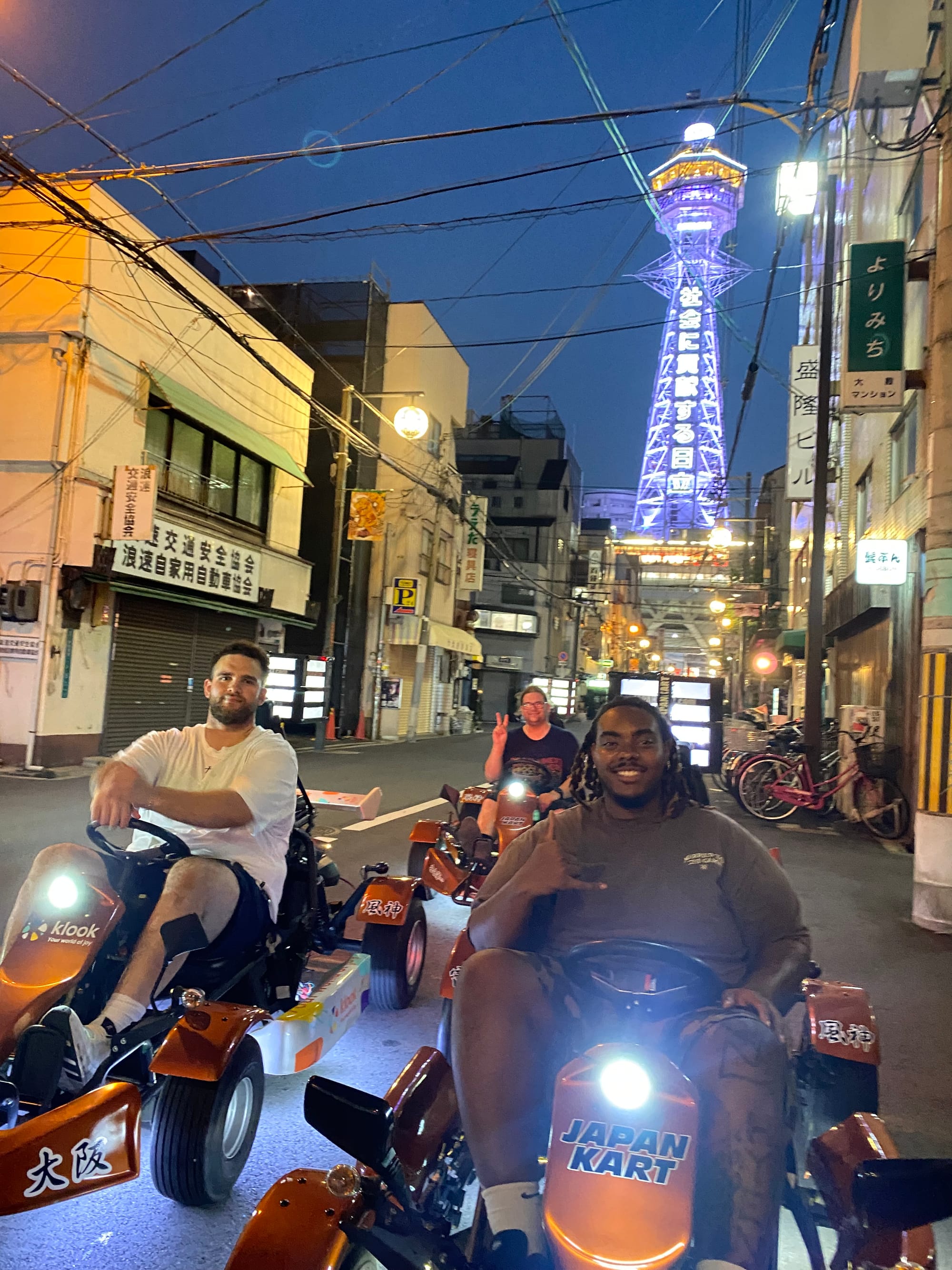
Participants drive go-karts through the streets of Osaka at night, with Tsutenkaku Tower illuminated in the background and city lights reflecting along the road.
A nighttime go-kart tour through Osaka passes beneath the illuminated Tsutenkaku Tower in Shinsekai, offering a unique view of one of the city's most iconic landmarks.

This one was a bit away from the hotel, but easy to get to via subway. Upon arriving, I needed to present my passport, my 1949 IDP (International Driving Permit which only costs £5.50 and i'll need it a couple more times during my time here) and driving licence. If you want to possibly book the tour as well, you can find it here: JapanKart Osaka.
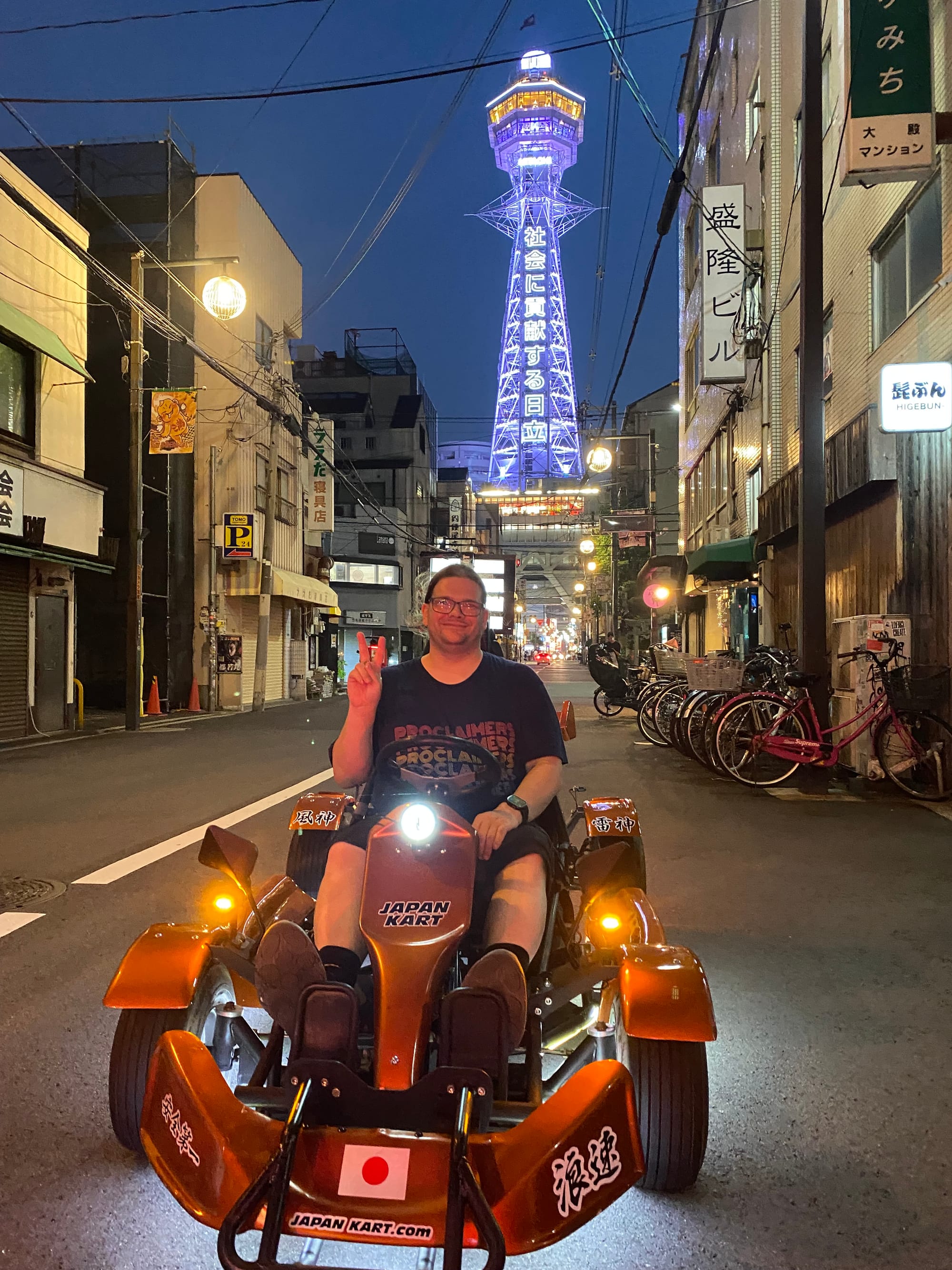
Visitor in a go-kart pauses on a street in Osaka's Shinsekai district at night, with the illuminated Tsutenkaku Tower rising above the surrounding buildings.
Stopping for a photo during a night-time go-kart tour of Osaka, with the brightly lit Tsutenkaku Tower providing a spectacular backdrop in the heart of Shinsekai.

As much as it was good doing it at night as the sun wasn't out and it was cooler (still 31c), last time I did it in Tokyo for 2 hours, it was 38c during the day, which you just needed to remember to sunscreen up for it. There were only me and 2 others, who were from Washington State, USA there for the evening tour, which made it quite good and relaxed a bit.
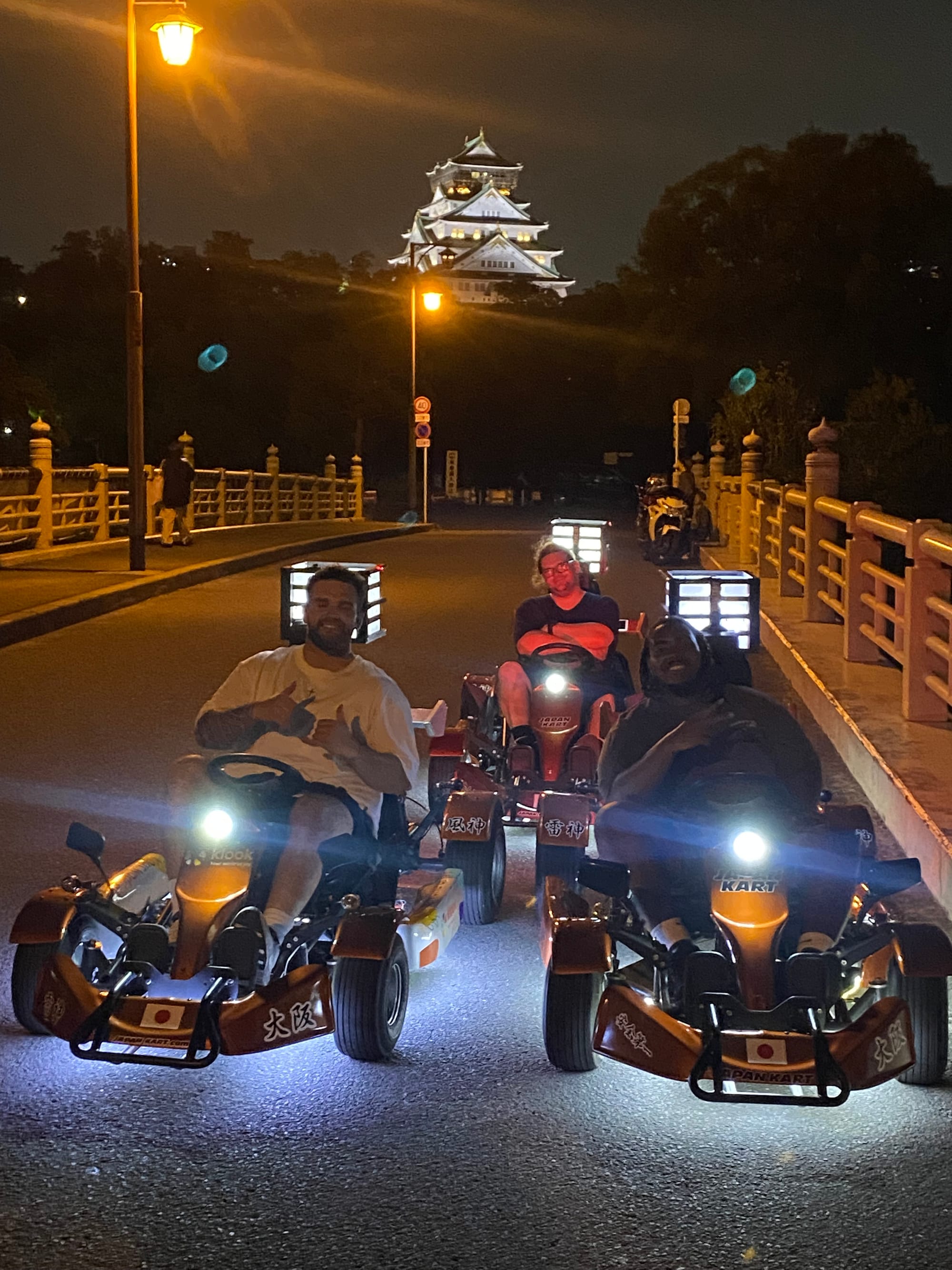
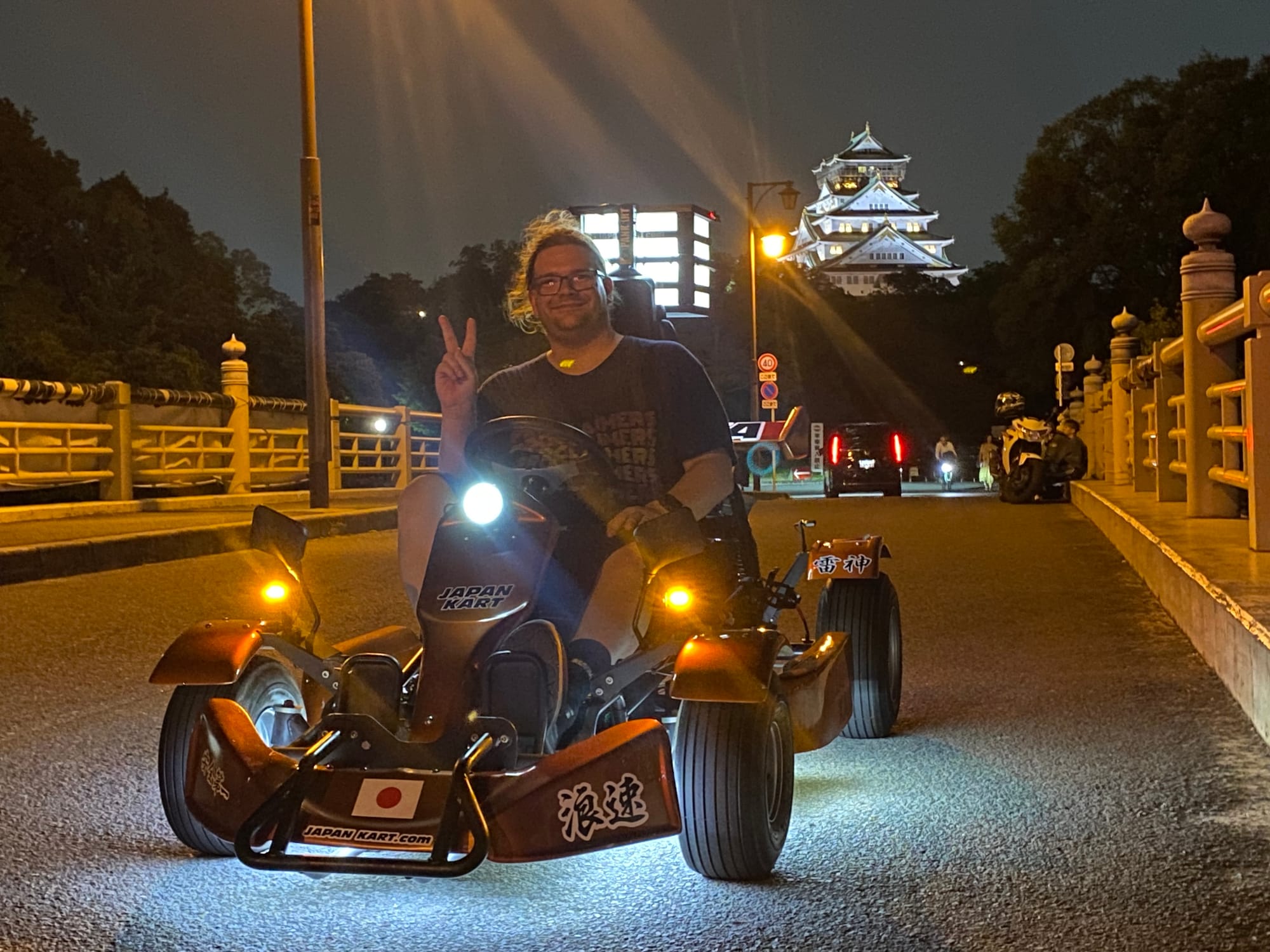
Go-karts parked on a bridge in Osaka at night, with Osaka Castle illuminated in the background and riders posing beneath the glow of street lamps.
A stop during a night-time go-kart tour of Osaka, with the illuminated Osaka Castle rising above the trees and providing a memorable backdrop to the evening adventure.
Visitor seated in a go-kart on a bridge in Osaka at night, making a peace sign, with the illuminated Osaka Castle rising above the trees in the background.
Posing for a photo during a night-time go-kart tour of Osaka, with the floodlit Osaka Castle providing a spectacular backdrop to the evening's adventure.

It was good apart from the roads in Osaka being a bit bumpy, which made me get a bit of airtime once or twice and at least unlike the UK there wasn't potholes every 2 meters. It was nevertheless a fun activity to do and was well worth the £46.73 that it cost.

Please join me next time I am move from here to Kagoshima, which is all the way on the southern tip of the Kyushu (Southern Island of Japan), which has a rich samurai history relating to the last samurai and has Japan’s most active volcano across the bay, which I am going on a cycling tour around (yes, I am crazy), see you all later (hopefully)!