Hiroshima and Miyajima

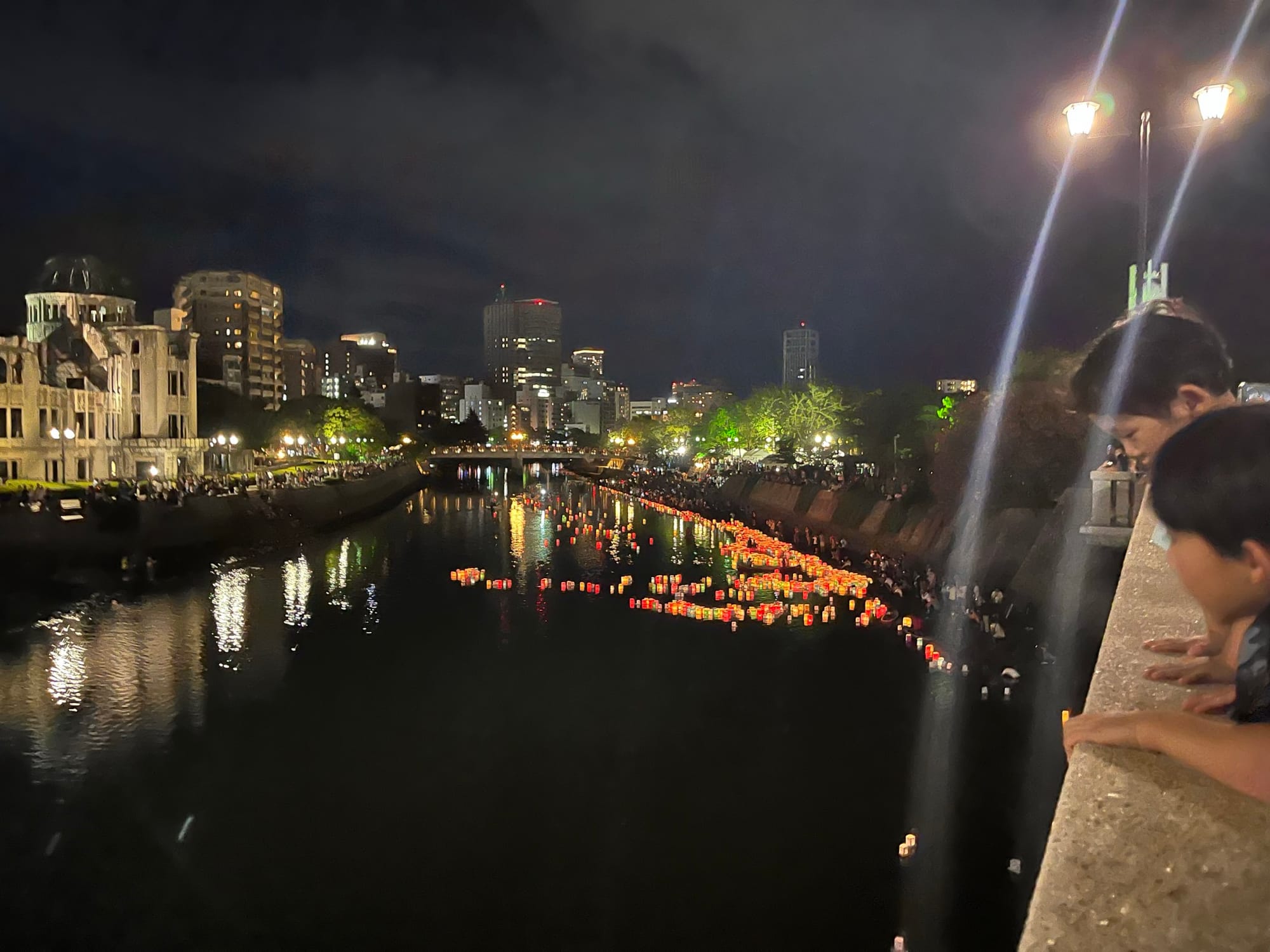
Lanterns float on the Motoyasu River in Hiroshima at night during a memorial ceremony, with the Atomic Bomb Dome and city lights reflected in the water.
Floating lanterns illuminate the Motoyasu River in Hiroshima during a peace memorial ceremony, with the Atomic Bomb Dome standing as a reminder of the city's resilience and commitment to peace.

Moving Day Again

4th August

So, I won’t bore you with the details about bullet trains again, but there was another nice Ekiben involved. Today was the day I moved on from Nagasaki to Hiroshima which took just less than 3 hours. By bullet trains and limited express trains. I also ended up losing my cap on the Shinkansen as I fell asleep and then woke up just before Hiroshima.

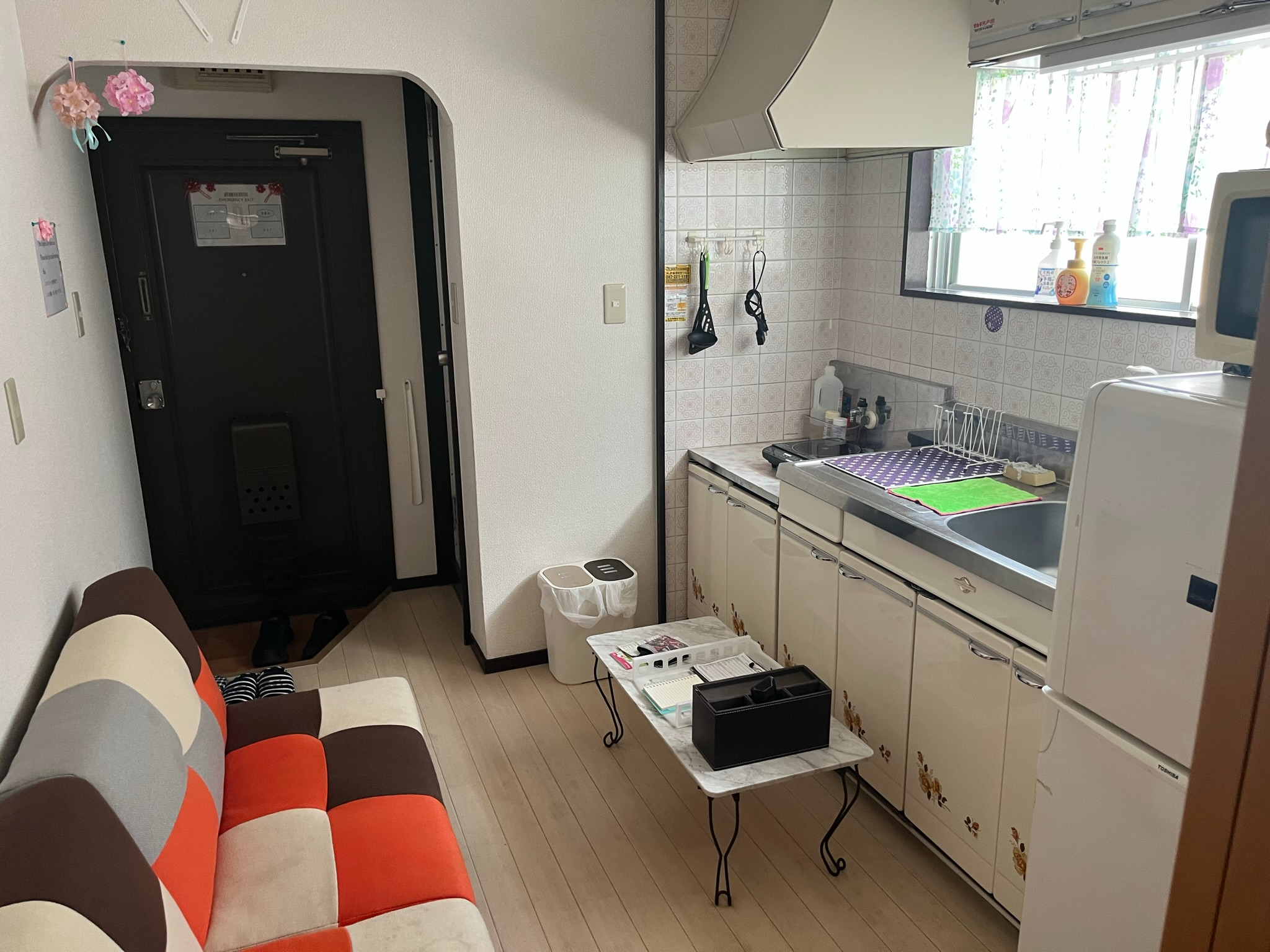
The place I am staying at is called Cocostay Felice. It is an apartment building near the atomic peace park and had everything that I needed.
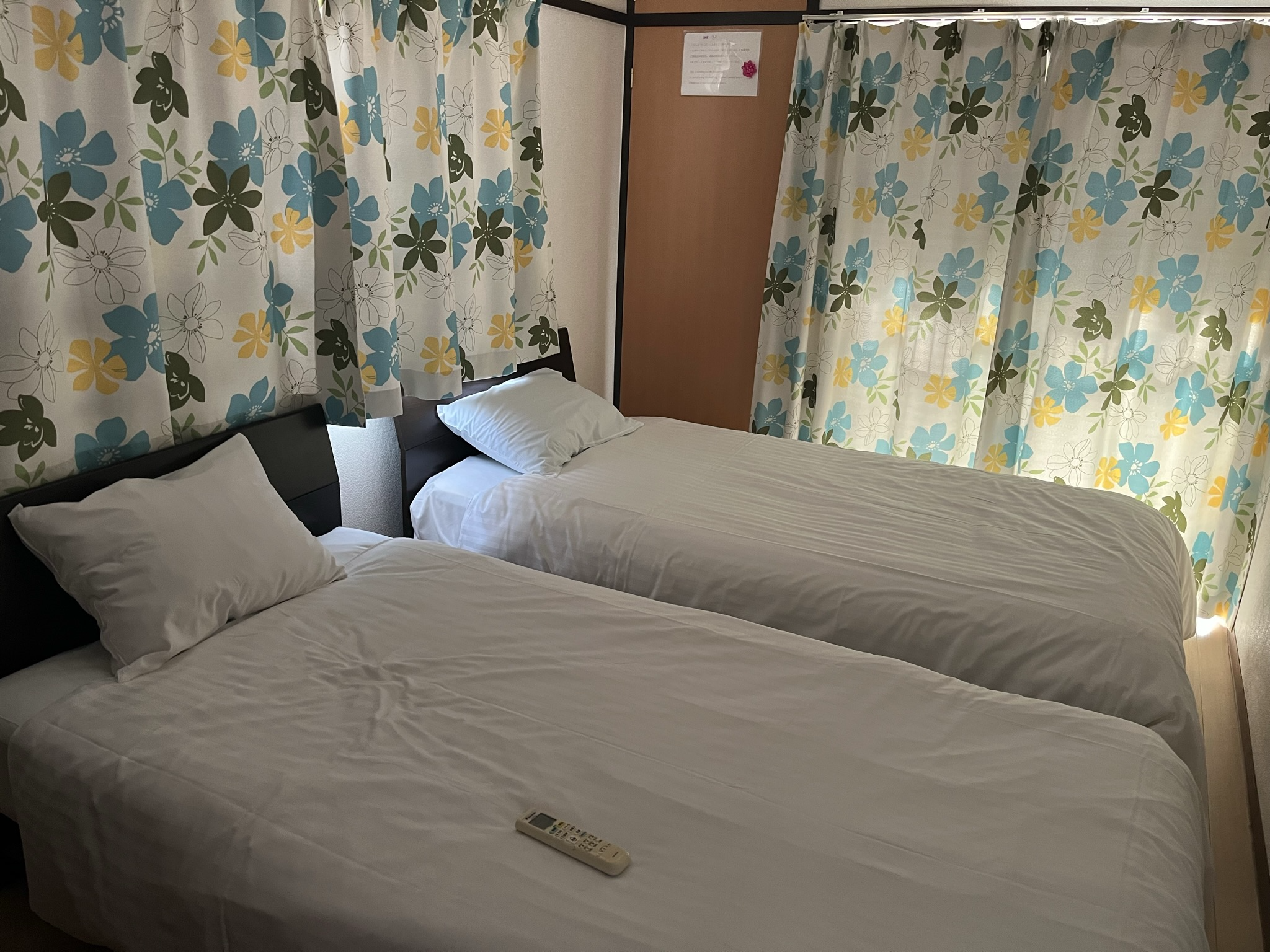
Twin-bed room in a Japanese guesthouse or apartment, featuring floral curtains, white bedding and a compact, practical layout with natural light filtering inside.
A simple and comfortable twin room in Japan, providing a convenient base for exploring the local area during the trip.
Compact apartment kitchen and living area in Japan, featuring a small sofa, kitchenette, fridge, microwave and dining table in a bright, practical space.
The compact kitchen and living area of a Japanese apartment, providing a comfortable and practical base with self-catering facilities during the trip.
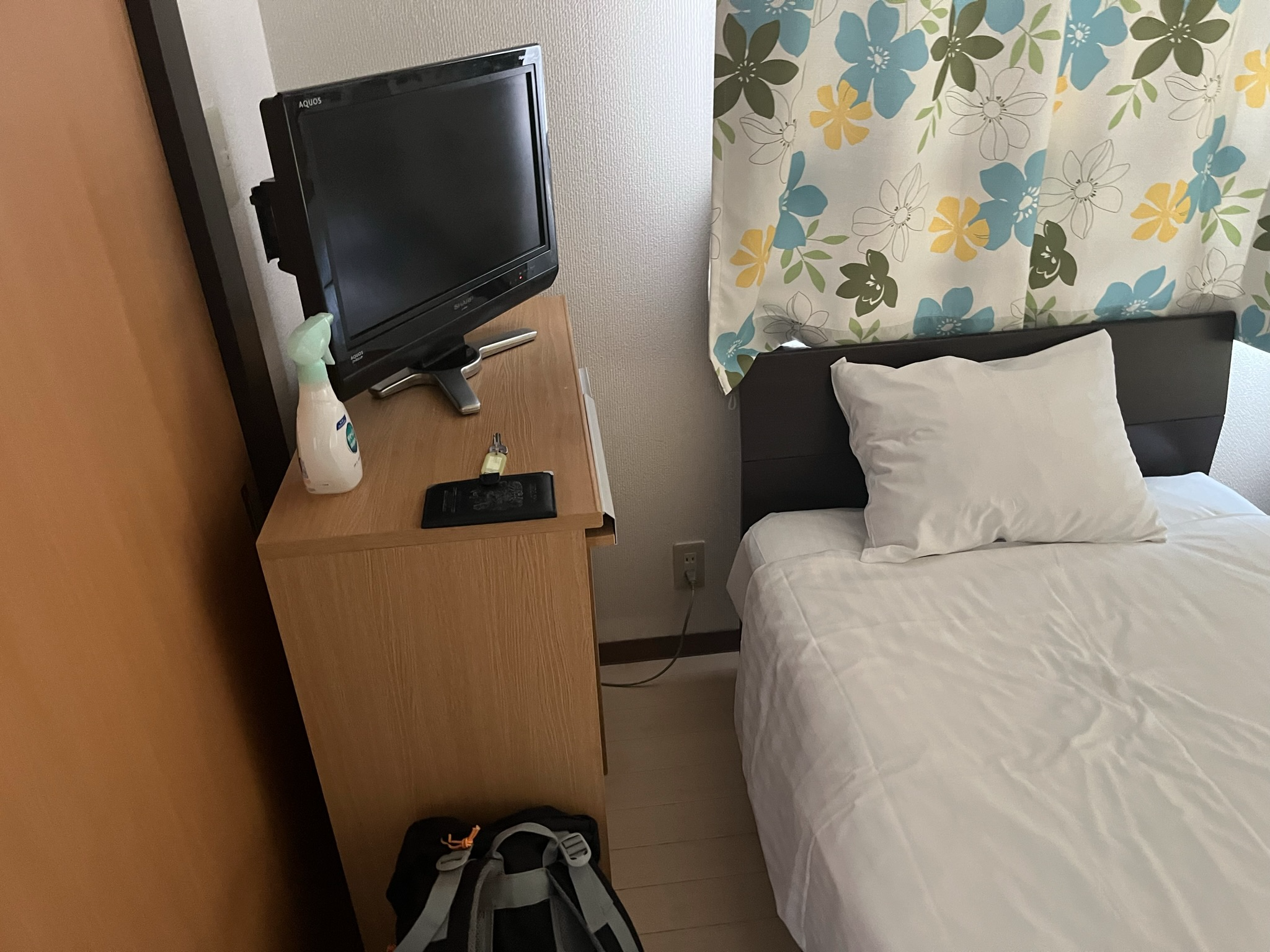
Single bed in a compact Japanese apartment, beside a small television cabinet and floral curtains, with a backpack and personal items visible in the room.
A compact bedroom in a Japanese apartment, providing a simple and comfortable place to stay while travelling through Japan.

I also went out for dinner to get a local Hiroshima speciality called Okonomiyaki. The one I had was made from crepe dough and had cabbage, Egg, Noodles, pork and I am sure it had a teriyaki sauce on top as well. Okonomiyaki has a history dating back to 16th century, but they became popular in the region after the 1923 Great Kanto Earthquake and again after WW2 due to it being an inexpensive and filling dish that all ages could enjoy.
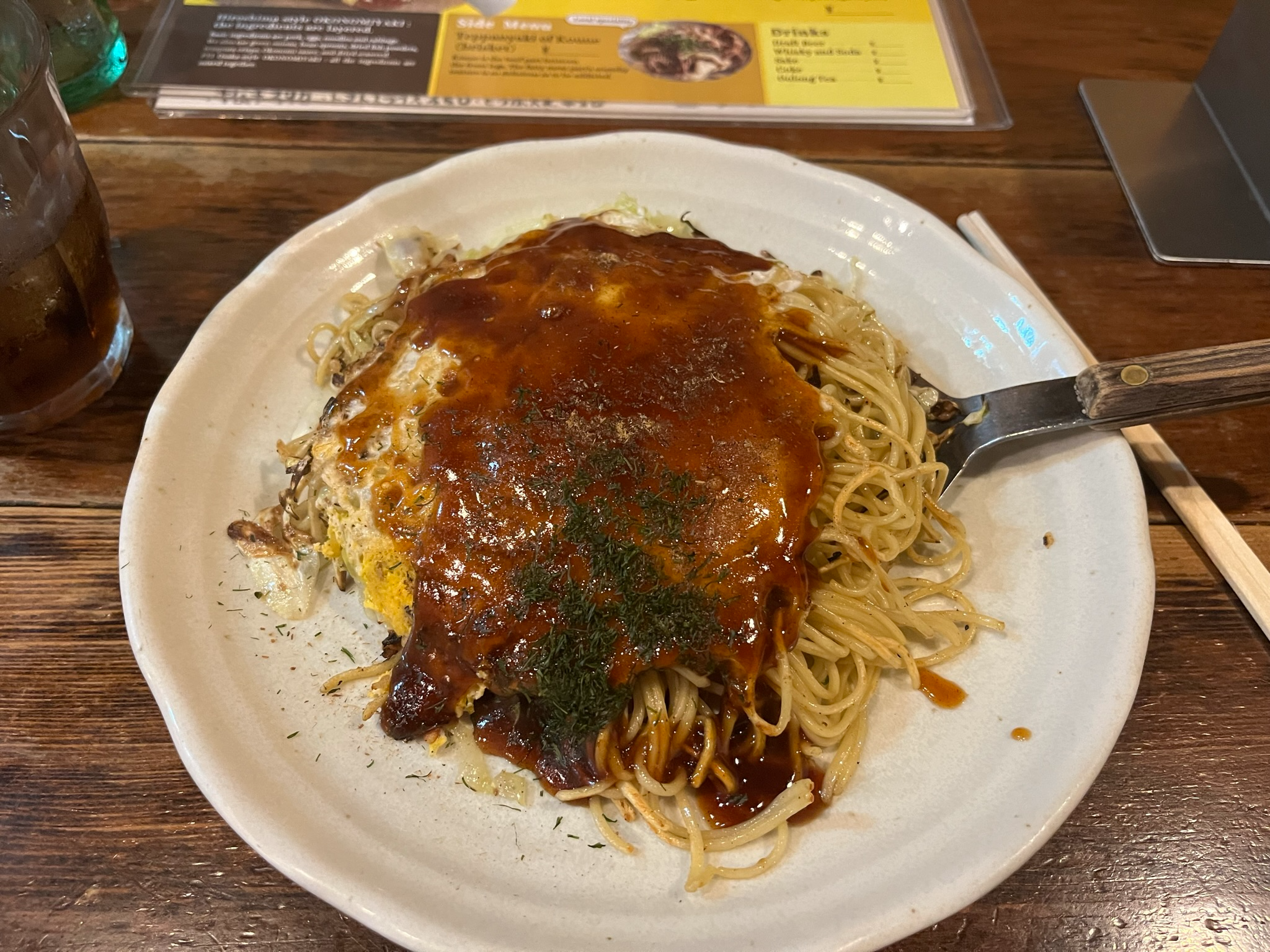
Hiroshima-style okonomiyaki, a local speciality made with layered noodles, cabbage, egg and rich sauce, enjoyed in the city where the dish is especially popular.
Plate of Hiroshima-style okonomiyaki layered with noodles, egg and vegetables, topped with savoury sauce and herbs, served in a restaurant in Hiroshima.

Bike Tour of Hiroshima and Hot Springs

5th August

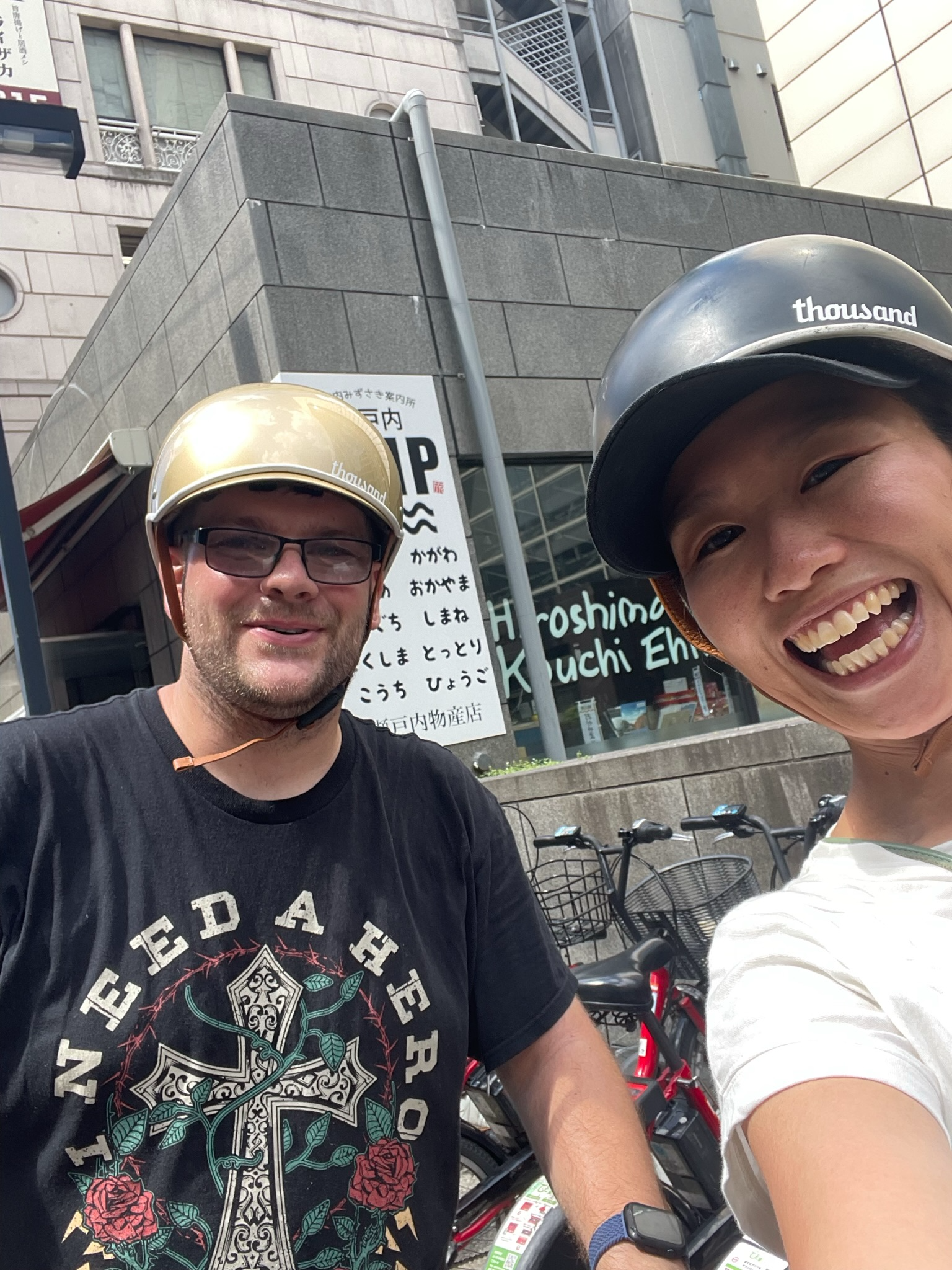
My first order of business today was to go to the Hiroshima peace park rest house and meet up with my guide for the day and the rest of the group. Now by some luck it ended up just being me and my guide as the 2 others had pulled out the day before, so I ended up having a private cycling tour of Hiroshima instead.

Here is the link to the cycling tour that I went on:
https://www.tripadvisor.co.uk/AttractionProductReview-g298561-d21304509-Hiroshima_Cycling_Peace_Tour_with_Local_Guide_Long_Course-Hiroshima_Hiroshima_Pref.html

Two cyclists pose for a selfie beside hire bicycles in central Hiroshima, wearing helmets outside a building near the Hiroshima Kuchi Eki cycle hire location.
Taking a break during a cycling tour of Hiroshima, with hire bikes providing an enjoyable way to explore the city's landmarks and waterfront areas.

My guide Moe spoke good English and was a good tour guide. I am glad that the bikes were electric bikes as I don’t think I would have been fit enough to do it all if they weren’t. We started off by going to Hiroshima Castle which was rebuild after the war.
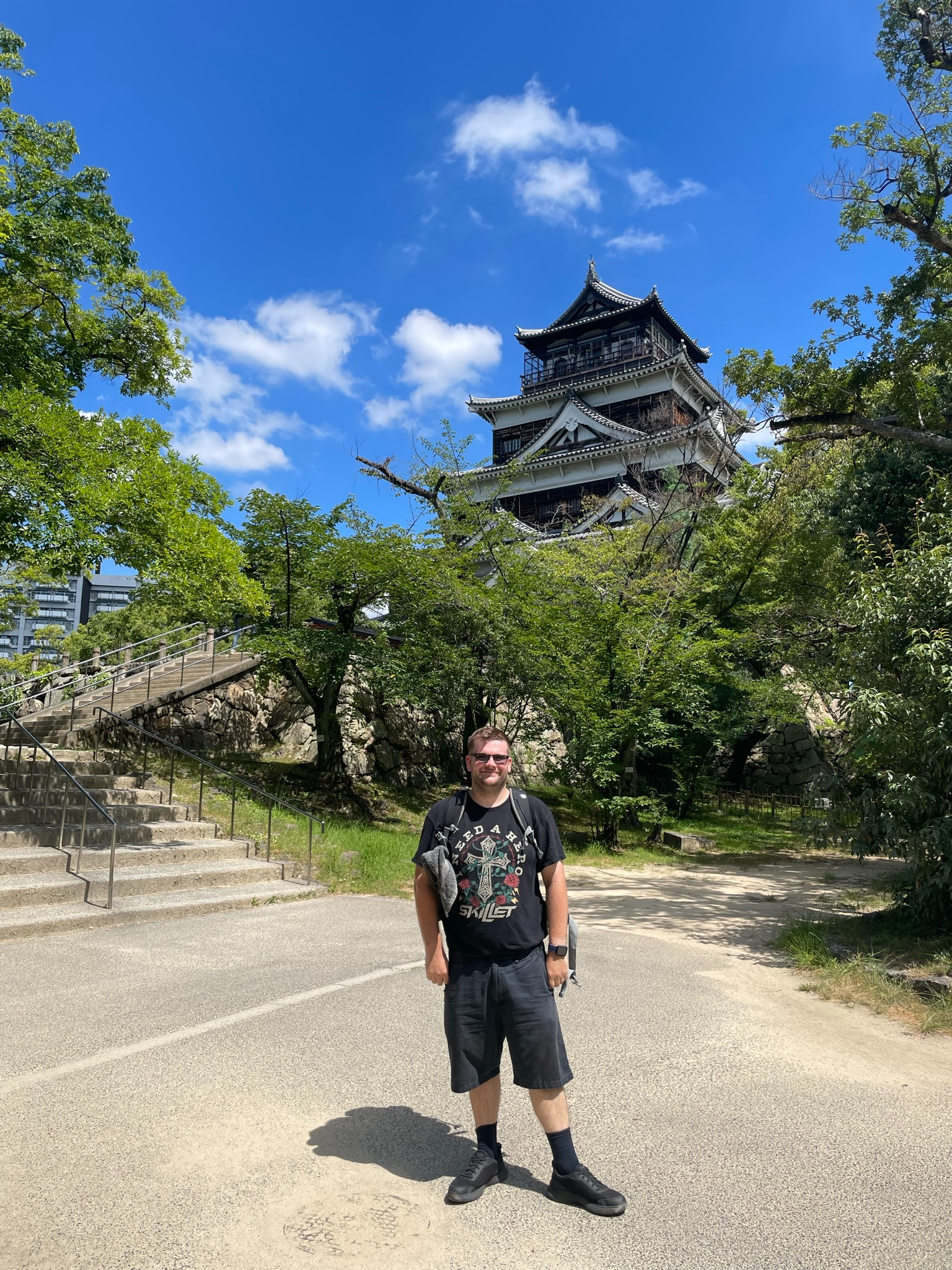
Visitor standing in front of Hiroshima Castle, with the reconstructed wooden keep rising above trees, stone walls and castle grounds beneath a bright blue sky.
Posing beneath Hiroshima Castle on a sunny summer day, with the reconstructed keep rising above the surrounding trees and historic grounds in the heart of the city.

The history of Hiroshima and how it was rebuilt was amazing to list to and the stories that her parents and grandparents told her really make it hit home about the devastation that happened.
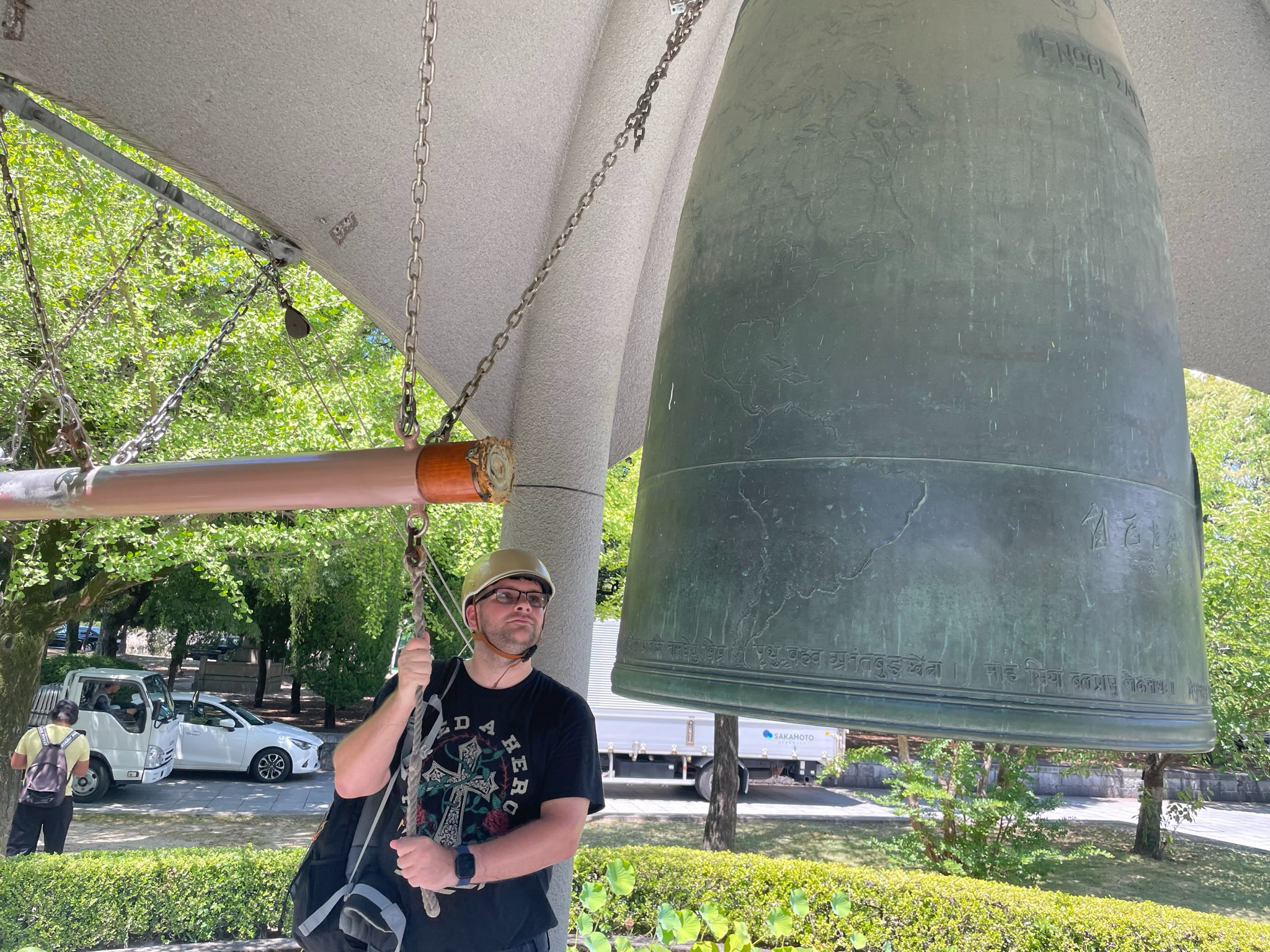
Visitor standing in front of Hiroshima Castle, with the reconstructed castle keep rising above trees and stone walls beneath a bright blue summer sky.
A visit to Hiroshima Castle, where the reconstructed keep stands as a symbol of the city's history and recovery, surrounded by peaceful parkland in the heart of Hiroshima.
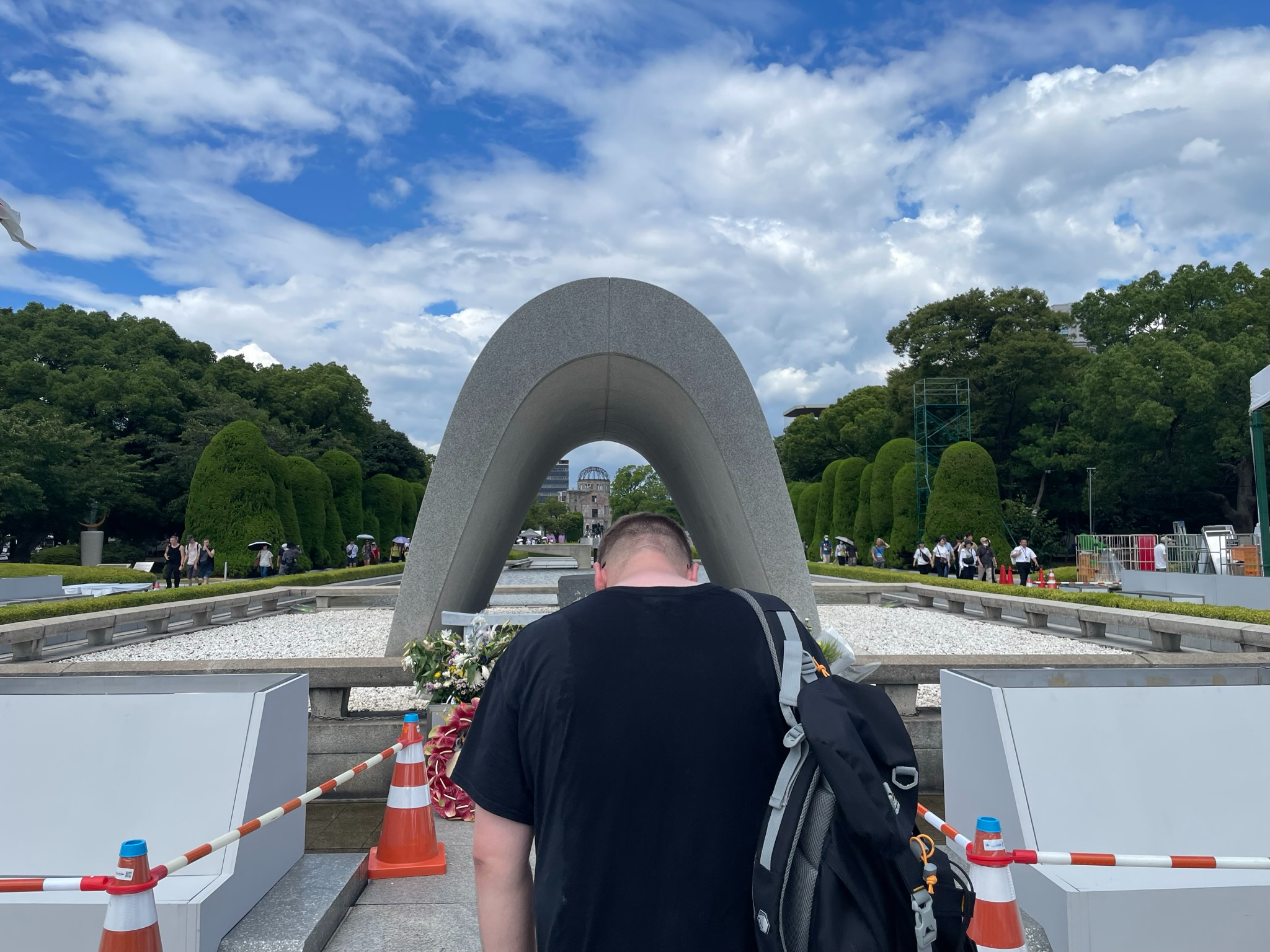
Visitor paying respects at the Cenotaph for the A-bomb Victims in Hiroshima Peace Memorial Park, with the Atomic Bomb Dome visible through the memorial arch.
Paying respects at the Cenotaph for the A-bomb Victims in Hiroshima Peace Memorial Park, where the memorial arch frames the Atomic Bomb Dome beyond, symbolising remembrance and peace.
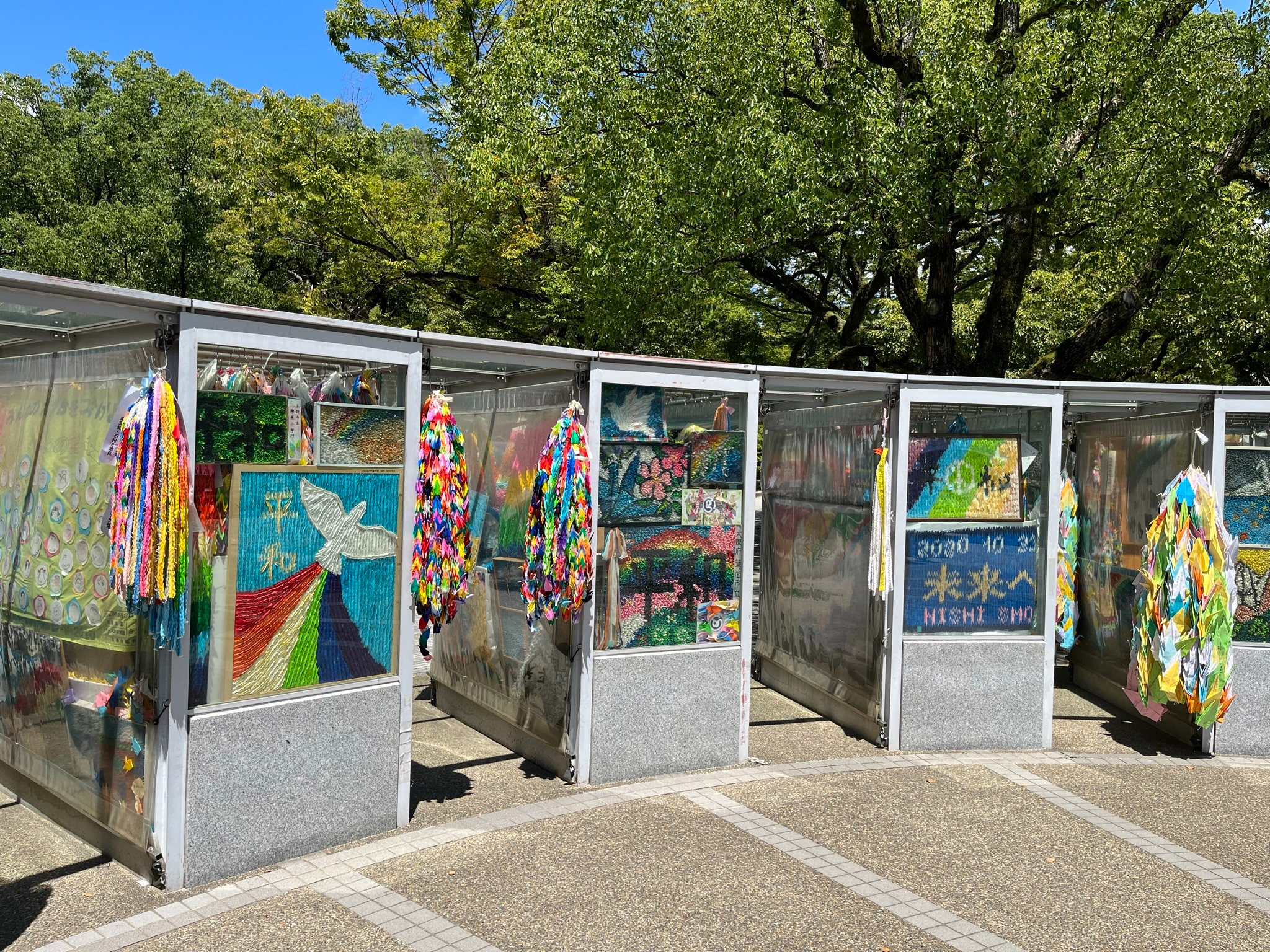
Display cases filled with colourful paper cranes and peace-themed artwork in Hiroshima Peace Memorial Park, created by visitors and schools in remembrance of the bombing victims.
Viewing colourful paper cranes and messages of peace in Hiroshima Peace Memorial Park, where thousands of folded origami cranes commemorate the victims of the atomic bombing and symbolise hope for a more peaceful future.

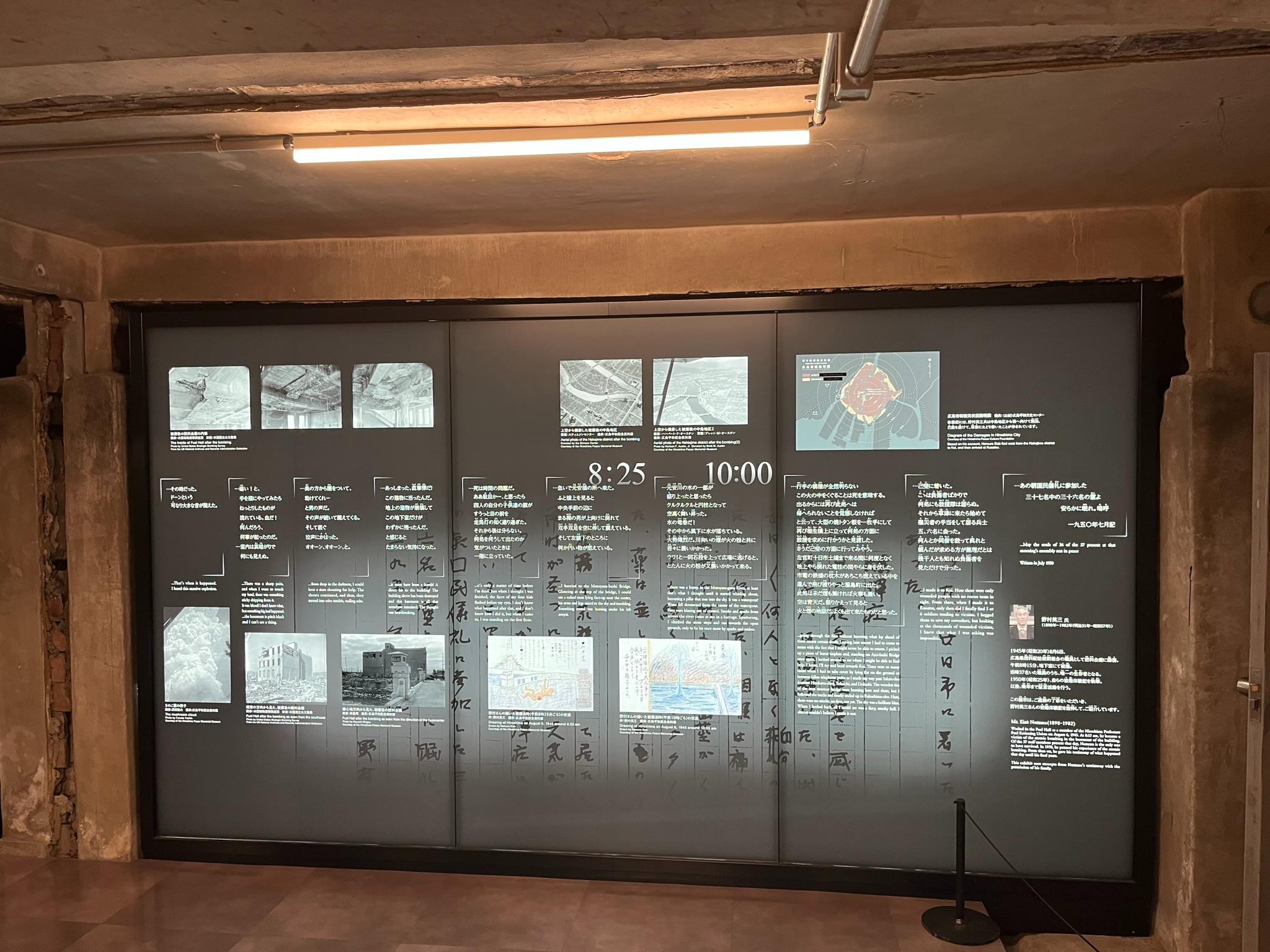
Part way though we ended up taking a rest back at the rest house as it was hot outside and that is when she took me down to the basement which was where one of the survivors Mr Eizo Nomura survived the blast. For him it was a day like any other. He came to his usual job at the fuel house (fuel rationing building) where he went to start work, only his boss hadn’t brought up the paperwork from the basement as usual. He couldn’t ask anyone else to do it because they were all busy, so he went down to find the paperwork he needed and was struggling to find it. Then it happened. The bomb went off. He only survived the bomb because he was in the basement. The rest of the build where he worked was destroyed.
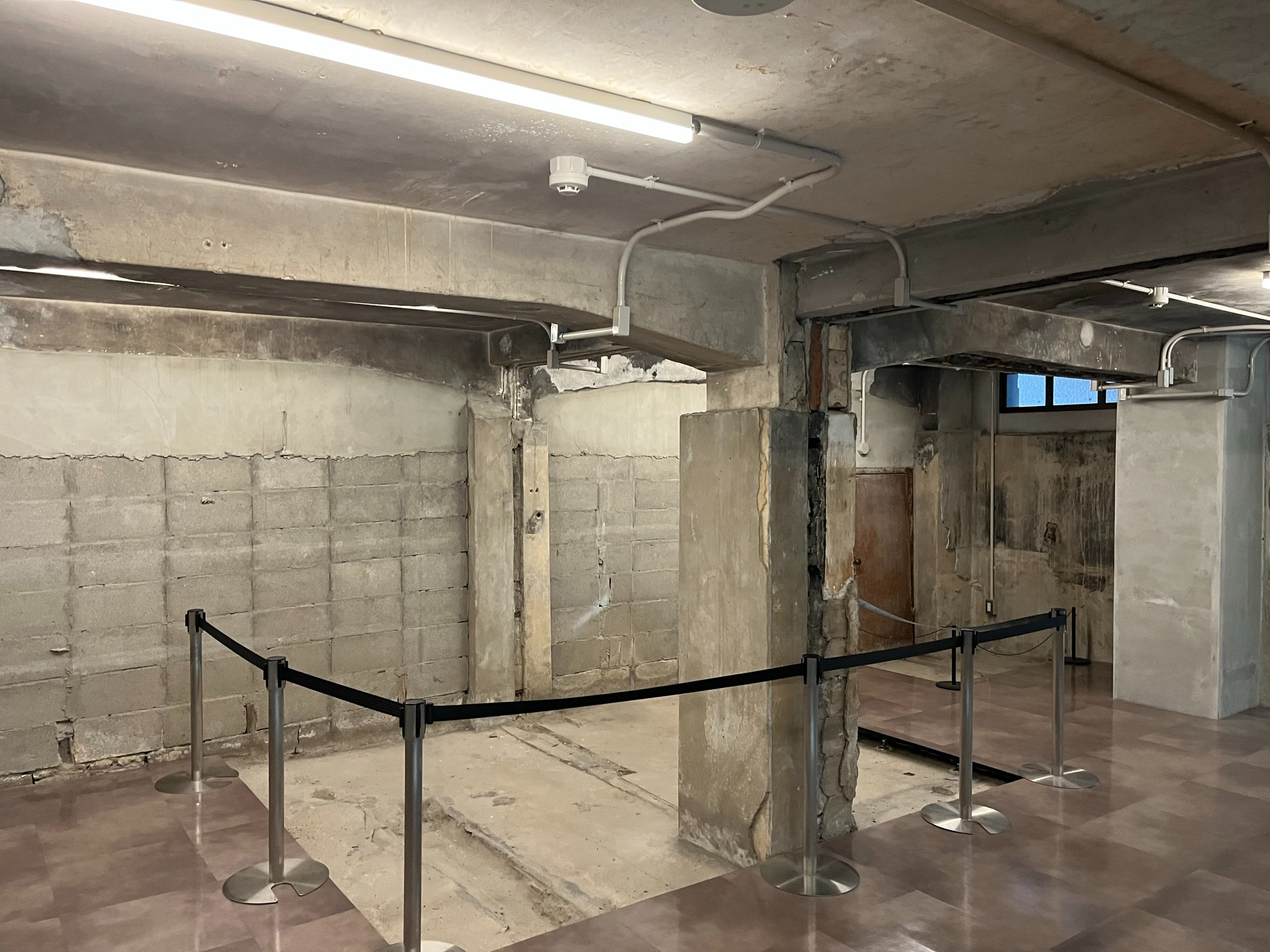
Preserved interior of a bomb-damaged building in Hiroshima, featuring exposed concrete columns, cracked walls and structural damage retained as a historical exhibit.
Exploring the preserved remains of a building damaged by the atomic bombing in Hiroshima, where exposed concrete walls and structural scars provide a powerful reminder of the events of 6 August 1945.
Exhibition display inside the Hiroshima Peace Memorial Museum featuring photographs, survivor accounts, timelines and historical information panels set within a preserved structure.
Reading survivor accounts and historical records inside the Hiroshima Peace Memorial Museum, where personal testimonies and preserved artefacts help tell the story of the atomic bombing and its lasting impact on the city.

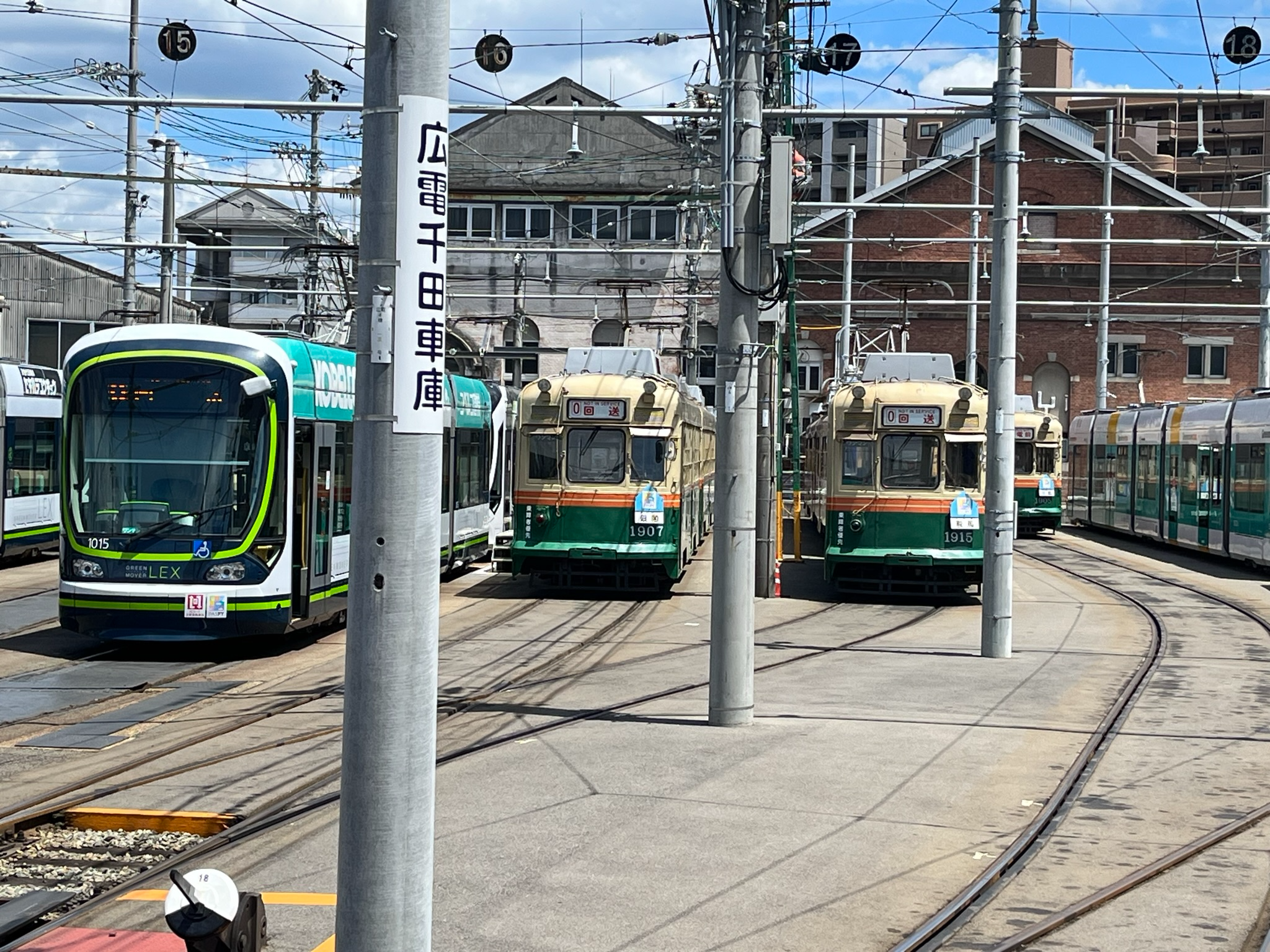
She took me to the Cenotaph to pay my respects to the fallen and then to see a symbol of Hiroshima’s recovery and that is the streetcar (also known as trams to us). Three of the 650 series that rolled off the line in 1942 and was state of the art at the time are still in operation today. This mean the cars are over 80 years old and they are still carrying passengers!!!
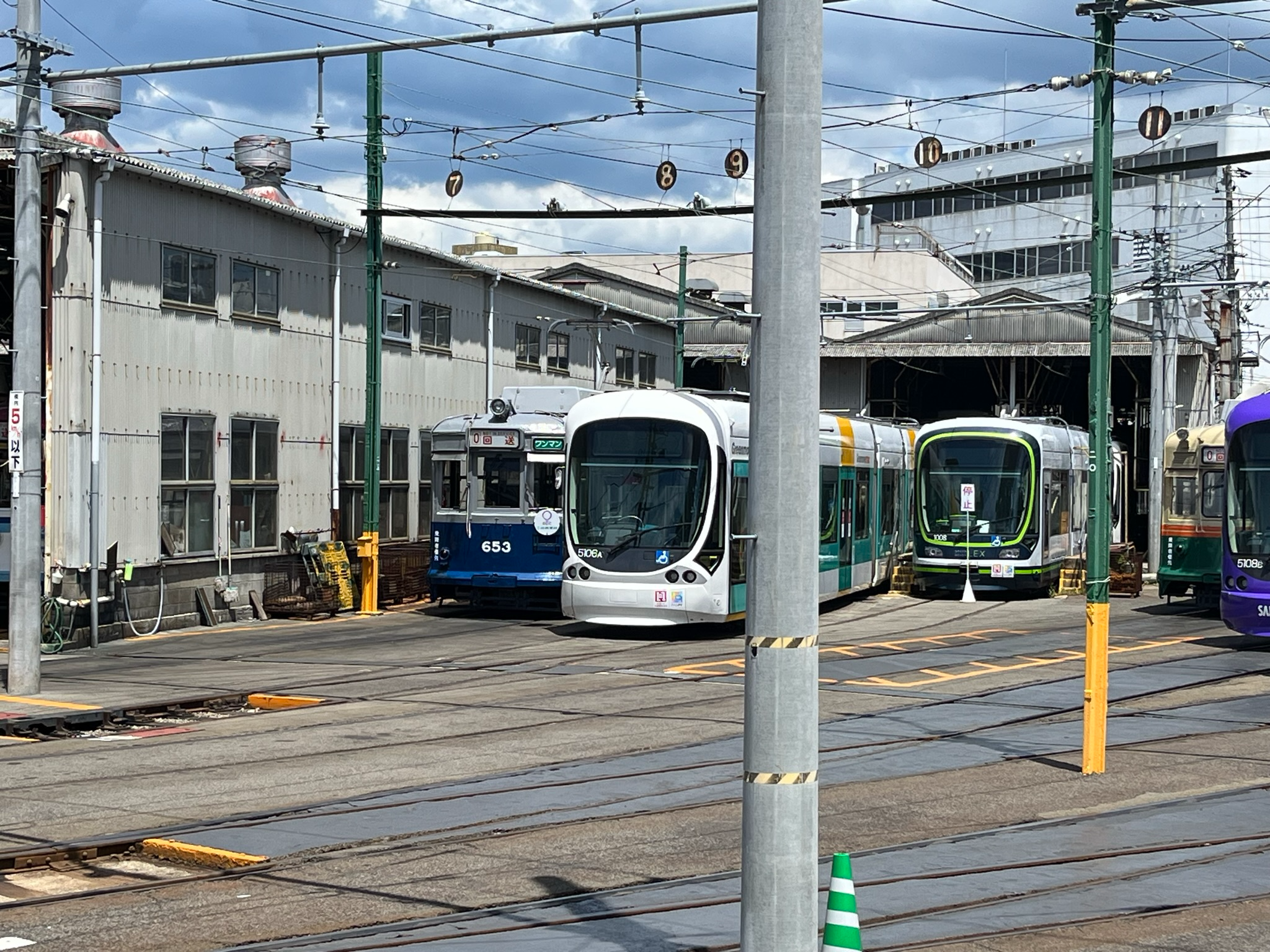
Several Hiroshima streetcars parked at a tram depot, including both vintage and modern trams, with overhead power lines, tracks and maintenance buildings visible.
Spotting a mix of historic and modern trams at a Hiroshima streetcar depot, highlighting the city's extensive tram network that remains one of the most convenient ways to explore the city.
Vintage and modern Hiroshima streetcars parked at a tram depot, with multiple tracks, overhead wires and maintenance buildings visible beneath a partly cloudy sky.
Checking out a fascinating mix of vintage and modern streetcars at Hiroshima's tram depot, where decades of transport history can be seen side by side on one of Japan's most extensive tram networks.

The streetcars were also back up and running about 3 days after the bomb was set off which helped people to recover because when all you see around you is nothing moving and the destruction that had been caused, something moving and blowing its whistle can cause people to get back up and give people some hope to move on and not and not to just look at the despair that was all around them.

After this I went back to my apartment and started looking for a hot spring because it had been a really hot day. I managed to find one, but I had to take a streetcar about 15-20 mins and then walk another 10 to get there. Hot springs can also be referred to as an onsen, and the concept will be extremely weird to most westerners as you get a small towel to bathe with and that is it. Yep, no budgie smugglers or swimming shorts are allowed. Now yes it was weird at first, but after getting in the relaxing waters which are supposed to be good for you, well it didn’t really bother me any more. I even had this kid about 12 years old, come up to me and ask me where I was from and what I was doing in Japan. It was good to have a conversation with someone even though I am a foreigner there and he spoke good English as well.

Miyajima and Rememberance Day

6th August

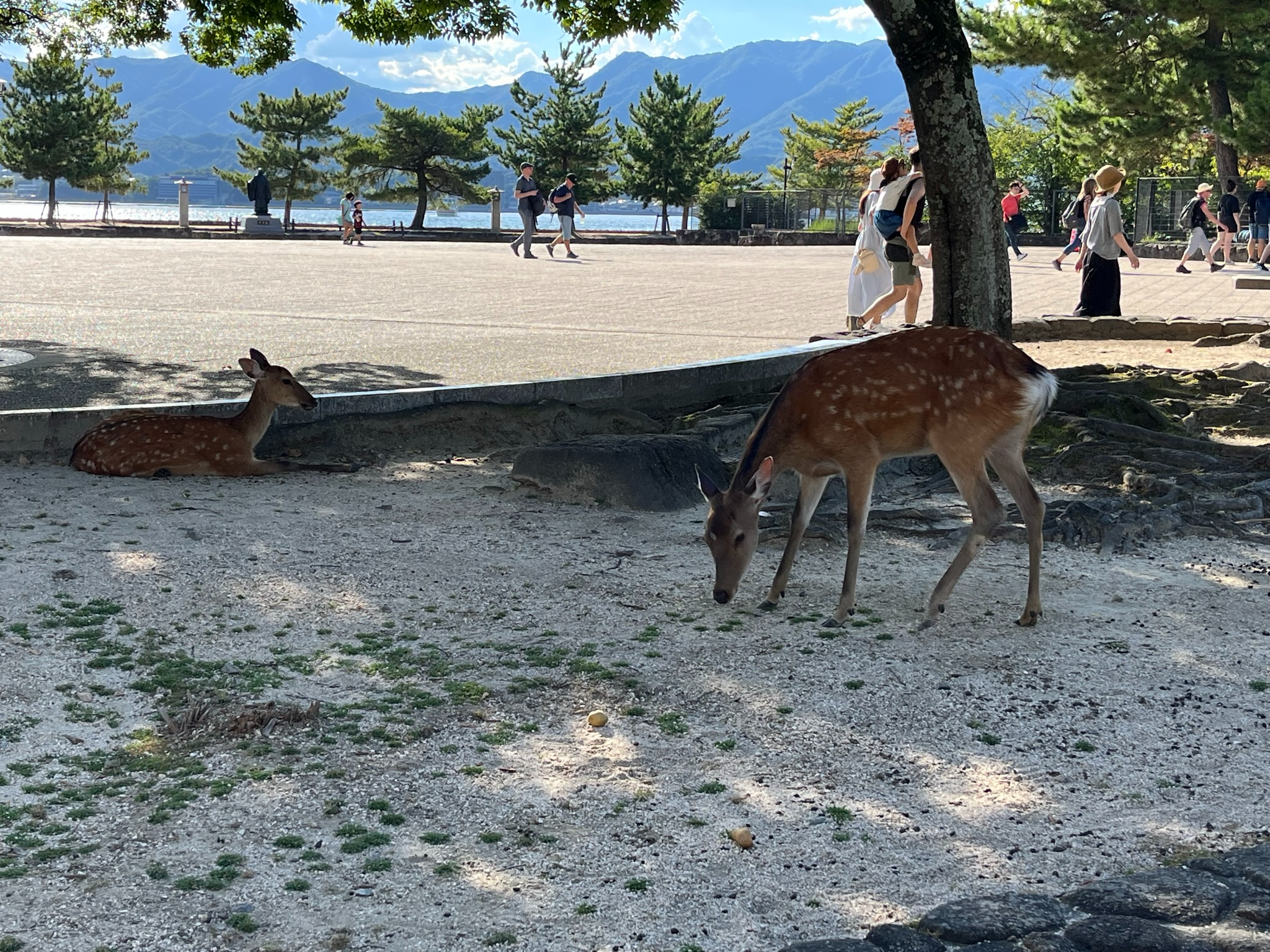
So, I had a bit of lie in today as I was absolutely knackered and unfortunately didn’t wake up in time for the remembrance service at about 8am in the morning. So, I got up and started to make my way to Miyajima. That is an island just in Hiroshima’s bay and there used to be a bridge that would appear at low tide connecting both the mainland and Miyajima together. There are also loads of deer about the island chilling and are not afraid to be around humans.
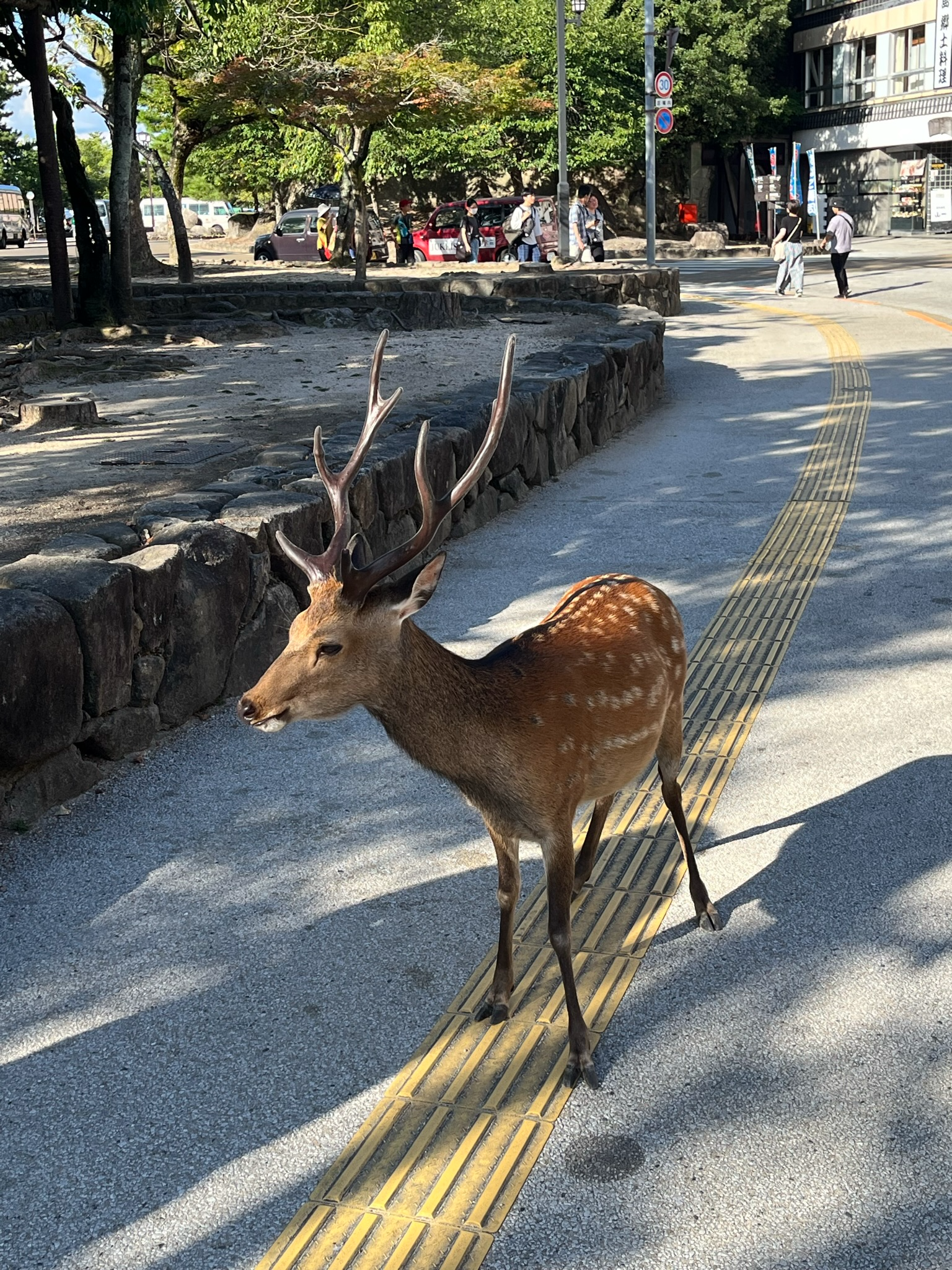
Deer with large antlers standing on a pathway on Miyajima Island, with visitors, trees and nearby buildings visible in the background on a sunny day.
Encountering one of Miyajima's famous free-roaming deer while exploring the island, where these gentle animals wander freely among visitors near Itsukushima Shrine and the island's historic streets.
Two deer resting and grazing beneath trees on Miyajima Island, with visitors, waterfront views and forested mountains visible across the bay on a sunny afternoon.
Watching Miyajima's famous free-roaming deer wander beneath the trees near the waterfront, with the island's mountains and Seto Inland Sea providing a beautiful backdrop to the scene.

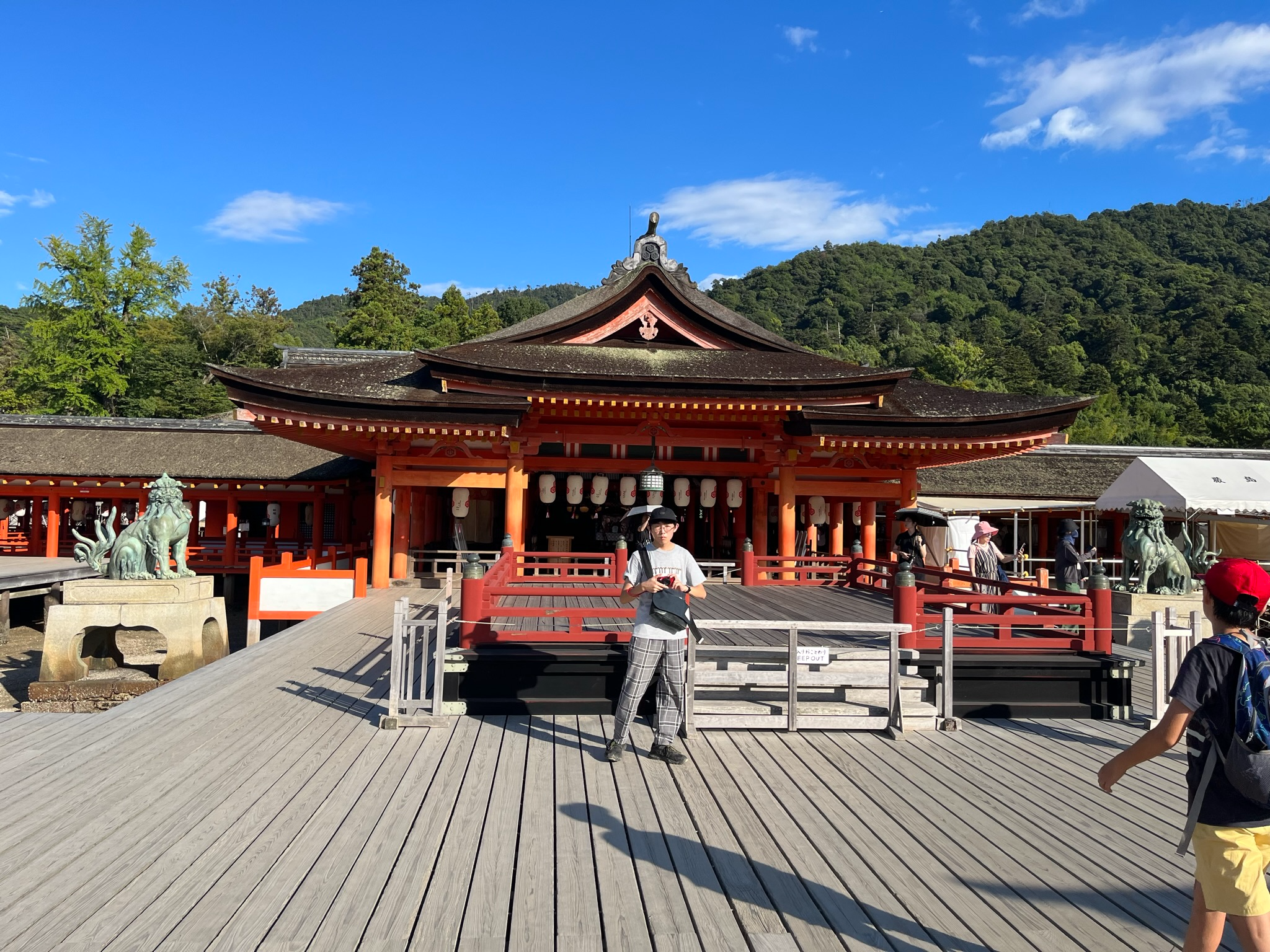
It also has a very famous Torii gate which gets fully uncovered during low tide and becomes partly submerged during high tide. As I arrived here quite late, I couldn’t do what I wanted to do and go for a hike especially as it would be going dark in the next 2 hours. Instead, I took a bit of a tour around the island, went to the Shrine that was there and then I got a bit lost.
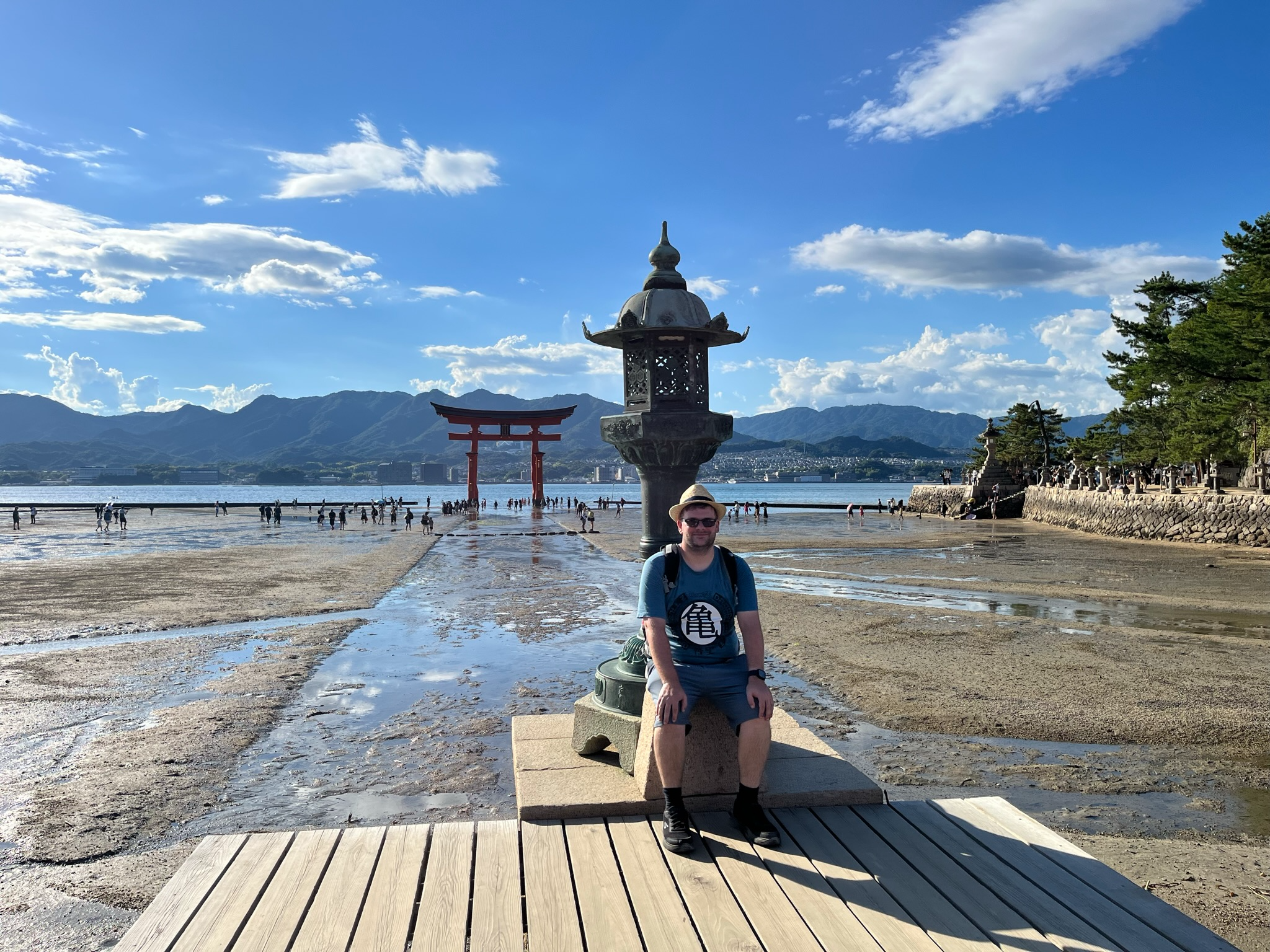
Visitor seated beside a stone lantern on Miyajima at low tide, with the famous red torii gate of Itsukushima Shrine, distant mountains and blue skies beyond.
Taking a moment to enjoy the view at low tide on Miyajima, with the iconic floating torii gate of Itsukushima Shrine standing offshore against the backdrop of the Seto Inland Sea and surrounding mountains.
Itsukushima Shrine on Miyajima Island, featuring vermilion wooden buildings, a broad boardwalk, stone guardian statues and forested hills beneath a clear blue sky.
Visiting Itsukushima Shrine on Miyajima, with the striking vermilion shrine buildings and forested hills providing a beautiful setting beside the Seto Inland Sea.

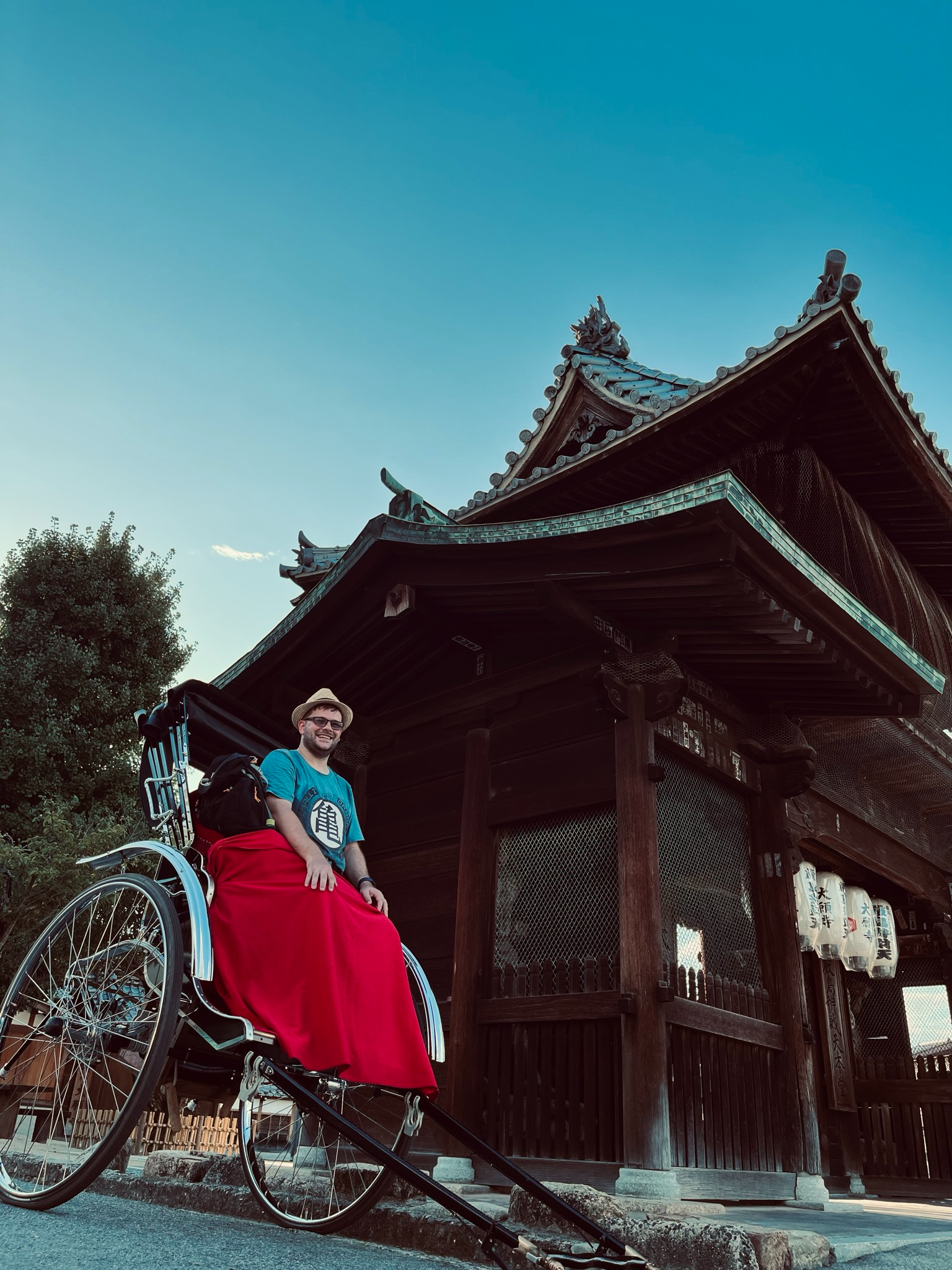
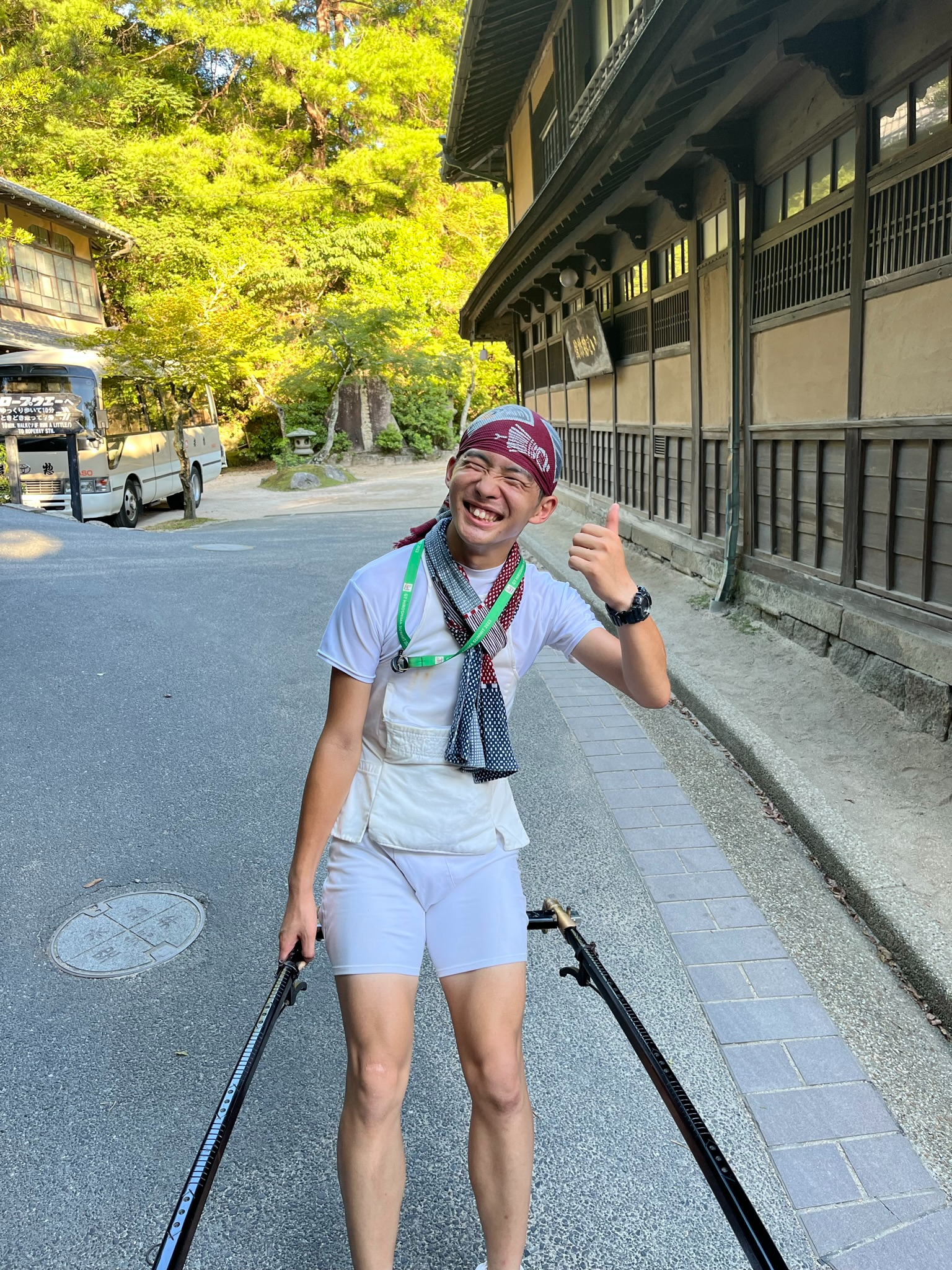
There was a rickshaw person who could see I was a bit lost called Takumi Shiroyama. I was a bit apprehensive about going on a rickshaw as it was expensive, but I tell you what, at the same time it was great fun!
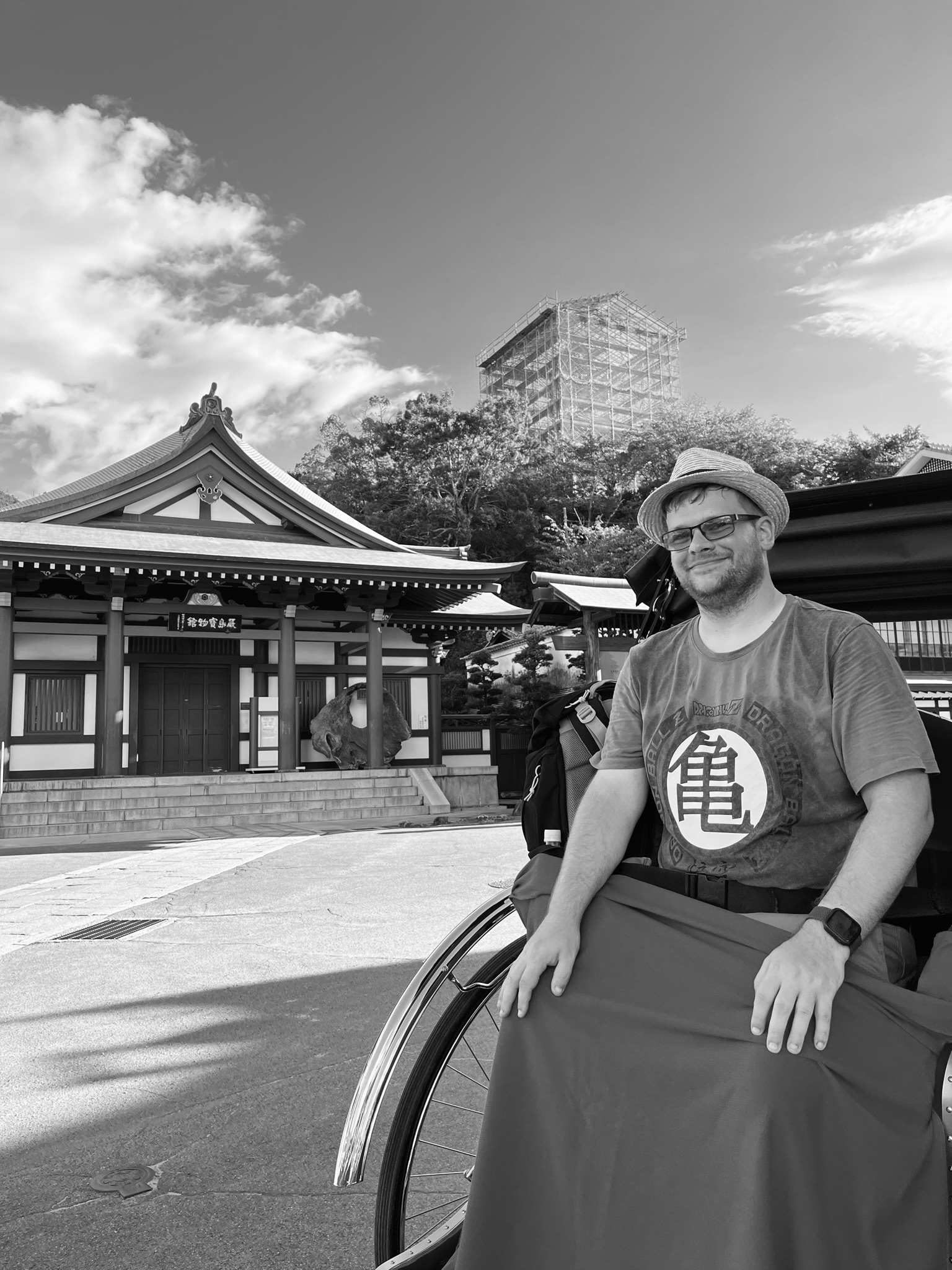
Visitor seated in a traditional rickshaw in Asakusa, with historic Japanese buildings, temple architecture and a rickshaw guide visible along a sunny street.
Trying a traditional rickshaw ride while exploring the historic streets of Asakusa, with a knowledgeable guide providing a unique way to experience one of Tokyo's most famous cultural districts.
Rickshaw puller standing beside a traditional rickshaw on Miyajima Island, with historic wooden buildings, trees and a quiet street visible in the background.
Meeting the rickshaw guide during a tour of Miyajima, with a traditional hand-pulled rickshaw providing a unique way to explore the island's historic streets, temples and waterfront scenery.
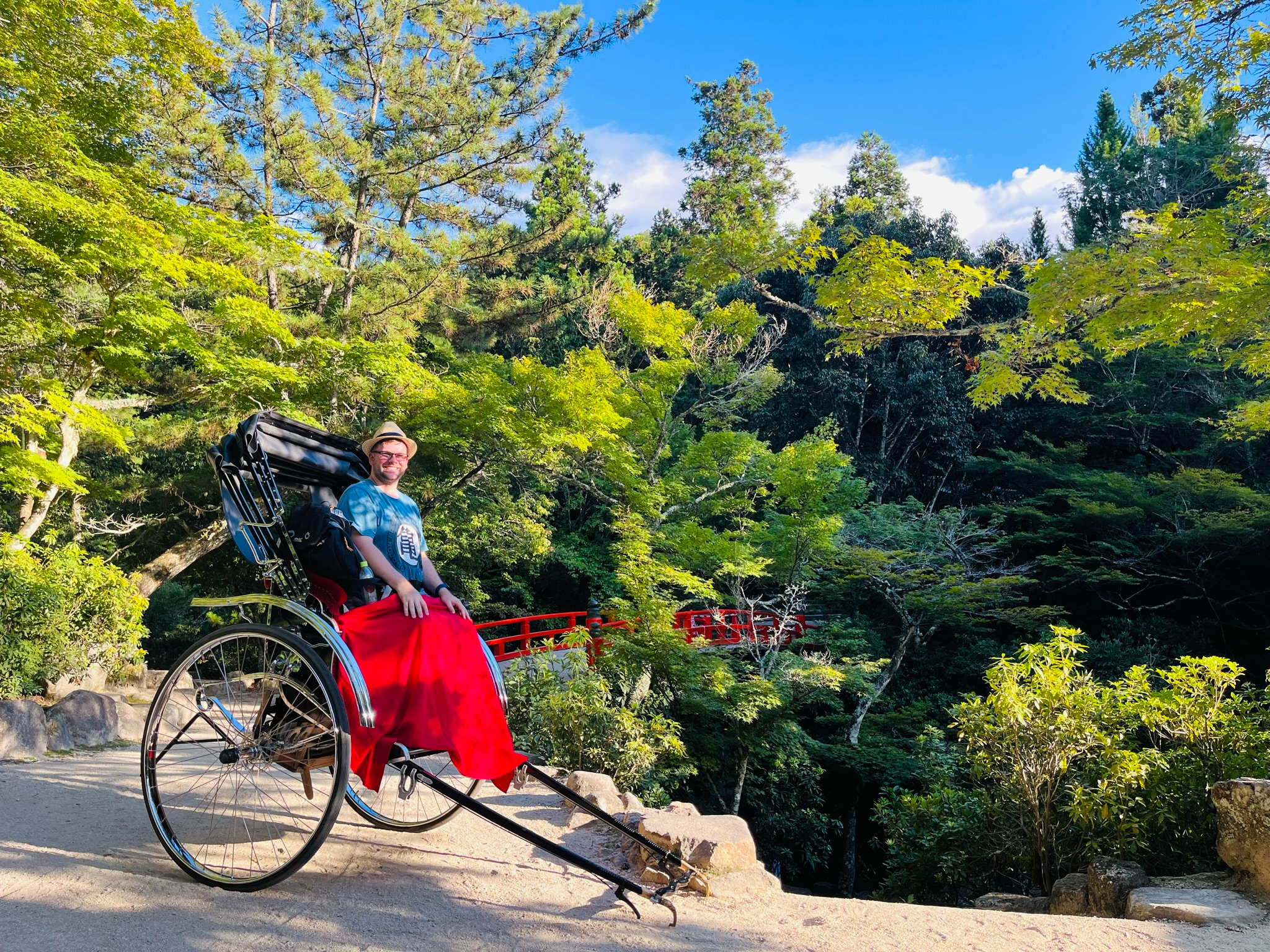
Visitor seated in a traditional rickshaw on Miyajima Island, overlooking a scenic Japanese garden with dense greenery and a red bridge among the trees in the background.
Enjoying a rickshaw tour through the quieter side of Miyajima, with traditional Japanese gardens, red bridges and lush woodland providing a peaceful contrast to the island's busy waterfront attractions.
Visitor seated in a traditional rickshaw beside a historic wooden temple building on Miyajima Island, featuring ornate roof details, lanterns and traditional Japanese architecture.
Exploring Miyajima by traditional rickshaw, with a stop beside one of the island's historic temple buildings providing a glimpse into the rich cultural heritage found beyond the famous waterfront shrine.
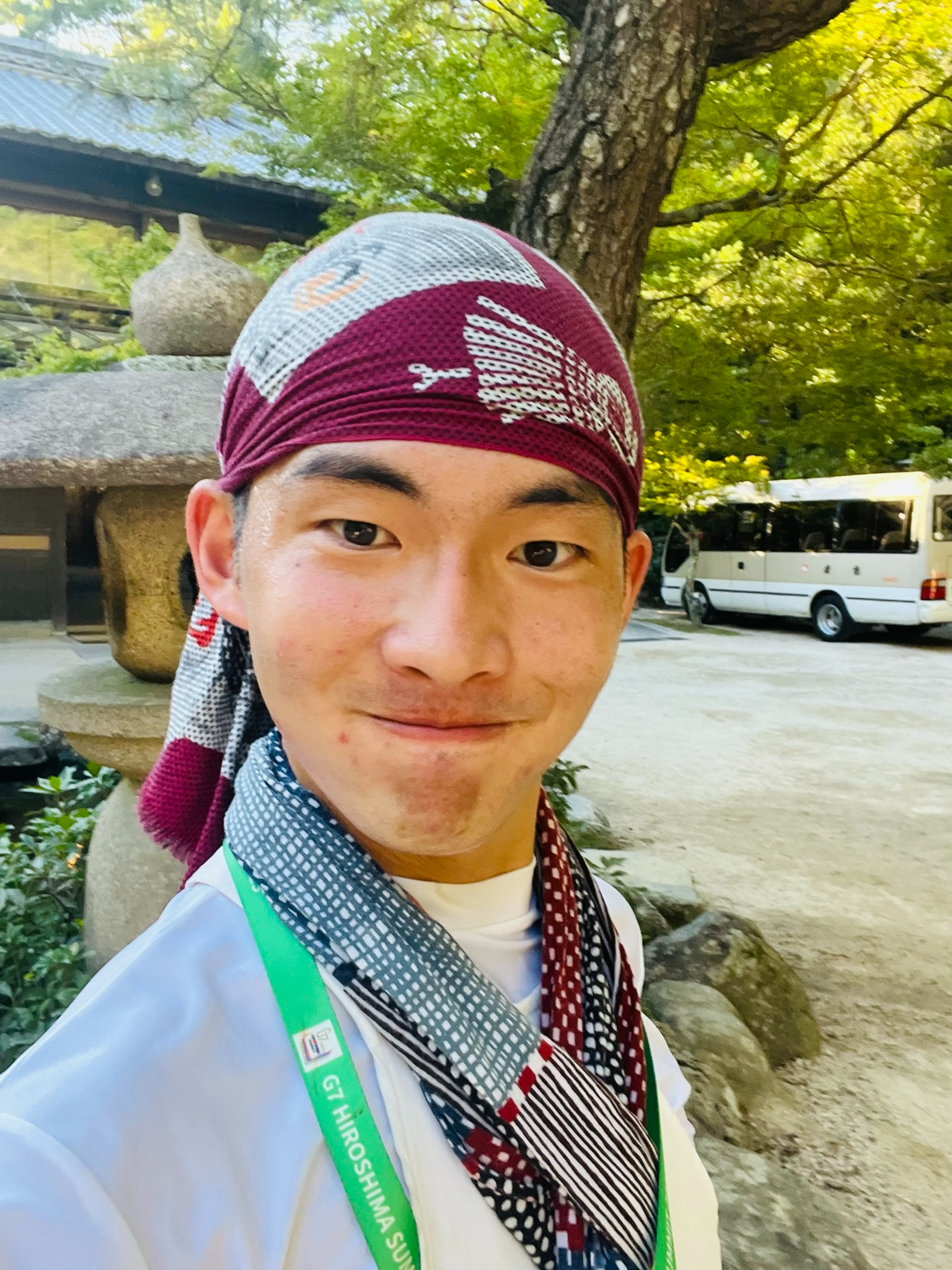
Close-up portrait of a rickshaw guide on Miyajima Island, wearing traditional tour attire and standing near historic buildings, trees and a stone lantern.
Meeting the rickshaw guide who helped bring Miyajima's history and hidden corners to life, making the tour as memorable as the island's famous shrines, temples and scenic landscapes.
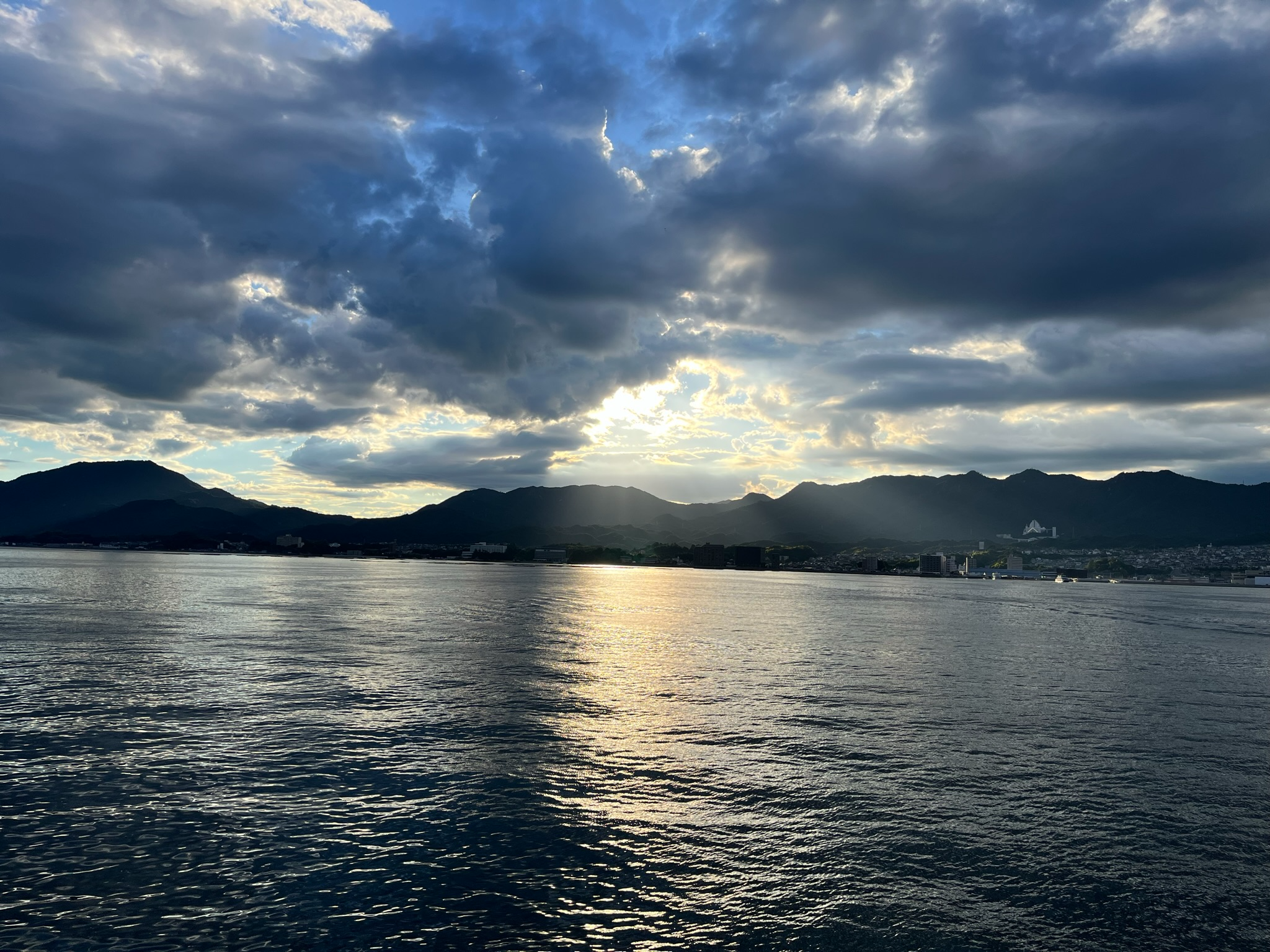
Watching the ferry journey between Miyajima and the mainland draw to a close, with dramatic evening light breaking through the clouds above the mountains of Hiroshima Bay and reflecting across the calm waters of the Seto Inland Sea.
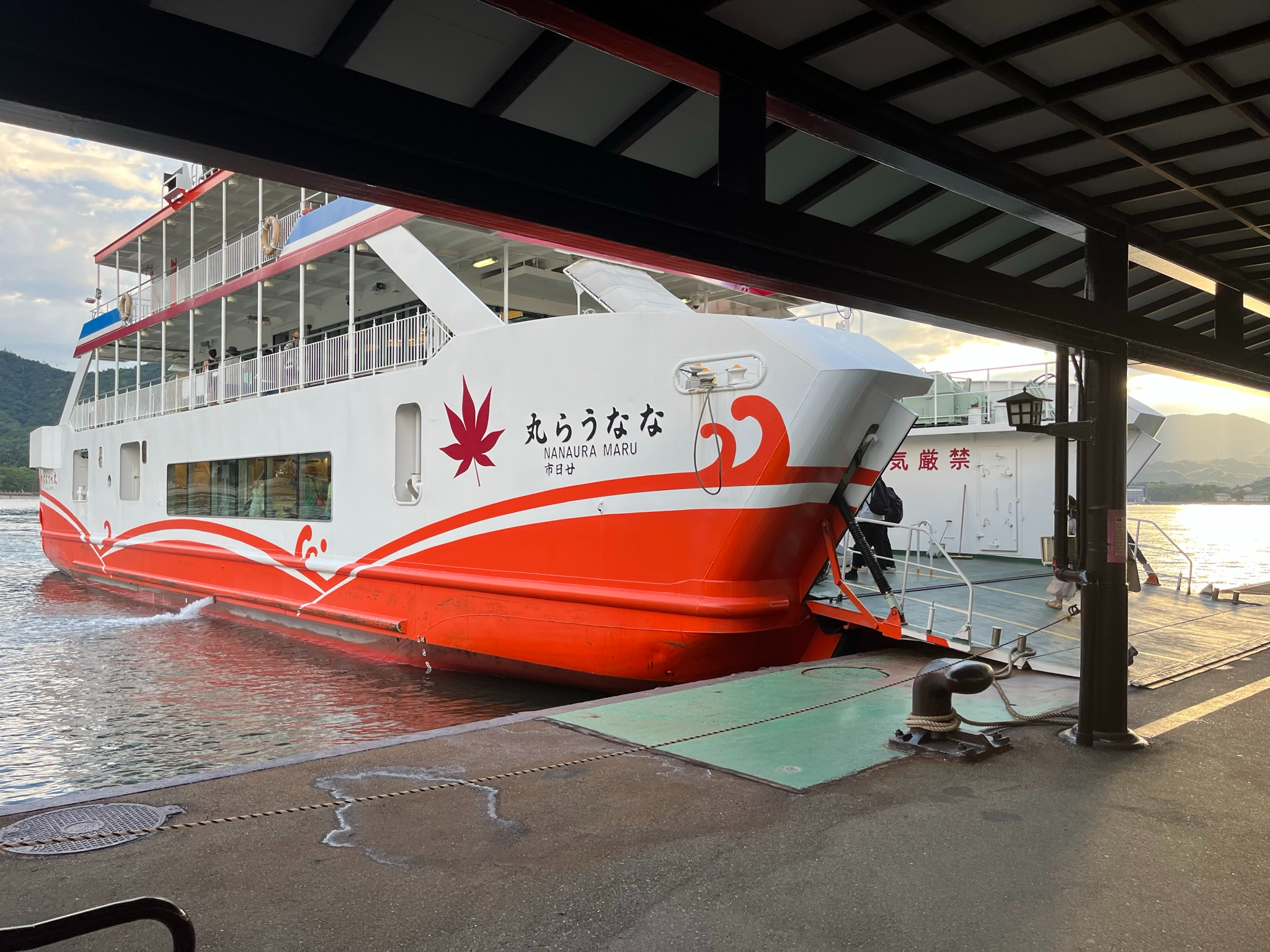
NANAURA MARU ferry docked at Miyajima, featuring a red maple leaf design on the hull as passengers board for the crossing across Hiroshima Bay at sunset.
Boarding the ferry after a day on Miyajima, with the Momiji-themed NANAURA MARU providing a scenic journey across the Seto Inland Sea between the island and the Hiroshima mainland.

After getting the ferry back from Miyajima it was time to go back to the apartment, drop off my backpack and head to the Hiroshima Peace Park again, but this time for the lanterns.
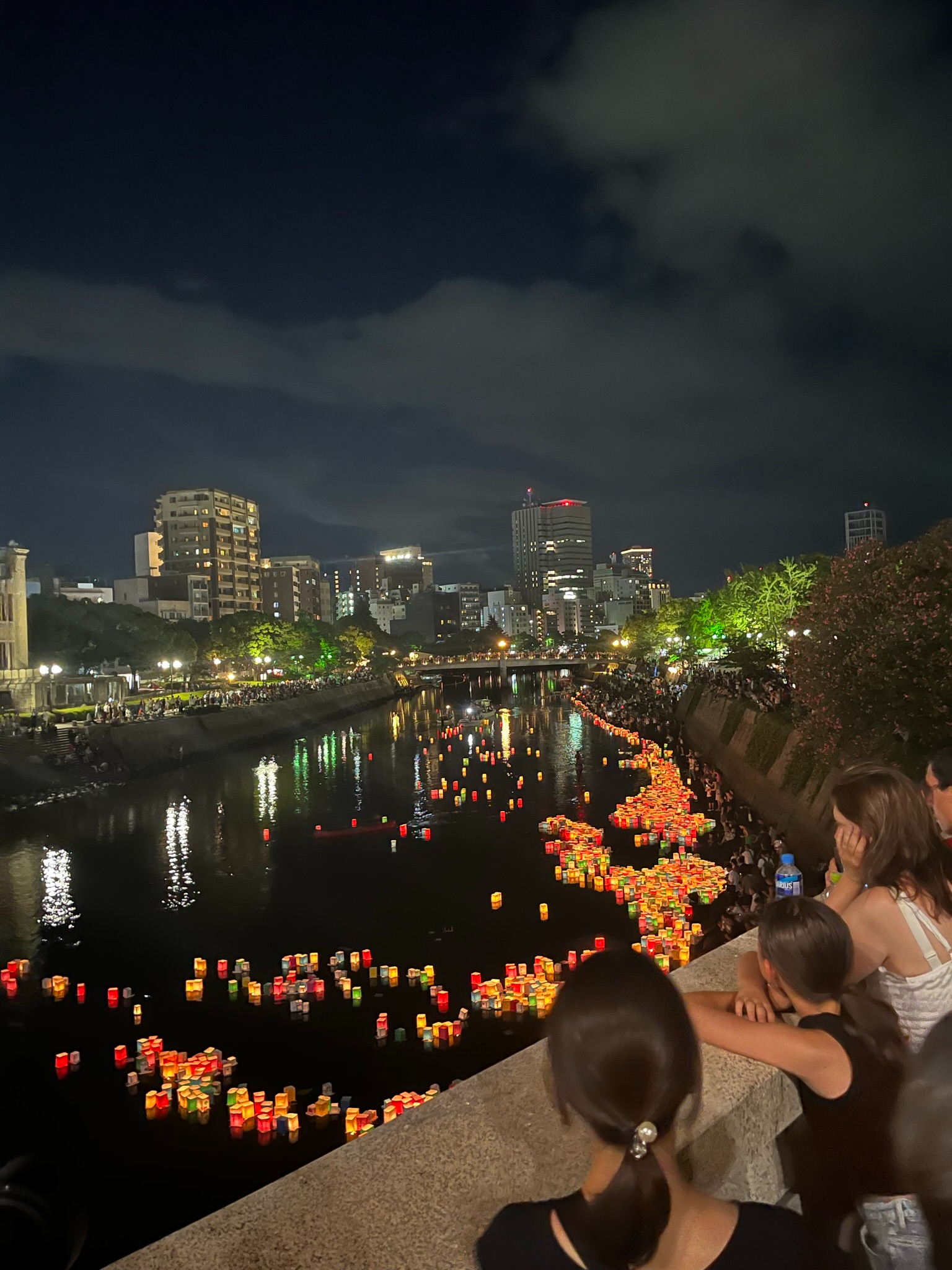
Hundreds of illuminated paper lanterns floating along the Motoyasu River in Hiroshima at night, as visitors gather along the riverbanks to observe the memorial ceremony.
Watching thousands of lanterns drift along the Motoyasu River during Hiroshima's Tōrō Nagashi ceremony, where tributes to the victims of the atomic bombing create a moving evening display of remembrance and hope for peace.

I joined the queue for the lanterns and started to realise that I needed to get the paper for mine before I queued. I kindly asked the couple in front of me where do I get them from. So, the guy Takumi took me to buy one and then we meet back up with his wife Kayto. There were a nice couple who live in Hiroshima and even though my Japanese language skills was limited and so was their English, we became friends (through the help of google translate).
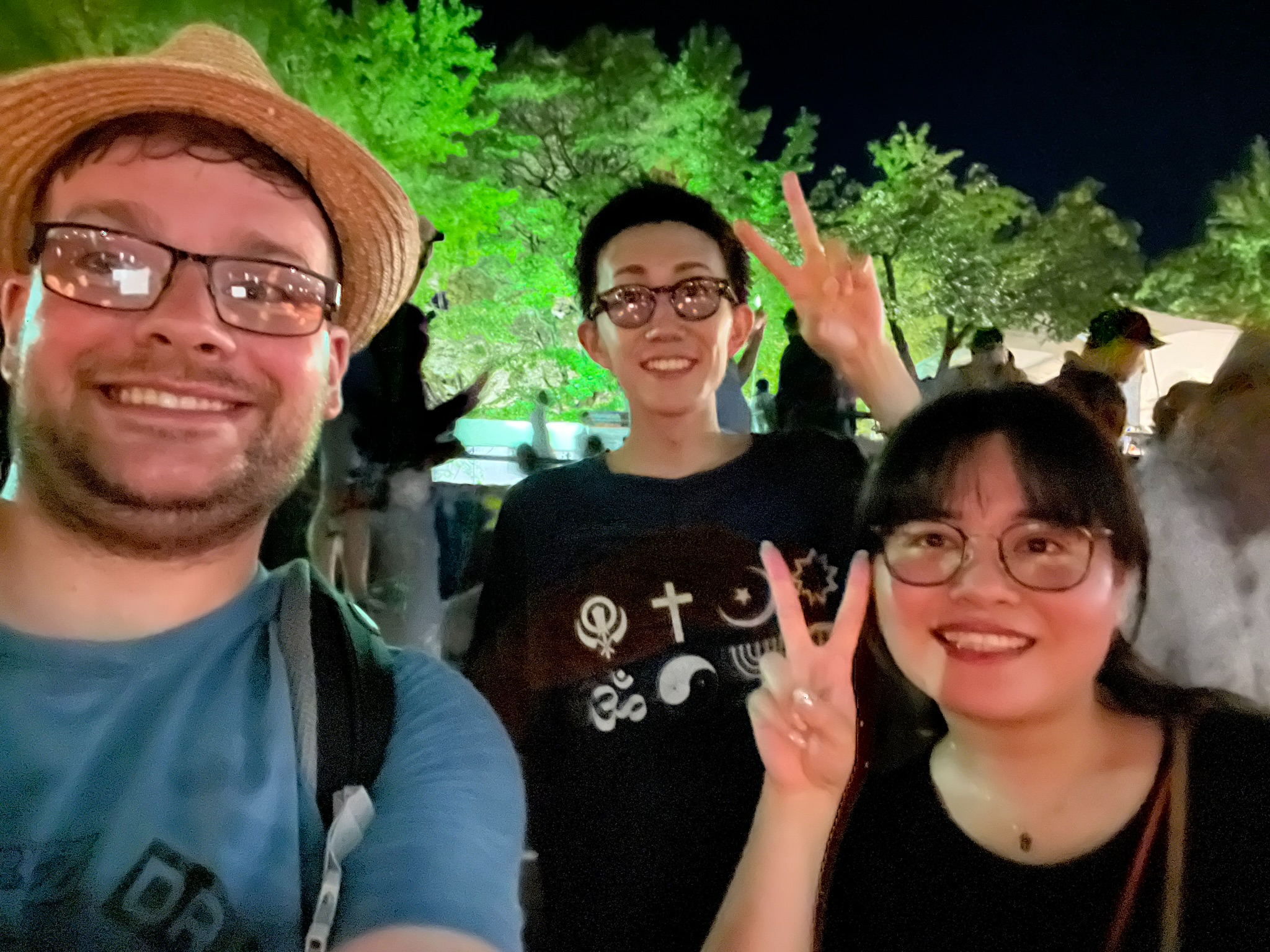
Three visitors posing for a photo during Hiroshima's evening lantern floating ceremony, with illuminated trees, festival crowds and memorial activities visible in the background.
Making new friends during Hiroshima's Tōrō Nagashi lantern floating ceremony, where people from around the world come together to remember the victims of the atomic bombing and share a message of peace.

It was good being able to be a part of the lantern remembrance and wishes for world peace festival. I am just sad that it was my last day in Hiroshima.
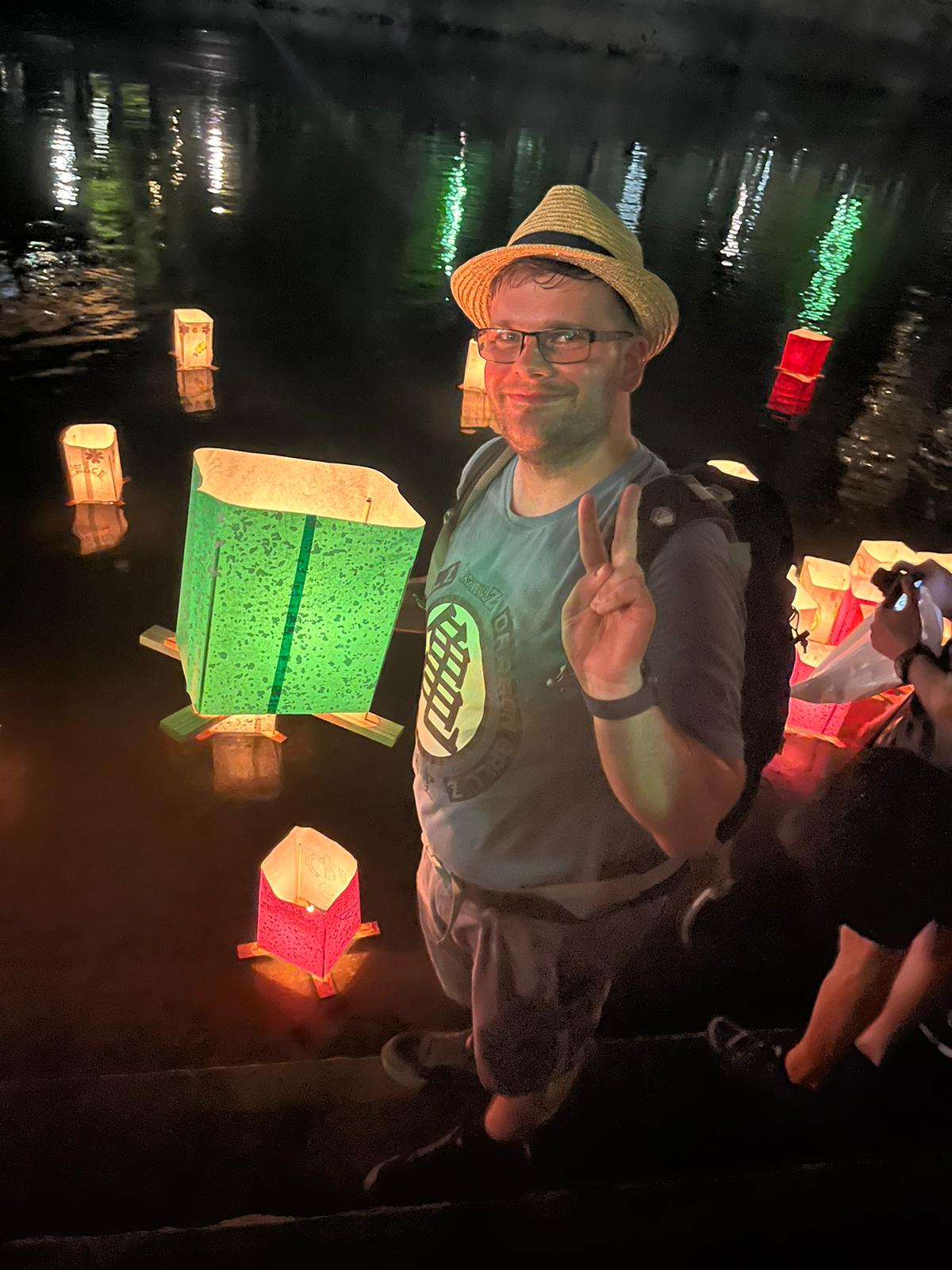
Visitor standing beside illuminated paper lanterns floating on the Motoyasu River during Hiroshima's Tōrō Nagashi ceremony, with reflections shimmering across the water at night.
Taking part in Hiroshima's Tōrō Nagashi lantern floating ceremony, with a personalised lantern joining thousands of others on the Motoyasu River in a moving tribute to the victims of the atomic bombing and a shared hope for peace.
0:00
/0:20

Video of me taking part in Hiroshima's Tōrō Nagashi lantern floating ceremony, with a lantern joining thousands of other on the Motoyasu River in a moving tribute to the victims of the atomic bombing and a shared hope for peace

Next time I will be blogging from Matsue, a castle town about 3.5 hour north of Hiroshima. Thanks for reading everyone.